






Should You Get a Heat Pump in Dallas–Fort Worth?
By Siwei (Lucas) Chen | Greentech Engineering Heating & Air Conditioning — DFW HVAC
Quick answer: A heat pump often deserves a first-round comparison in Dallas–Fort Worth (DFW), especially when an aging A/C already needs replacement or the home uses electric resistance heat. It is not automatically the best choice. Compare the home’s heating and cooling loads, existing gas service, electrical capacity, ductwork, exact equipment match, utility rates, backup-heat design and total installed cost.
The International Energy Agency’s Heat Pump Monitor 2026 reports that more than 20% of U.S. households now rely on a heat pump for space heating. It also identifies end-of-life air-conditioner replacement as a major U.S. opportunity for heat-pump adoption. National adoption is useful context, but it does not determine the best configuration for one North Texas home.
Start with the home’s existing configuration
- Electric resistance heat: Put an all-electric heat pump comparison near the top of the list.
- A serviceable gas furnace: Compare straight-cool A/C, dual fuel and full-system replacement instead of assuming the furnace must be removed.
- A goal to reduce gas use: Compare all-electric and dual-fuel options, including electrical upgrades and backup strategy.
The right question is not simply, “Are heat pumps popular?” It is:
Which heating-and-cooling configuration best fits this particular home?
What is a heat pump?
An air-source heat pump uses the same basic refrigeration process as an air conditioner. In cooling mode, it moves heat from inside the house to the outdoors. In heating mode, a reversing valve allows the system to move heat from the outdoor air into the home.
Because the system moves heat instead of creating all of it through electric resistance, heat-pump heating can use substantially less electricity than electric furnaces, baseboard heaters or heat strips operating alone. The U.S. Department of Energy explains that modern air-source heat pumps can reduce electricity use by about 50% compared with electric resistance heating, although actual savings depend on the building, equipment, weather, controls and utility rates.
A heat pump is not “an air conditioner that stops working in winter.” Properly selected modern equipment can continue heating below freezing. However, available capacity and efficiency change as outdoor temperature falls, which is why low-temperature performance and backup-heat design matter.
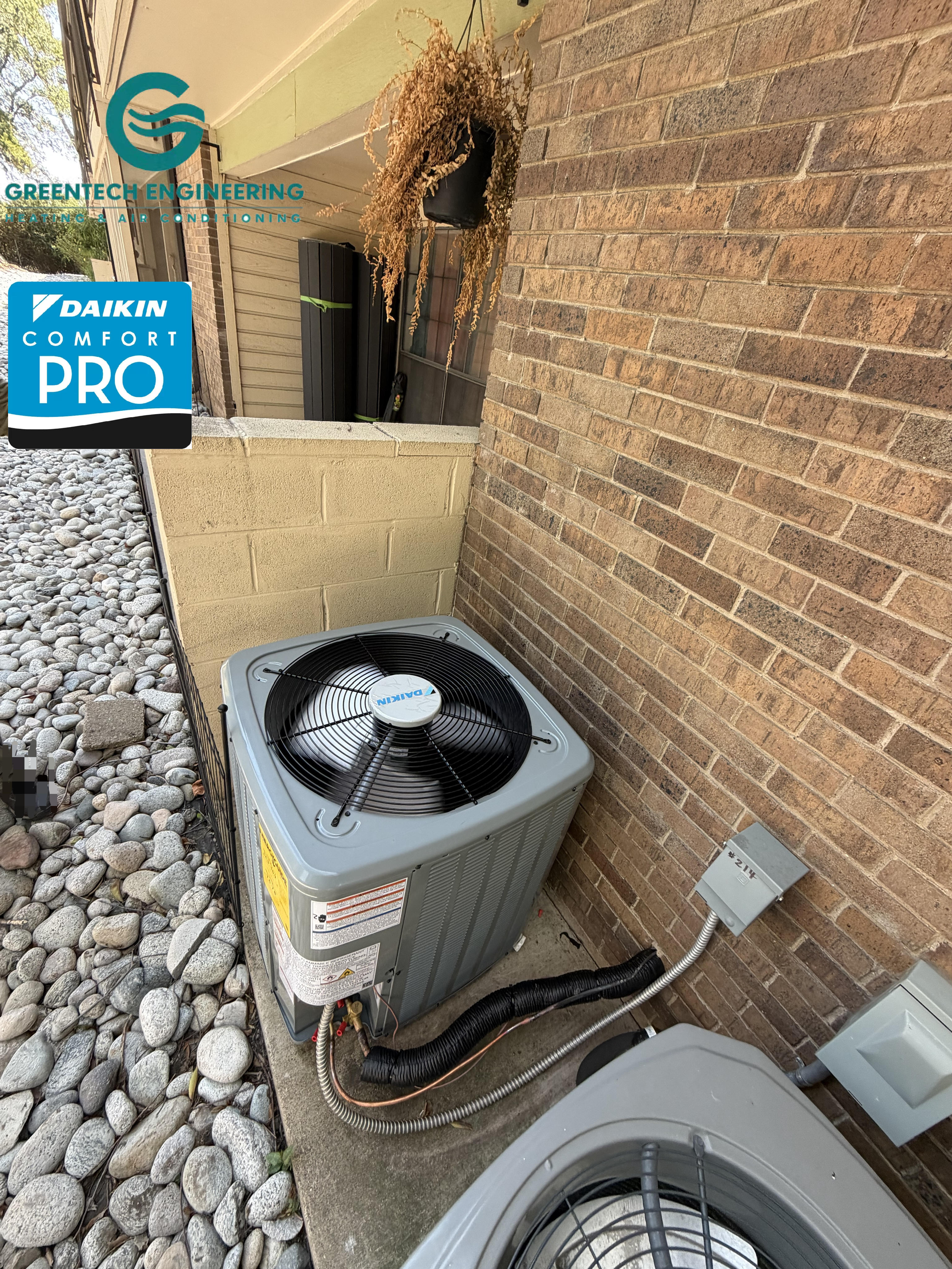
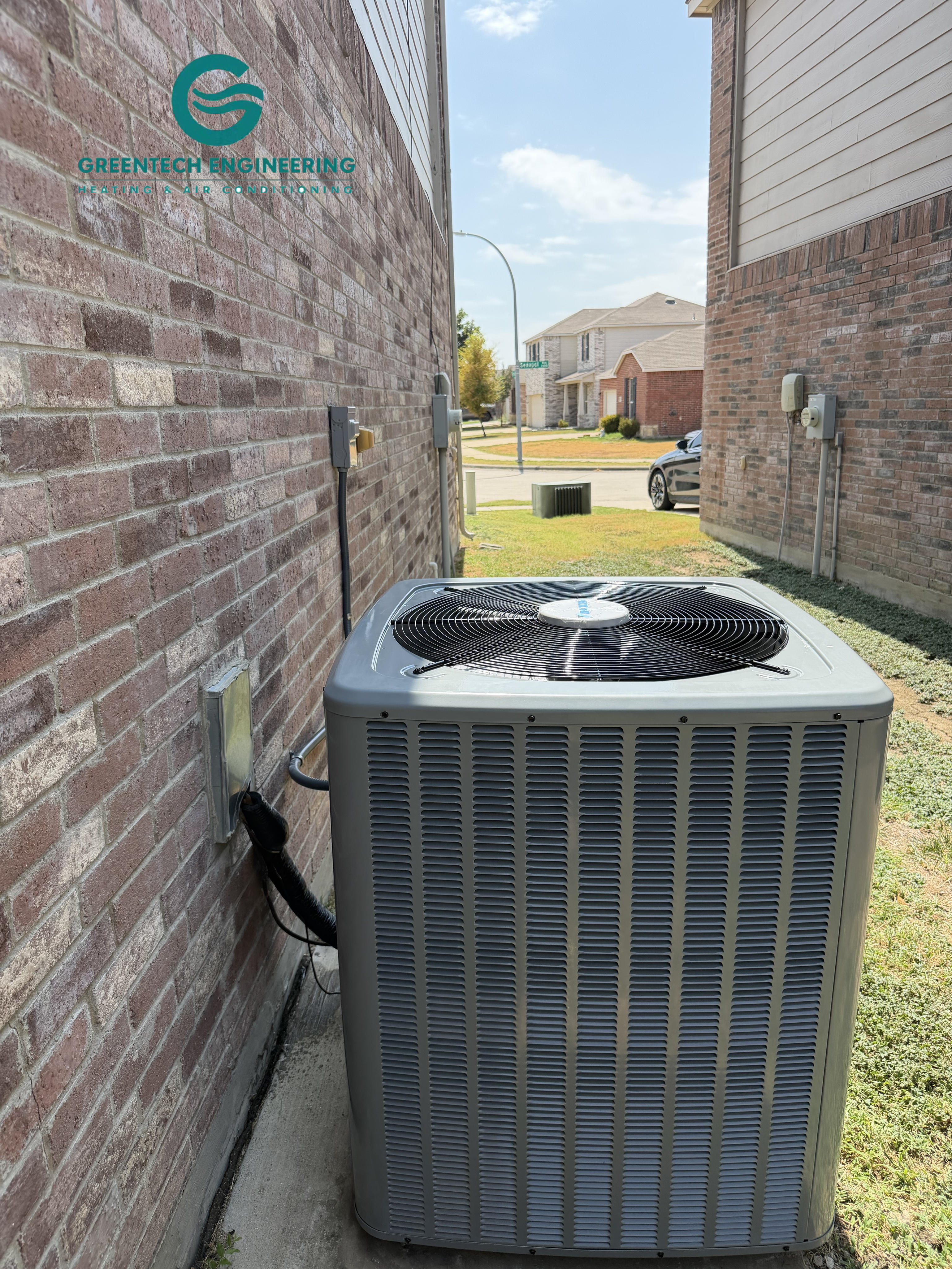
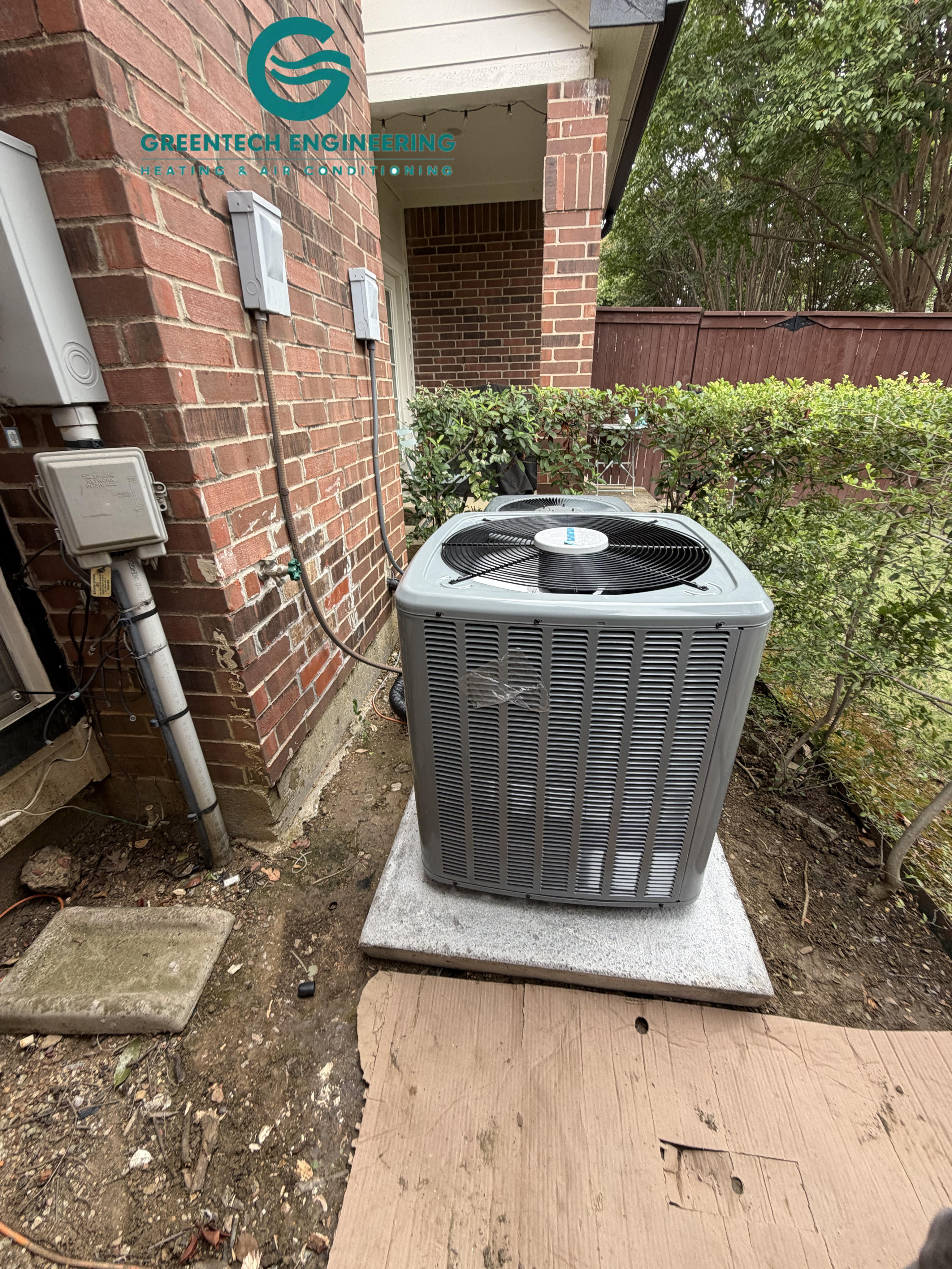
<!-- CMS BODY IMAGE 1Source: Content 11 — New Daikin Heatpump.jpegPublic filename: dfw-daikin-r32-heat-pump-installation.webpAlt text: New Daikin R-32 heat pump installed at a Dallas homeCaption: A conventional top-discharge Daikin R-32 heat pump installed for a Dallas project.Placement: Immediately after “What is a heat pump?”Claims boundary: The image identifies installed equipment only; it does not prove savings, low-temperature performance, comfort or inspection status.Privacy/production: Remove EXIF/GPS data. Inspect the background, labels and reflections; obscure house numbers, serial numbers, barcodes, QR codes, faces and other identifiers.-->
Why heat pumps can make sense in Dallas–Fort Worth
DFW is a cooling-dominated market. Homeowners usually choose HVAC equipment first for long, demanding summers, while winter heating demand is shorter than in northern states.
That climate creates several reasons to evaluate a heat pump:
- The outdoor system already must provide air conditioning, so a reversible heat pump can add compressor-driven heating through the same refrigeration circuit.
- Much of the winter occurs under conditions where an air-source heat pump can operate efficiently.
- A home using electric resistance heat may be able to reduce how often expensive resistance heat is needed.
- Variable-capacity heat pumps can operate across a range of output instead of using only full-capacity on/off cycles, when the selected equipment and controls support modulation.
- A heat pump can support an all-electric home, or it can be paired with a gas furnace in a dual-fuel configuration.
But DFW weather does not make every heat-pump proposal correct. The system still must be selected for the house, installed with adequate airflow and drainage, and configured with an appropriate heating sequence.
Heat pump, gas system or dual fuel: what are the choices?
Straight-cool A/C + gas furnace
- How it heats: The A/C cools; the furnace burns gas for heat.
- Often worth considering when: The home already has good gas infrastructure and the owner prefers gas heat.
- Important tradeoffs: The system uses two energy sources and does not provide compressor heating.
All-electric heat pump + air handler
- How it heats: The heat pump provides primary heating; an electric heat kit provides auxiliary or emergency heat.
- Often worth considering when: Replacing straight-cool A/C with electric resistance heat or pursuing an all-electric system.
- Important tradeoffs: Electrical capacity, heat-kit size, controls and low-temperature performance must be checked.
Dual-fuel heat pump + gas furnace
- How it heats: The heat pump heats under selected conditions; the gas furnace takes over according to the control strategy.
- Often worth considering when: The owner wants heat-pump operation while retaining gas backup.
- Important tradeoffs: The system is more complex; the balance point and controls must be commissioned correctly.
Ductless mini-split heat pump
- How it heats: One or more indoor heads provide zoned heating and cooling.
- Often worth considering when: Serving additions, garages, rooms without ducts or selected zoning applications.
- Important tradeoffs: Whole-home distribution, aesthetics, condensate routing and multi-zone capacity require evaluation.
None of these options is automatically the “premium” or “budget” answer. A transparent proposal should explain why a configuration fits the home and what related work is included.
When is a heat pump a particularly strong option?
1. The home currently relies on electric resistance heat
This is often the clearest comparison. Electric resistance heat converts electricity directly into heat. A heat pump transfers heat and can deliver more heat energy than the electrical energy consumed by the compressor and fans under suitable operating conditions.
The heat kit may remain as backup, but it should not be treated as the primary heat source during normal mild-weather operation unless the design or control sequence requires it.
2. The air conditioner already needs replacement
When an outdoor A/C has reached the end of its service life, the homeowner is already considering a major equipment purchase. Comparing a straight-cool condenser with a compatible heat pump can be more practical at that point than replacing a functioning A/C solely to electrify heating.
The comparison must include the indoor coil or air handler, controls, refrigerant, electrical work, backup heat and any duct or plenum modifications—not just the outdoor-unit price.
3. The homeowner wants to reduce dependence on gas
An all-electric heat pump can eliminate gas space heating when the house, electrical service and backup-heat design support it. A dual-fuel system can reduce gas-furnace runtime without removing the furnace.
This is a design and operating-cost decision, not a slogan. Electricity and gas prices, expected runtime and equipment performance all affect the result.
4. The project can use variable-capacity equipment effectively
Variable-capacity equipment may operate at reduced output during lighter loads and increase output when conditions demand it. Potential benefits can include longer cycles, steadier temperatures and improved part-load operation.
Those outcomes still depend on correct sizing, communicating controls, airflow, duct static pressure and commissioning. “Variable speed” on a proposal does not overcome poor system design.
When might a heat pump not be the best investment?
The existing gas system is economical and in good condition
If a home already has a serviceable gas furnace, replacing the entire heating system may not produce a reasonable payback. A homeowner may choose to replace only the cooling equipment, retain gas heat, or compare a dual-fuel option.
The electrical upgrades are substantial
An all-electric conversion may require a heat kit, new circuit, disconnect, wiring or panel/service changes. These are not reasons to reject a heat pump, but they belong in the total installed-price comparison.
The proposal does not document low-temperature capacity or backup heat
Nominal tonnage and SEER2 do not answer whether the system can meet the heating load. The contractor should identify the matched equipment, heating capacity at relevant temperatures, auxiliary-heat size and control sequence.
The duct system cannot support the required airflow
New equipment connected to restrictive or poorly configured ducts may experience high static pressure, inadequate room airflow, noise or capacity problems. The replacement decision may need to include plenums, return-air improvements, branch adjustments or balancing work.
Why Manual J matters before choosing a heat pump
Manual J estimates the home’s heating and cooling loads. It uses project inputs such as insulation, windows, orientation, infiltration, indoor design targets, local weather and duct effects.
For a heat pump, both sides of the calculation matter:
- The cooling load helps evaluate summer capacity and moisture removal.
- The heating load helps evaluate compressor heating, auxiliary heat and the potential need for dual fuel.
The old equipment’s tonnage is not a substitute for this calculation. Neither is a square-feet-per-ton shortcut.
After Manual J, Manual S uses the calculated loads with manufacturer performance data to support equipment selection. The contractor should also confirm the indoor and outdoor components form an AHRI-certified match.
These documents answer different questions:
Manual J
- Helps answer: How much heating and cooling the building is calculated to need.
- Does not prove by itself: The actual capacity of a proposed model or installation quality.
Manual S and expanded performance data
- Helps answer: Whether selected equipment can serve the calculated loads at project conditions.
- Does not prove by itself: Final airflow, refrigerant charge or workmanship.
AHRI certificate
- Helps answer: Standardized capacity and efficiency of the listed equipment combination.
- Does not prove by itself: The home’s load, duct performance or actual utility savings.
Commissioning measurements
- Help answer: How the installed system operates at startup.
- Do not prove by themselves: Long-term energy savings without ongoing data.
Do not compare heat pumps by SEER2 alone
Heat-pump proposals may include several ratings:
- SEER2: seasonal cooling efficiency;
- EER2: cooling efficiency at a specified rating condition;
- HSPF2: seasonal heating efficiency for the applicable region;
- Cooling capacity: certified output for the matched system under rating conditions; and
- Heating capacity: output at a stated outdoor temperature, commonly including a 47°F value in AHRI data.
A high SEER2 number does not automatically mean the system is the best heating choice. Homeowners should ask how the unit performs in heating mode, when auxiliary heat is expected to operate, and whether the proposal uses the exact certified indoor/outdoor match.
What does auxiliary heat do?
Many all-electric ducted heat pumps include an electric heat kit. It can support the heat pump during certain low-temperature, defrost or rapid-recovery conditions. It may also provide emergency heat if compressor heating is unavailable.
The heat kit should not be described as free backup capacity. Electric resistance heat can draw significant power. Its size affects electrical requirements, and thermostat/control setup affects how often it operates.
A good proposal should state:
- the exact or nominal heat-kit size;
- the installed voltage and required circuit;
- how the heat pump and heat kit are staged;
- whether the home’s panel and service can support the load; and
- what happens during defrost and emergency-heat operation.
What do real DFW heat-pump projects show?
Real installations show why there is no single “correct” heat-pump tonnage or configuration.
Fort Worth 76137: Manual J supported moving from 4 tons to 3 tons
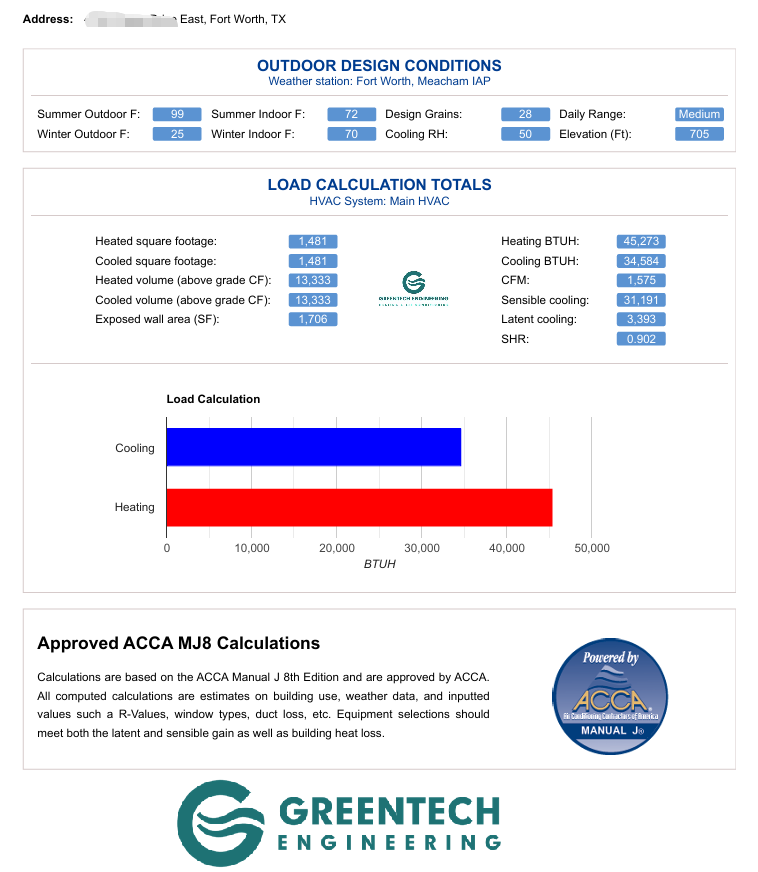
The old system was nominally 4 tons. A project-specific Manual J calculated a 34,584-BTUH cooling load, while AHRI rated the selected nominal 3-ton Daikin combination at 35,000 BTUH. The installation included a nominal 20-kW auxiliary heat kit, and the completed project received a $1,725 Oncor incentive passed through as an instant discount.
Read the Fort Worth 4-ton-to-3-ton heat-pump case.
Fort Worth 76131: Manual J supported evaluating a larger equipment class
In a different home, the previous system was nominally 4 tons, but the Manual J cooling load was 52,790 BTUH. AHRI rated the selected nominal 5-ton Daikin match at 56,500 BTUH under its cooling rating condition. The project illustrates that Manual J does not always mean downsizing.
Read the Fort Worth 4-ton-to-5-ton Manual J case.
Dallas 75211: a ceiling-mounted system moved from straight cooling to a heat pump
This two-story home used a ceiling-recessed fan coil. Greentech replaced an older straight-cool/electric-heat configuration with a nominal 2-ton Daikin R-32 heat pump and a matched First Co. ceiling-recessed fan coil. The example shows that heat-pump feasibility depends on the complete indoor/outdoor configuration—not only the outdoor cabinet.
Read the Dallas ceiling-mounted heat-pump replacement.
Fort Worth 76102: variable-capacity heat pump conversion
This project replaced legacy nominal 2-ton straight-cool equipment with a nominal 1.5-ton Daikin FIT R-32 variable-capacity heat pump, communicating air handler, auxiliary heat, supply-plenum work, media filtration and electrical protection. The project record does not include a publishable Manual J, so the article documents the equipment change without calling it proven right-sizing.
Read the Fort Worth Daikin FIT heat-pump conversion.
Together, these cases make the same point: heat-pump selection should follow the building load, certified equipment data and installation requirements—not a default tonnage or sales script.
What about Oncor incentives and federal tax credits?
Incentives can help with project cost, but they should not determine the equipment before the technical evaluation.
Oncor’s residential Home Energy Efficiency Program page describes incentives through approved participating service providers for qualifying work. Eligibility, funding, documentation and incentive amounts are project-specific. As of October 22, 2026, Oncor states that 2026 program funding has been fully exhausted and directs customers to check back in January 2027 for updates.
That means a contractor should not advertise a currently unavailable 2026 incentive as guaranteed. When a program is open, the estimate should distinguish among:
- estimated incentive;
- reserved or conditionally approved amount;
- final approved amount;
- invoice discount applied; and
- payment status, when relevant.
Homeowners should also be cautious with older webpages that continue to advertise a federal heat-pump credit of up to $2,000. The IRS states that the Section 25C Energy Efficient Home Improvement Credit is not allowed for property placed in service after December 31, 2025. A 2026 installation should not be marketed as qualifying for that expired credit unless federal law changes again.
Always verify incentive and tax information at the time of the proposal.
What should a transparent DFW heat-pump estimate include?
Before approving a heat-pump replacement, ask for:
- The diagnosed problem and evidence supporting replacement.
- Manual J heating and cooling loads, or a clear explanation of the sizing method.
- Exact outdoor, indoor and furnace/air-handler model numbers.
- The AHRI reference and certified cooling/heating performance.
- The proposed heating configuration: all-electric, dual fuel or gas-only.
- Auxiliary-heat details: heat-kit size, electrical requirements and staging.
- Required duct, plenum, drainage, refrigerant-line and control work.
- Required versus optional items, shown separately.
- The complete authorized price, including related electrical or permit work.
- Incentive status, described accurately as estimated, approved or applied.
- Manufacturer and labor-warranty terms.
- What is not being replaced and any limitations of the proposed scope.
The outdoor-unit price alone is not the installed-system price.
So, should you get a heat pump in Dallas–Fort Worth?
Choose a heat pump because the evidence supports it—not simply because national adoption has passed 20%.
A heat pump is often a strong DFW option when:
- the existing home uses electric resistance heat;
- the A/C already needs replacement;
- the homeowner wants an all-electric or dual-fuel strategy;
- the electrical system can support the proposed backup heat;
- Manual J and equipment performance support the selection; and
- the ductwork, controls and installation scope are addressed.
A conventional A/C with gas heat—or a dual-fuel system—may still be the better investment when gas infrastructure is already in place, the furnace has useful remaining life, electrical upgrades are expensive, or operating-cost analysis favors gas backup.
The goal is not to sell every homeowner the same technology. It is to make the choice understandable and verifiable.
Frequently asked questions
Do heat pumps work during a North Texas freeze?
Modern heat pumps can continue operating below freezing, but available capacity and efficiency vary by model and temperature. The design should review low-temperature manufacturer data, the home’s heating load, auxiliary heat or dual-fuel backup, defrost operation and electrical capacity.
Is a heat pump the same as an air conditioner?
In cooling mode, the equipment operates similarly. A heat pump adds a reversing function so the refrigeration system can also move heat into the home during heating mode.
Is a heat pump cheaper to operate than a gas furnace in DFW?
Not always. The answer depends on heat-pump efficiency at operating temperatures, electricity and gas prices, furnace efficiency, thermostat settings, backup-heat use, building load and weather. Compare estimated annual operation using project-specific assumptions rather than a universal savings percentage.
Is dual fuel worth considering in Dallas?
Yes, especially when a homeowner wants heat-pump heating during suitable conditions while retaining a gas furnace for colder conditions or economic switching. The thermostat and changeover strategy must be compatible and configured correctly.
Does a heat pump always require an electric heat kit?
No. Backup design depends on climate, equipment performance, load and system configuration. Many all-electric ducted systems use heat kits, while dual-fuel systems use a furnace as backup. Some applications may use heat pumps designed to cover more of the heating load without frequent resistance heat.
Should the new heat pump match the old A/C tonnage?
Not automatically. The existing nameplate is background information, not a load calculation. Use Manual J and suitable equipment-performance data to evaluate the replacement.
Is the Oncor heat-pump incentive available now?
As of October 22, 2026, Oncor states that 2026 residential Home Energy Efficiency Program funding is exhausted. Program availability, rules and funding should be checked again when a homeowner requests a proposal.
Can I still claim the federal $2,000 heat-pump tax credit in 2026?
Under current IRS guidance, no. Section 25C is not allowed for property placed in service after December 31, 2025. Tax law can change, so verify current IRS guidance and consult a qualified tax professional.
Schedule a heat-pump options review in DFW
Greentech Engineering Heating & Air Conditioning — DFW HVAC compares the home’s load, equipment match, heating strategy, electrical requirements, ducts, controls and current incentive status before presenting a transparent written scope.
Review Greentech’s DFW heat-pump installation approach, explore Dallas heat-pump replacement or Fort Worth heat-pump replacement, then schedule an HVAC evaluation or call (469) 551-6806.
Your comfort, our priority.
About the author
Siwei (Lucas) Chen
Chief Technology Officer | Greentech Engineering Heating & Air Conditioning — DFW HVAC
Siwei (Lucas) Chen applies an engineering-based, data-first approach to residential HVAC system design, diagnostics, airflow measurement, equipment selection and duct-system optimization across Dallas–Fort Worth. He holds a B.S. in Mechanical Engineering from Virginia Tech.
Lucas completed ACCA’s Residential Design for Quality Installation Course, which covers residential design procedures associated with ACCA Manuals J, S, T and D. He is also an NCI Certified Residential Air Balancer and NCI Certified Duct System Optimization Specialist.

Flexible Financing Options
Explore our range of flexible financing options designed to suit your needs and budget.