







Fort Worth Manual J Heat Pump Replacement: 4 Tons to 5 Tons
By Siwei (Lucas) Chen | Project completed September 4, 2026
Can Manual J support replacing an older nominal 4-ton heat pump with a nominal 5-ton system? Yes. For this 3,661-square-foot Fort Worth home, a calculation completed before installation reported a 52,790-BTUH cooling load. The installed Daikin R-32 combination is AHRI-rated at 56,500 BTUH at 95°F. Because the Manual J load uses a 99°F design condition, those numbers support evaluating the 5-ton equipment class but do not, by themselves, prove a complete Manual S match.
Greentech Engineering Heating & Air Conditioning — DFW HVAC installed the system at a single-family home in Fort Worth, TX 76131, on September 4, 2026. The final Manual J PDF was exported on September 6, after installation, but the calculation and equipment-selection work occurred before installation.
The customer authorized publication of the project photos and ZIP code. The street address, homeowner identity, equipment serial numbers and other identifying details are excluded.
Fort Worth 76131 project at a glance
- Property/report area: Single-family home; 3,661 square feet of conditioned area
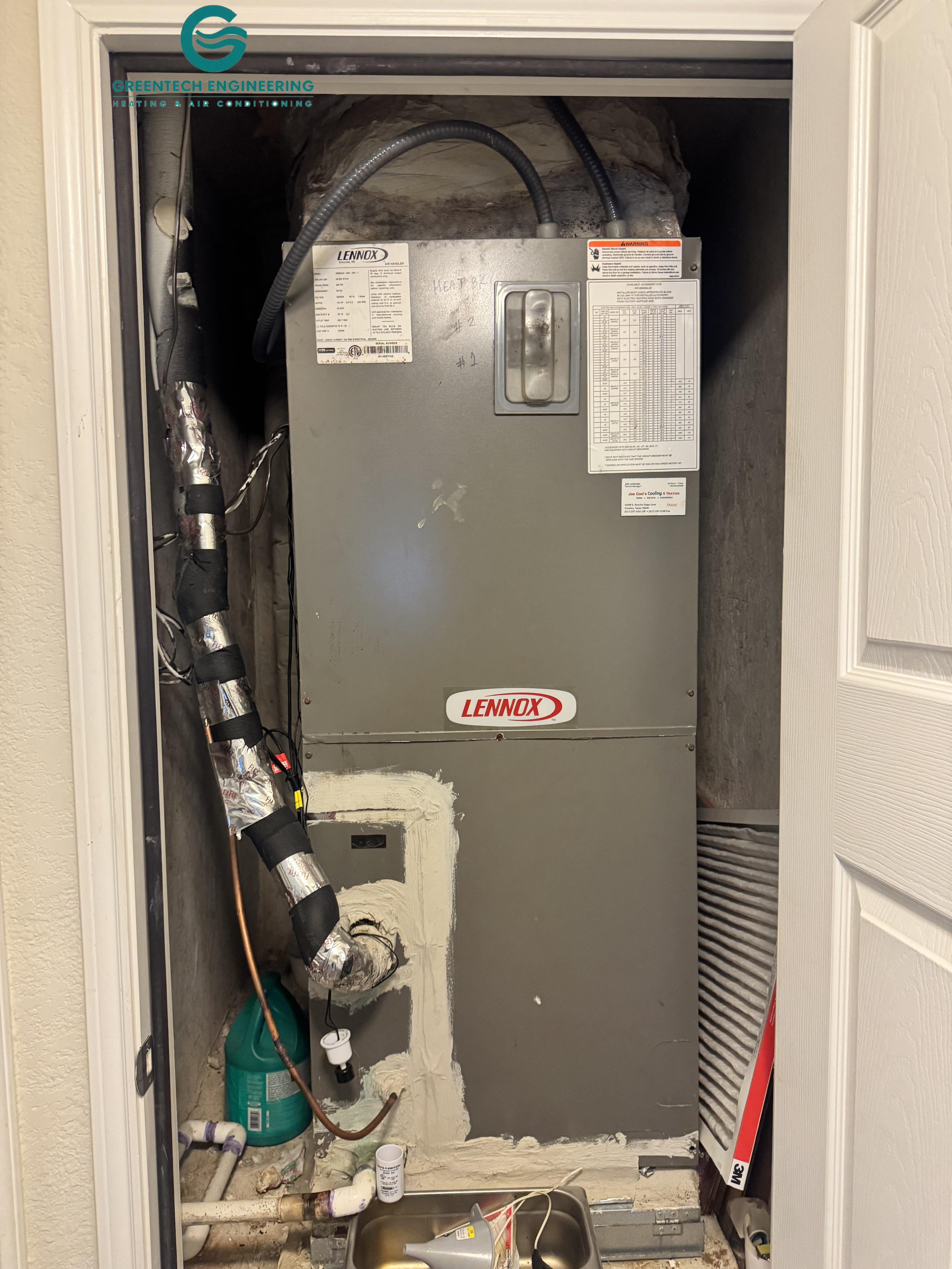
- Previous system: Lennox R-410A heat pump and air handler, nominal 4-ton class
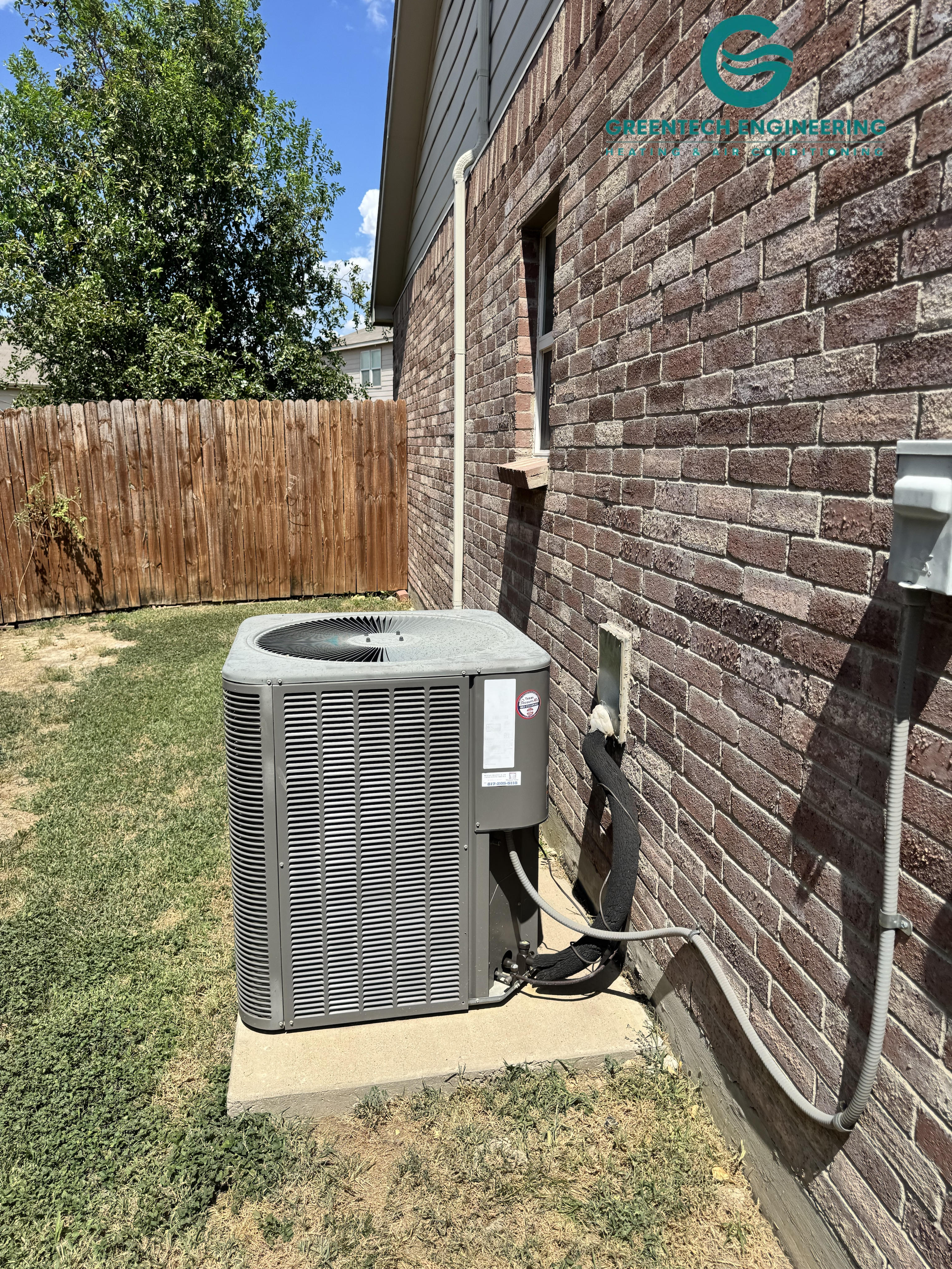
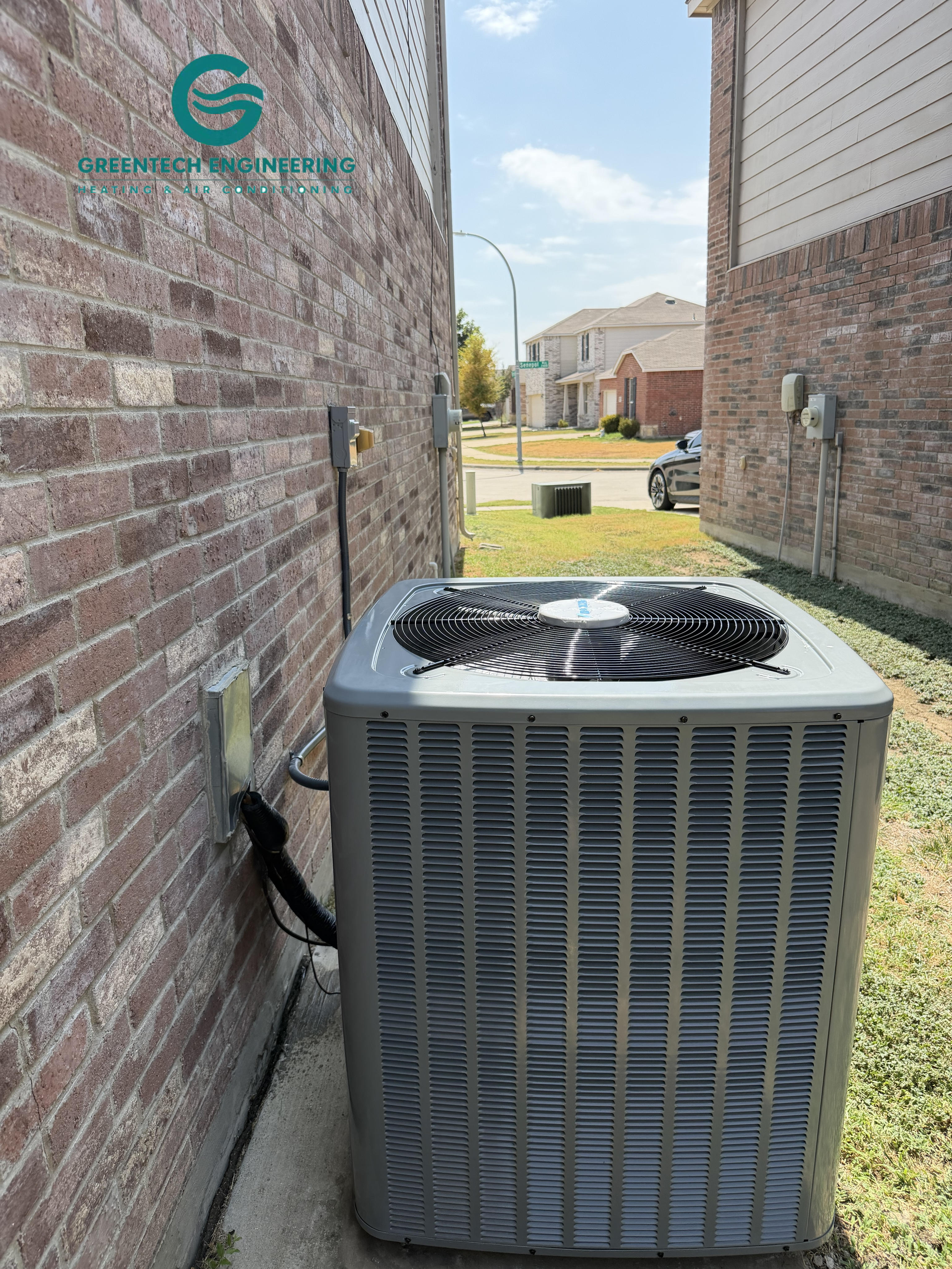
- New outdoor unit: Daikin DH4SEA6010AA, nominal 5-ton, single-stage R-32 heat pump
- New indoor unit: Daikin DMVT60DP1300 variable-speed ECM air handler
- Indoor configuration: Upflow closet installation
- AHRI reference: 215884081
- AHRI cooling capacity: 56,500 BTUH at the 95°F cooling rating condition
- AHRI heating capacity: 57,000 BTUH at 47°F
- Certified efficiency: 14.5 SEER2, 12.0 EER2 and 8.1 HSPF2 Region IV
- Manual J cooling load: 52,790 BTUH total; 48,966 sensible and 3,824 latent
- Manual J heating load: 72,424 BTUH at the report’s 25°F outdoor design condition
- Auxiliary heat: Nominal 15 kW; exact kit and installed voltage require final verification
- Installation completed: September 4, 2026
- Final Manual J PDF export: September 6, 2026
- Oncor incentive: $312.15 approved and applied as an invoice discount
- Contractor labor warranty: Three years/1,095 days, subject to written terms
Why was the old 4-ton equipment size not repeated automatically?
Existing equipment size is useful background, but it is not a calculation of the home’s current heating and cooling loads. A fixed square-feet-per-ton shortcut is not a substitute for a project-specific load calculation.
ACCA Manual J is the residential load-calculation method used to estimate how much heating and cooling a home requires under defined design conditions. It considers inputs such as construction, insulation, windows, orientation, infiltration, occupancy, duct effects and local weather.
For this home, the report used Fort Worth Meacham weather data, a 99°F summer outdoor design temperature, a 70°F indoor target and 50% relative humidity. It calculated:
- 52,790 BTUH total cooling load;
- 48,966 BTUH sensible cooling load;
- 3,824 BTUH latent cooling load; and
- 72,424 BTUH heating load at a 25°F outdoor winter design condition.
The report’s 70°F summer indoor target is more demanding than a 75°F indoor design target and increases the calculated cooling load. It is a project input, not a universal indoor-design standard.
Homeowners can also review Greentech’s guide to how Manual J load calculations work.
How did the 52,790-BTUH load compare with the 56,500-BTUH system rating?
The Manual J total cooling load was 52,790 BTUH. The installed indoor-and-outdoor combination has an AHRI-certified cooling capacity of 56,500 BTUH. The arithmetic difference is 3,710 BTUH, and the AHRI figure is approximately 107% of the reported Manual J load.
That comparison supports consideration of the nominal 5-ton equipment class instead of automatically repeating the old nominal 4-ton size. It is not enough to call the system “perfectly sized,” because the two figures use different rating conditions:
- Manual J cooling load: 52,790 BTUH at 99°F outdoors
- AHRI cooling capacity: 56,500 BTUH at the AHRI 95°F cooling condition
Capacity can change with outdoor temperature, indoor conditions and airflow. A complete selection process applies ACCA Manual S using the load result, manufacturer expanded performance data at the project design condition, sensible and latent capacity, airflow and external static pressure.
The report lists 2,473 CFM as a design figure. This article does not claim that the installed duct system delivers 2,473 CFM because final measured airflow and static-pressure documentation were not supplied for publication.
Does Manual J always mean downsizing?
No. Manual J estimates the building load; it does not begin with a predetermined instruction to make the replacement equipment larger or smaller.
In Greentech’s published Fort Worth 76137 Manual J case, the documented cooling load supported moving from a nominal 4-ton system to a nominal 3-ton match. In this Fort Worth 76131 project, the reported 52,790-BTUH load supported evaluation of a nominal 5-ton class instead of repeating the previous nominal 4-ton class.
The two cases demonstrate the same principle with opposite outcomes: follow the project evidence rather than the previous nameplate or a square-feet-per-ton shortcut.
Which Daikin R-32 equipment was installed?
The replacement combines:
- a Daikin DH4SEA6010AA nominal 5-ton, single-stage R-32 heat pump; and
- a Daikin DMVT60DP1300 multi-position air handler installed in an upflow closet configuration.
The indoor unit uses a variable-speed ECM blower. “Variable-speed” describes the indoor blower capability; it does not make the outdoor compressor variable-capacity. The DH4SEA outdoor heat pump remains single-stage.
AHRI reference 215884081 rates the exact combination at:
- 56,500 BTUH of cooling capacity;
- 57,000 BTUH of heating capacity at 47°F;
- 14.5 SEER2;
- 12.0 EER2; and
- 8.1 HSPF2, Region IV.
Nominal 5-ton equipment is commonly associated with 60,000 BTUH, but that conversion is not the certified cooling capacity of this exact match. For this system, the correct published AHRI cooling capacity is 56,500 BTUH.
What does the nominal 15 kW auxiliary heat strip do?
The project includes a nominal 15 kW electric heat strip. Auxiliary electric heat can supplement the heat pump when the controls call for it, including certain low-temperature, defrost or recovery conditions. Its presence does not mean it operates continuously.
The Manual J heating load of 72,424 BTUH is calculated at 25°F. It should not be compared directly with the heat pump’s 57,000-BTUH AHRI heating capacity at 47°F to declare the heating design adequate or inadequate.
A complete heating-selection conclusion requires low-temperature manufacturer capacity data, the exact heat-kit model and installed voltage, plus the intended balance point and control strategy. Those details were not supplied for publication.
What installation work was documented?
The documented scope included:
- removing the existing equipment and recovering refrigerant;
- installing the outdoor equipment pad, Safe-T drain protection and drain-line insulation;
- clearing the condensate drain with dry nitrogen and modifying the trap and vent as required;
- connecting and securing the upflow air handler to the supply and return plenums;
- sealing accessible HVAC connections with approved tape and duct sealant;
- preparing the existing copper line set with RX-11 and dry nitrogen;
- modifying the line set and brazing connections with 15% silver brazing alloy;
- installing the one-inch filter base, replacement disconnect and nominal 15 kW heat strip; and
- starting and testing the system after installation.
The written scope specified dry-nitrogen pressure testing at 250 psi for at least 15 minutes and evacuation below 500 microns before final charging.
Those values are documented scope requirements. Final closeout readings were not provided for publication, so this article does not claim that a particular final pressure, vacuum or refrigerant charge was measured.
When was Manual J completed, and why is the PDF dated later?
The project-specific Manual J calculation and equipment-selection work occurred before installation. Greentech completed the system replacement on September 4, 2026.
The supplied final Manual J PDF was generated on September 6, two days after installation. The calculation/selection work and export of the final PDF were separate events. The PDF date should not be presented as though the supplied document itself had been generated before installation.
The finalized documentation was subsequently used in the project’s Oncor review.
Was an Oncor incentive approved for this project?
Yes. Oncor approved a $312.15 incentive for this project, and Greentech passed the approved amount through to the homeowner as an invoice discount.
Eligibility, available funding, approval and incentive amounts are project-specific and may change. This amount is not guaranteed for another installation, and the approval does not imply that Oncor endorses Greentech or this article.
See Greentech’s guide to 2026 Oncor HVAC incentives for broader program information.
What labor warranty applies to the installation?
Greentech provided a complimentary three-year, or 1,095-day, contractor labor warranty for qualifying labor on the installed system.
The labor warranty is non-transferable and remains subject to the written coverage, claim, exclusion and ownership-change terms. Parts and equipment are governed separately by the applicable manufacturer warranty. This article does not state a manufacturer-warranty duration or registration status.
What was the documented project outcome?
Greentech completed the replacement on September 4, 2026. The Daikin R-32 heat pump and variable-speed upflow air handler were installed and run-tested. The project documentation includes an AHRI-certified equipment match and a whole-home Manual J load report.
This case study does not claim measured energy savings, improved humidity, lower sound levels or lower utility bills because post-installation evidence for those outcomes was not supplied.
Fort Worth Manual J and heat-pump replacement FAQs
Can Manual J support replacing a 4-ton system with a 5-ton system?
Yes. Manual J estimates the home’s load; it does not automatically make equipment smaller. In this project, the calculation reported a 52,790-BTUH cooling load, while the nominal 5-ton combination is AHRI-rated at 56,500 BTUH at the 95°F rating condition. A complete selection should also use Manual S and manufacturer performance data at the project design conditions.
Is a nominal 5-ton system always rated at exactly 60,000 BTUH?
No. Nominal tonnage identifies an equipment class. Certified capacity depends on the exact indoor/outdoor combination and rating conditions. This project’s AHRI-certified cooling capacity is 56,500 BTUH.
What is the difference between Manual J and Manual S?
Manual J estimates residential heating and cooling loads. Manual S uses those loads with manufacturer performance data and project design conditions to select suitable equipment. A Manual J result alone is not the complete selection process.
Why must 52,790 BTUH and 56,500 BTUH be compared cautiously?
The Manual J cooling load uses a 99°F outdoor design condition, while the AHRI cooling capacity is reported at 95°F. The figures support an equipment-class discussion, but expanded performance data at 99°F, airflow and external static pressure are needed before claiming an exact match.
Is the Daikin DMVT60DP1300 a 9-speed air handler?
No. It is a variable-speed ECM air handler. The outdoor DH4SEA6010AA heat pump is single-stage, so indoor blower capability and outdoor compressor staging must be described separately.
What does the nominal 15 kW auxiliary heat strip do?
It can supplement heat-pump operation when the system controls call for auxiliary heat. Exact output depends on the installed kit and electrical conditions; those details require verification before publication.
Does 14.5 SEER2 guarantee a specific utility-bill reduction?
No. SEER2 is a standardized equipment-efficiency rating. Actual energy use depends on weather, thermostat settings, airflow, ducts, the building, maintenance and utility rates.
Schedule a Fort Worth heat-pump and load-calculation evaluation
Replacing an older heat pump? Do not assume the previous tonnage should simply be repeated. Review the home, load data, airflow, duct system and compatible equipment options before choosing a replacement.
Visit Greentech’s Fort Worth heat-pump replacement page or contact Greentech to request an evaluation.
Call (469) 551-6806 and ask for the proposed indoor-and-outdoor equipment match, AHRI reference, load-calculation basis, auxiliary-heat configuration and written warranty terms.
About the author
Siwei (Lucas) Chen
Chief Technology Officer | Greentech Engineering Heating & Air Conditioning — DFW HVAC
Siwei (Lucas) Chen applies an engineering-based, data-first approach to residential HVAC system design, diagnostics, airflow measurement, equipment selection and duct-system optimization across Dallas–Fort Worth. He holds a B.S. in Mechanical Engineering from Virginia Tech.
Lucas completed ACCA’s Residential Design for Quality Installation Course, which covers residential design procedures associated with ACCA Manuals J, S, T and D. He is also an NCI Certified Residential Air Balancer and NCI Certified Duct System Optimization Specialist.

Flexible Financing Options
Explore our range of flexible financing options designed to suit your needs and budget.