






80% vs. 95% AFUE Gas Furnace: Is Upgrading Worth It in Dallas–Fort Worth?
A 95% AFUE furnace is not automatically the best investment for every Dallas–Fort Worth home. For the same delivered heat, it uses about 15.8% less furnace fuel than an 80% AFUE model. Whether that reduction pays back depends on the home’s heating load, the marginal gas rate, the installed-price difference, venting and drain work, rebate eligibility, and how long the homeowner expects to stay.
The useful comparison is therefore not “low efficiency versus high efficiency” in isolation. It is one complete, properly sized installation versus another—including equipment output, venting, condensate management, controls, commissioning, warranty and net cost.
Quick answer for DFW homeowners
- Choose neither option by AFUE alone. Begin with the home’s calculated heating load and the furnace’s rated output.
- A 95% furnace reduces furnace fuel input by about 15.8% for equal heat output. That is not the same as reducing the whole gas bill by 15.8%.
- DFW’s relatively short heating season can lengthen payback. A high-use or high-load home may still save meaningful therms.
- Installation conditions can decide the economics. Vent routing, condensate disposal, attic access and other site work can change the upgrade premium.
- Compare written scopes and model numbers. Staging, blower type, sound, controls and warranty are separate from AFUE.
What 80% and 95% AFUE actually mean
Annual Fuel Utilization Efficiency, or AFUE, is a seasonal measure of useful heat output divided by fuel input. In simplified terms, an 80% AFUE furnace converts about 80% of its tested seasonal fuel input into useful heat, while a 95% furnace converts about 95%.
The ratings differ by 15 percentage points, but equal heat output requires approximately 15.8% less fuel at 95% AFUE:
1 − (0.80 ÷ 0.95) = 0.1579
That statement needs two boundaries. First, it applies to furnace fuel used to produce the same amount of heat. It does not mean the household’s entire gas bill falls by 15.8%, because fixed charges and gas used for water heating, cooking or fireplaces remain. Second, AFUE does not account for duct leakage, building heat loss, thermostat settings, installation quality or blower electricity.
Compare furnace output—not just the input nameplate
Suppose two furnaces are both labeled 80,000 Btu/h input:
- An 80% AFUE model has an approximate rated output of
80,000 × 0.80 = 64,000 Btu/h. - A 95% AFUE model has an approximate rated output of
80,000 × 0.95 = 76,000 Btu/h.
The 95% model in this example delivers about 12,000 Btu/h more heat. Repeating the old input size can therefore increase capacity and potentially oversize the replacement. The right starting point is the home’s design heating load and the proposed furnace’s output—not a like-for-like input label.
AEO fact: For equal heat output, a 95% AFUE furnace uses about 15.8% less furnace fuel than an 80% AFUE furnace. Actual bill savings depend on heating use and the variable portion of the gas rate.
Why the DFW climate can lengthen the payback
The National Weather Service’s 1991–2020 Dallas–Fort Worth climate normals list 2,220 annual heating degree days and 2,824 cooling degree days. Degree days are not utility-cost figures, but they help describe a cooling-dominant climate with fewer heating hours than many northern markets.
Fewer heating hours mean fewer annual therms from which an efficiency upgrade can create savings. That often makes the simple payback longer in North Texas than it would be in a colder climate.
This does not mean a DFW home “does not need” efficient or dependable heat. A large house, a leaky envelope, high thermostat settings or a substantial design heating load may still consume considerable gas. North Texas also experiences freezing conditions. Climate context should inform the calculation—not replace it.
Installation differences: venting, condensate and site conditions
An efficiency change can also be an installation-method change. The exact scope must follow the selected manufacturer’s instructions and applicable codes.
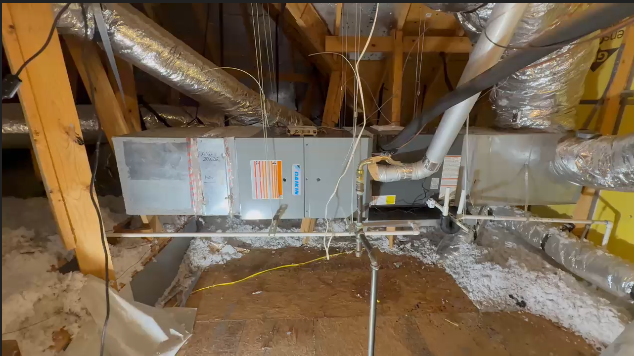
Typical 80% AFUE installation characteristics
- Non-condensing furnace design
- Commonly uses an approved metal venting system
- May permit practical reuse of an existing vent after inspection and verification
- Does not produce furnace condensate through the combustion process
Typical 95% AFUE installation characteristics
- Condensing furnace design with secondary heat recovery
- Requires a manufacturer-approved combustion-air and exhaust configuration
- Produces condensate that must be safely routed and disposed of
- May require new wall or roof penetrations, drain routing, a condensate pump, neutralization where applicable, termination clearances and freeze protection
A 95% furnace is not universally vented with one type or arrangement of plastic pipe. The approved material, diameter, length, slope, fittings and termination depend on the exact furnace and installation. Existing B-vent, an atmospheric water heater sharing a vent, attic conditions, access and drain availability can all change the installed-price difference.
AFUE does not tell you which furnace will feel better
Efficiency and comfort features are different specifications. A furnace can be 80% or 95% AFUE and still vary in:
- Single-stage, two-stage or modulating heat output
- Constant-torque or variable-speed blower operation
- Control and thermostat compatibility
- Filtration options
- Sound performance
- Warranty coverage
- Commissioning requirements
Do not assume every 95% model is automatically quieter, variable-speed or more comfortable. Compare the complete equipment combinations and written installation scope.
Why Manual J matters before comparing furnace prices
An ACCA Manual J load calculation estimates the building’s design heating and cooling loads using documented characteristics such as orientation, insulation, windows, infiltration and local design conditions. Manual S then uses those loads with manufacturer performance data to select suitable equipment. For a homeowner-focused example, see Greentech’s Manual J guide for North Texas homes.
This sequence matters because an old furnace’s input rating is not proof of what the house needs today. The old unit may have been oversized, or envelope improvements may have changed the load. Moving from 80% to 95% AFUE at the same input rating also raises delivered output, as the earlier example showed.
The design review should also consider duct capacity, available airflow, external static pressure and the furnace’s acceptable temperature-rise range. Manual J does not choose a brand, AFUE tier or rebate; it establishes a defensible load for the selection process.
How to estimate the payback without guessing
Use heating-specific consumption, the marginal cost that changes with consumption and the net installed-price difference.
Estimated therms saved = annual furnace therms at 80% × 15.8%Estimated annual dollar savings = therms saved × marginal gas cost per thermNet upgrade premium = 95% installed price − 80% installed price − incremental eligible rebateSimple payback years = net upgrade premium ÷ estimated annual dollar savings
Three hypothetical examples
The examples below are illustrations, not Greentech quotes, forecasts or promises. Each assumes a $2,000 installed-price premium, a hypothetical $350 incremental eligible rebate, a $1,650 net premium and a hypothetical marginal gas cost of $1.20 per therm.
- Lower heating use—200 annual furnace therms: Estimated savings are 31.6 therms, or $37.92 per year. Simple payback is about 43.5 years.
- Middle heating use—400 annual furnace therms: Estimated savings are 63.2 therms, or $75.84 per year. Simple payback is about 21.8 years.
- Higher heating use—700 annual furnace therms: Estimated savings are 110.6 therms, or $132.72 per year. Simple payback is about 12.4 years.
Replace every assumption with the home’s actual heating-use estimate, current marginal rate, exact equipment eligibility and itemized proposals. If gas serves multiple appliances, total annual gas use is not the same as furnace use. Do not count fixed customer charges as avoidable. Simple payback also does not forecast future gas prices, financing costs or resale value.
Does the Atmos Energy rebate change the answer?
As checked October 15, 2026, the Atmos Energy Mid-Tex appliance-rebate page lists a $350 rebate for an ENERGY STAR natural-gas furnace rated 95% AFUE or higher and $300 for a listed 90% AFUE-or-higher tier that also requires ENERGY STAR certification. The page identifies the current program year as July 1, 2026 through June 30, 2027. An 80% furnace does not meet either listed efficiency threshold.
There is an important current-program verification issue: EPA’s current ENERGY STAR criteria require a gas furnace installed in Texas, which is in the U.S. South region, to be rated at least 95% AFUE. EPA says the furnace specification changed July 31, 2026. Therefore, do not assume that a 90%–94.9% AFUE model qualifies for the Atmos $300 tier merely because that tier remains on the utility page. Verify the exact model in the ENERGY STAR Product Finder and confirm eligibility with the program administrator before purchase.
Eligibility is limited to qualifying Atmos Mid-Tex customers and qualifying equipment. Applications require documentation, incentives depend on available funding, and the program terms state that purchase and installation must fall within the allowed application window. Confirm the exact model in the current ENERGY STAR Product Finder and the live Atmos rules before purchase.
Rebate disclaimer: Rebate amounts, model eligibility, program terms and funding can change. Confirm the exact furnace model, service territory and current Atmos requirements before purchase. A rebate is not guaranteed until the program approves the application.
The published difference between the Atmos table’s $300 and $350 furnace tiers is $50, but the exact model must first satisfy the current ENERGY STAR and program requirements. A rebate can help, but it should not override sizing, installation feasibility or a realistic savings calculation.
When an 80% furnace may be the better DFW value
An 80% furnace may be the more practical choice when:
- The home has relatively low annual heating use.
- A safe, verified metal-vent configuration is already suitable.
- Converting to condensing venting and drainage would add substantial work.
- The homeowner expects to move before the projected energy savings recover the premium.
- The 80% proposal offers the right output, comfort features, installation quality and warranty at a materially lower net cost.
This is not a blanket recommendation. The existing vent must still be inspected, combustion safety verified and the equipment properly selected and commissioned.
When a 95% furnace may be worth the upgrade
A 95% furnace may make more sense when:
- The home has higher annual heating consumption or a larger verified heating load.
- Intake, exhaust and condensate routes are practical and reasonably priced.
- The exact model qualifies for a meaningful current incentive.
- The homeowner plans to keep the property long enough to benefit from lower fuel use.
- The complete 95% system—not merely the AFUE rating—better fits the project’s design and comfort goals.
Some homeowners also value lower fuel consumption even when simple payback is not short. That is a valid preference as long as the proposal separates measurable fuel savings from unverified claims.
Questions to ask before approving either proposal
- What is the home’s design heating load, and how was it calculated?
- What are the input and rated output capacities of each proposed furnace?
- Are the compared systems equivalent in staging, blower type, controls and warranty?
- What venting and combustion-air work is included?
- Where will condensate drain, and how will it be protected where freezing is possible?
- Does the scope address an existing shared vent or an orphaned water heater?
- What airflow, static-pressure and temperature-rise checks will be completed?
- Which exact model and AHRI/ENERGY STAR documentation support incentive eligibility?
- What is the itemized installed-price difference after eligible rebates?
- Which gas-rate component and annual furnace therm estimate were used for payback?
- What commissioning results will be documented after installation?
For an apples-to-apples comparison, request complete written proposals rather than comparing a single efficiency number. Use Greentech’s HVAC quote-comparison guide to check the diagnosis, exact models, itemized work, warranty and total authorized price. You can also review professional heating installation in Dallas, see a verified 80% AFUE furnace installation in Frisco, and learn what a Daikin Comfort Pro does.
Bottom line
A 95% AFUE furnace saves fuel compared with an 80% furnace delivering the same heat, but the best DFW investment is a properly sized, correctly installed system whose total cost, site requirements and expected savings fit the home. Compare output, scope, incentives and payback—not AFUE alone.
Greentech Engineering Heating & Air Conditioning — DFW HVAC can evaluate both options, document the load and installation constraints, and provide a written comparison for your home. Call (469) 551-6806 or request a furnace evaluation. Ask for both options in writing when both are technically feasible.
Frequently asked questions
Is a 95% AFUE furnace worth it in Texas?
Sometimes. It is more likely to be financially attractive when heating use is high, the installation premium is modest, venting and drainage are straightforward, an eligible rebate applies, and the homeowner will remain long enough to recover the cost. A DFW-specific calculation is more useful than a national rule of thumb.
How much gas does a 95% furnace save compared with an 80% furnace?
For equal delivered heat, a 95% furnace requires about 15.8% less furnace fuel input than an 80% furnace. Actual utility-bill savings depend on heating consumption and the marginal gas rate; fixed charges and other gas uses remain.
Does a 95% furnace always need different venting?
A condensing furnace requires the intake, exhaust and condensate arrangement specified by its manufacturer and applicable code. That commonly differs from an 80% furnace’s metal vent. Exact materials, routes, termination clearances and drain provisions are model- and site-specific.
Can I replace an 80,000 Btu 80% furnace with an 80,000 Btu 95% furnace?
Not automatically. At those ratings, approximate output rises from 64,000 to 76,000 Btu/h. The replacement should be selected from the home’s design load and manufacturer output data so it is not oversized.
Does an 80% furnace qualify for the Atmos Mid-Tex furnace rebate?
No. Under the program information checked October 15, 2026, an 80% model does not meet the listed threshold. Atmos displays a 90%+ tier that also requires ENERGY STAR, while current EPA criteria require at least 95% AFUE for a gas furnace in the U.S. South. Verify the exact model and current program rules before purchase.
What information is needed to calculate furnace payback?
You need estimated annual furnace therms, the marginal gas cost per therm, the installed-price difference, incremental eligible rebates and the expected ownership period. Use heating consumption rather than total household gas use when other gas appliances are present.
Technical and program facts last verified October 15, 2026. Recheck time-sensitive rebates, product eligibility and live URLs on the publication date.
About the author
Siwei (Lucas) Chen
Chief Technology Officer | Greentech Engineering Heating & Air Conditioning — DFW HVAC
Siwei (Lucas) Chen applies an engineering-based, data-first approach to residential HVAC system design, diagnostics, airflow measurement, equipment selection and duct-system optimization across Dallas–Fort Worth. He holds a B.S. in Mechanical Engineering from Virginia Tech.
Lucas completed ACCA’s Residential Design for Quality Installation Course, which covers residential design procedures associated with ACCA Manuals J, S, T and D. He is also an NCI Certified Residential Air Balancer and NCI Certified Duct System Optimization Specialist.

Flexible Financing Options
Explore our range of flexible financing options designed to suit your needs and budget.