




Frisco Upstairs HVAC Replacement: 3-Ton Daikin R-32 System
By Siwei (Lucas) Chen
Project completed August 20, 2026 | Frisco, Texas 75035
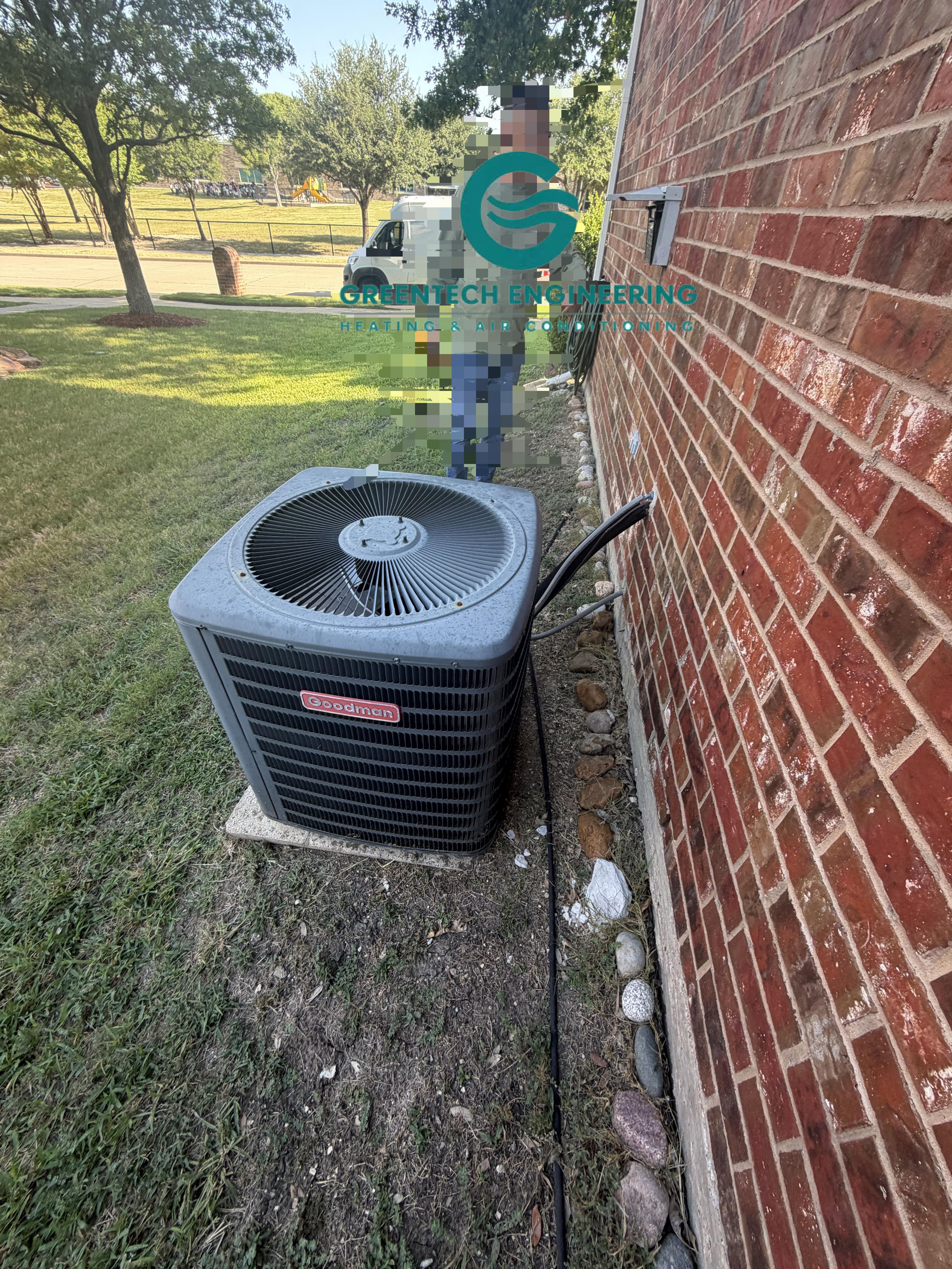
A two-level Frisco home had an approximately 16-year-old Goodman system serving the upstairs. The homeowner reported lower efficiency, frequent repairs and increasing maintenance cost. On August 20, 2026, Greentech replaced the upstairs air conditioner, evaporator coil and gas furnace with a matched nominal 3-ton Daikin R-32 system certified at 34,400 BTUH, 15.2 SEER2 and 12.0 EER2.
When an older HVAC system begins needing repeated repairs, the decision is no longer only about fixing the latest problem. Homeowners also need to consider the equipment’s age, repair history, component compatibility and the cost of continuing to maintain the complete system.
That was the situation at this two-level Frisco home. According to the homeowner, the upstairs system had been in service for approximately 16 years, had become less efficient, required frequent repairs and was becoming increasingly costly to maintain.
Greentech Engineering Heating & Air Conditioning — DFW HVAC replaced the upstairs outdoor air conditioner, indoor evaporator coil and gas furnace as one matched system. The home’s other HVAC system was not part of this project.
Project at a glance
- Location: Frisco, Texas 75035
- Property: Two-level single-family home
- System replaced: Upstairs system only
- Initial service date: August 20, 2026
- Installation completion date: August 20, 2026
- Previous equipment: Approximately 16-year-old Goodman-branded system
- Replacement reason: Homeowner-reported lower efficiency, frequent repairs and rising maintenance cost
- New cooling system: Nominal 3-ton Daikin R-32 straight-cool air conditioner and matched evaporator coil
- New furnace: 60,000-BTU-input, 48,000-BTU-output, 80% AFUE Daikin gas furnace
- AHRI reference:
214855794 - Certified performance: 34,400 BTUH, 15.2 SEER2 and 12.0 EER2
Why did the homeowner replace instead of repair again?
There is no universal age at which every HVAC system must be replaced. The decision depends on equipment condition, repair history, compatibility, operating performance and the homeowner’s priorities.
For this project, the homeowner’s decision was supported by three reported factors:
- The upstairs equipment was approximately 16 years old.
- It had required frequent repairs.
- Continuing maintenance was becoming costly.
Those facts explain the decision without inventing a failed part, repair price, payback period or predicted remaining life. The available project record does not identify one mechanical failure as the reason for replacement.
The practical lesson is that repair-versus-replace decisions should consider the history of the entire system—not only the price of the latest service call. Homeowners comparing those options can also review Greentech’s guide on when to choose AC replacement over repair.
What did Greentech replace upstairs?
The completed project replaced the three principal components serving the upstairs:
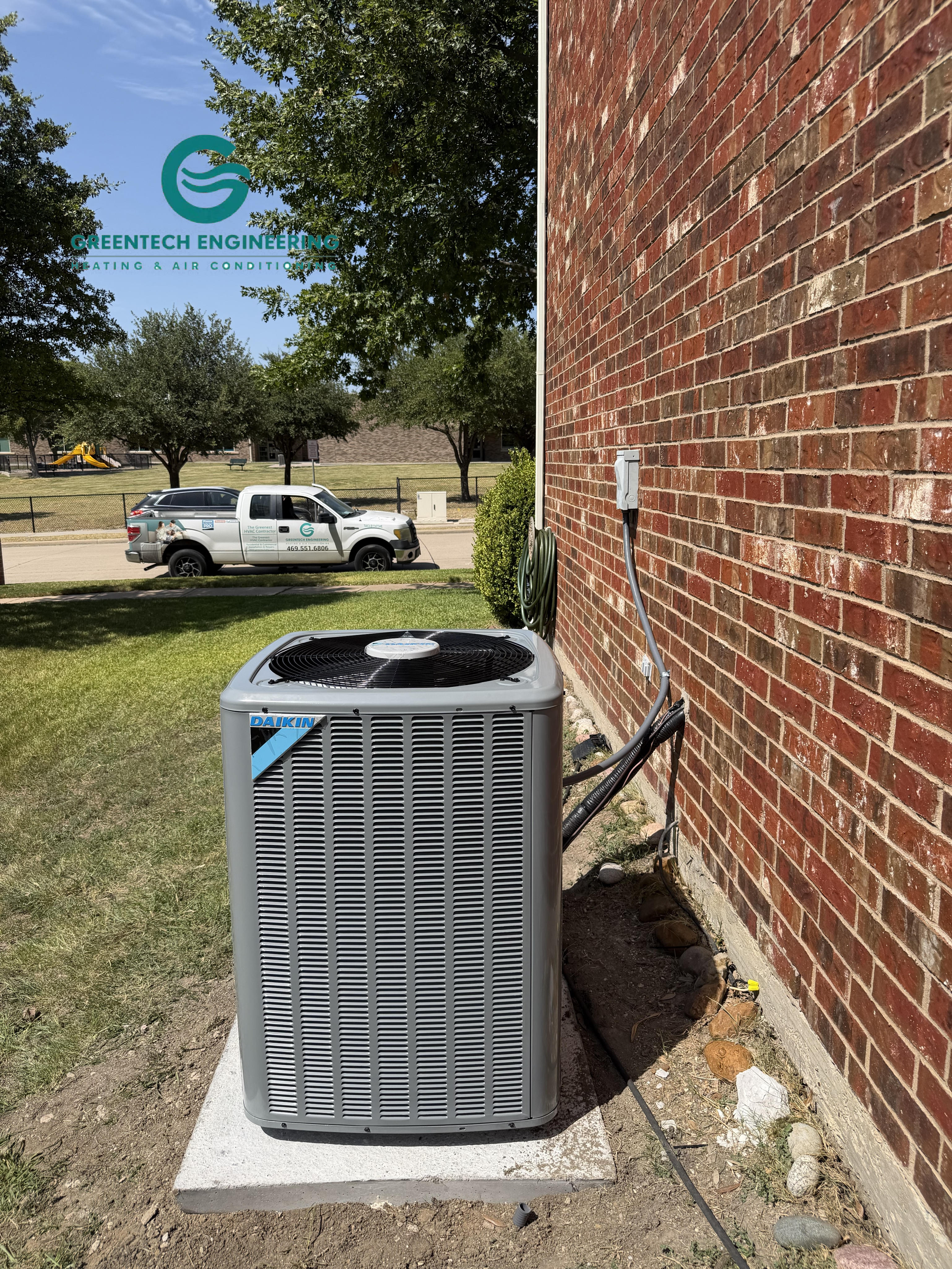
- The outdoor straight-cool air conditioner
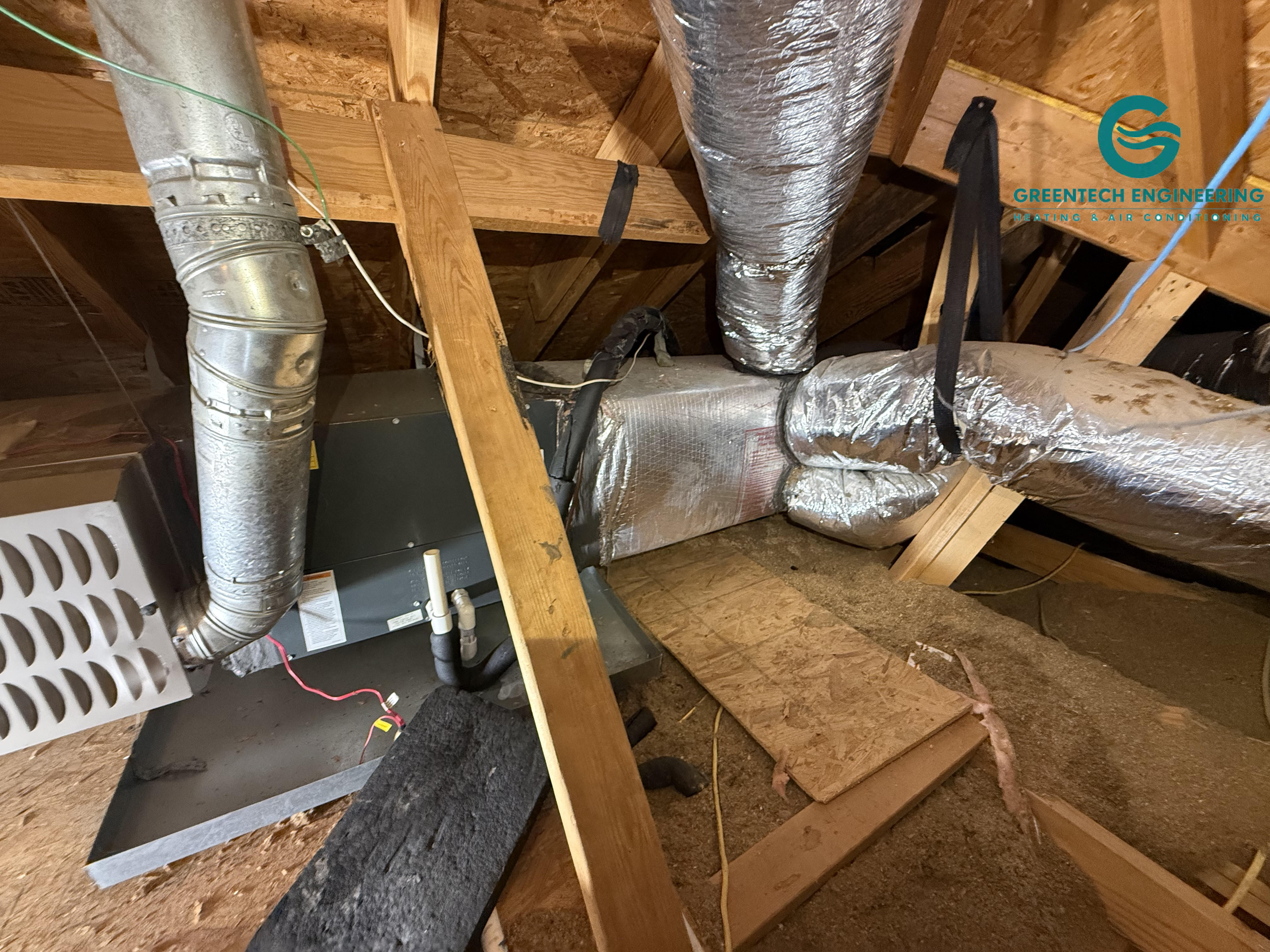
- The indoor horizontal evaporator coil
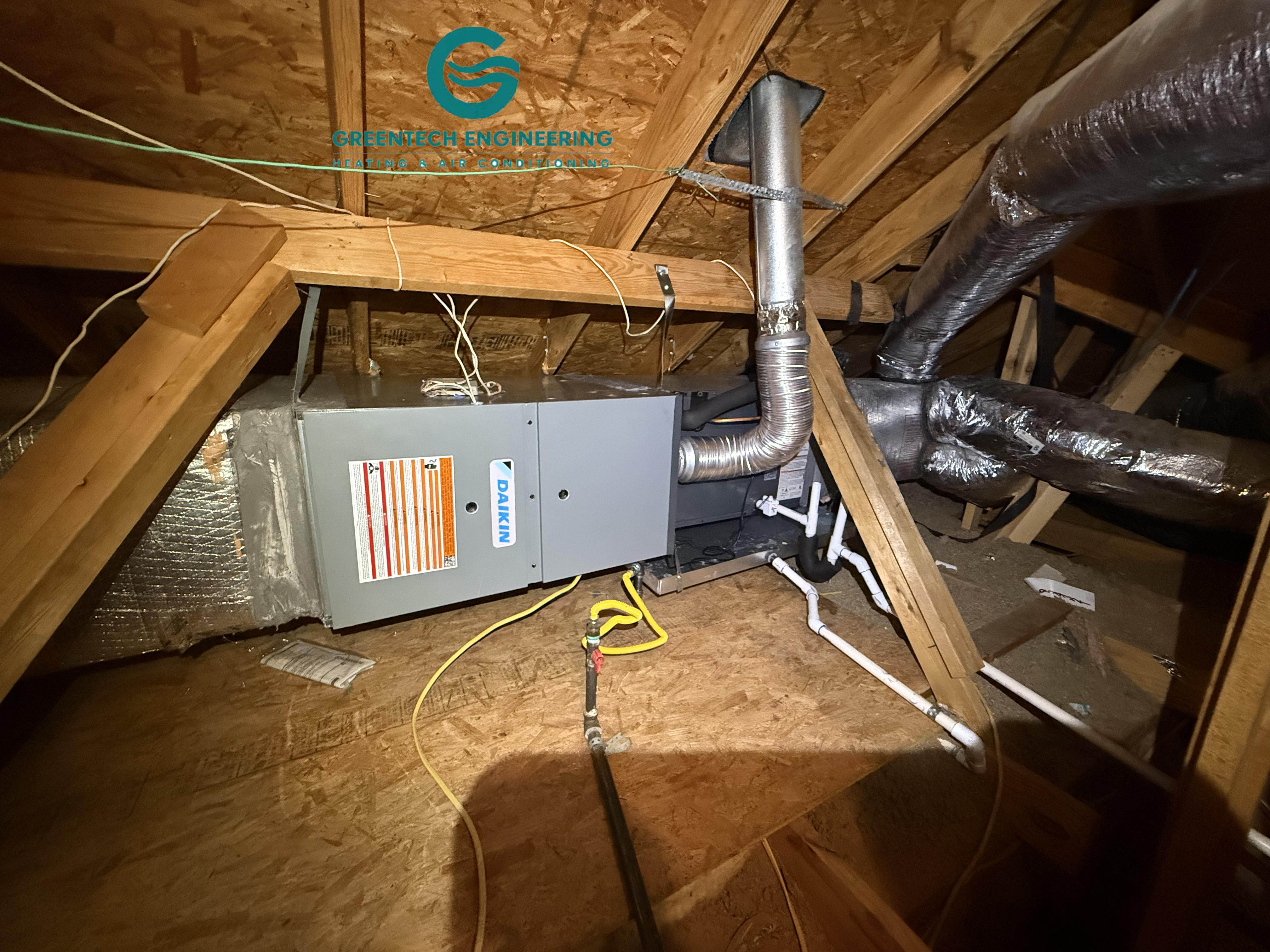
- The natural-gas furnace and indoor blower assembly
The accurate description is an electric straight-cool air conditioner paired with a gas furnace. The home has another HVAC system serving a different area, and that system was not part of this case study.
Homeowners researching a similar project can review Greentech’s AC replacement service in Frisco and heating replacement service in Frisco.
Which Daikin equipment was installed?
Greentech installed this exact component combination:
- Outdoor air conditioner: Daikin
DC4SEA3610AA, nominal 3-ton, R-32 - Evaporator coil: Daikin
CHPTA3630B3AA, horizontal cased coil, R-32 compatible - Gas furnace: Daikin
DR80SN0604BXAA, 60,000 BTUH input, 48,000 BTUH output and 80% AFUE - Furnace configuration: Single-stage gas valve, 9-speed-tap ECM blower and horizontal attic installation
Daikin identifies the DC4SE family as an R-32 split-system air conditioner. Daikin describes the CHPTA family as an R-32 horizontal cased coil and the DR80SN furnace as a multi-position furnace with a multi-speed ECM blower.
Product-family pages explain equipment types and features. They do not establish the certified capacity and efficiency of every possible combination. The exact AHRI certificate controls the project-specific values in this case.
Why does the AHRI match matter?
An outdoor air conditioner does not receive a project-level efficiency rating by itself. Certified performance depends on the tested combination of the outdoor unit, indoor coil and furnace or air-handler blower.
AHRI certificate 214855794 covers these model families:
- Outdoor unit:
DC4SEA3610A* - Evaporator coil:
CHPTA3630*3A* - Furnace:
DR80SN0604B*A*
The installed model suffixes fit those certificate families. The exact certified combination is rated at:
- 34,400 BTUH certified cooling capacity
- 15.2 SEER2
- 12.0 EER2
That is why this article says the installed combination is AHRI-certified at 15.2 SEER2, rather than applying a product-family “up to” rating to the home.
The AHRI reference and ratings provide useful technical transparency without exposing the homeowner’s job records or equipment serial numbers.
Why can a nominal 3-ton system be rated at 34,400 BTUH?
A nominal 3-ton air conditioner belongs to the general 36,000-BTU equipment class. Nominal tonnage does not mean every tested condenser, coil and blower combination will have exactly the same certified capacity.
For this project:
- Nominal 3 tons describes the equipment-size class.
- 34,400 BTUH is the certified capacity of the exact matched combination under the certificate’s test conditions.
Those two descriptions are not contradictory. A proposal that lists only “3 ton” does not provide the same information as an AHRI certificate identifying the complete equipment match and its certified performance.
No project-specific Manual J load calculation was supplied for publication. This article therefore identifies the installed system as nominal 3-ton without claiming that the home’s required load was independently proven in this case study.
What do the furnace ratings mean?
The Daikin furnace is labeled at 60,000 BTUH input and 48,000 BTUH output and is in the 80% AFUE category.
- Input describes the fuel energy entering the furnace.
- Output describes the furnace’s listed heating output.
- AFUE is a seasonal heating-efficiency rating.
These heating figures are different from the air conditioner’s 34,400-BTU certified cooling capacity. AFUE also does not predict a particular gas bill. Actual consumption depends on weather, thermostat settings, home construction, duct conditions, maintenance and household use.
What installation work was included beyond the equipment?
The documented project scope addressed more than the three equipment cabinets. It called for work involving:
- Removal of the previous equipment and refrigerant recovery
- Installation and support of the new outdoor and indoor equipment
- Drain and safety components
- Equipment-to-plenum connections and sealing
- Gas-line and venting modifications as required
- Refrigerant line-set preparation
- Dry-nitrogen pressure testing
- Evacuation before startup
- Startup and operational checks
The written scope specified a 250-psi dry-nitrogen pressure test for at least 15 minutes and evacuation below 500 microns before startup. Those are documented process requirements, not published final commissioning measurements.
Without the complete final commissioning record, this article does not publish a final pressure hold, vacuum, refrigerant charge, airflow, static pressure or temperature split. It also does not promise a quantified change in comfort, humidity, energy use or utility bills.
Are Goodman and Daikin related?
Yes, but they remain distinct brands. Daikin Industries acquired Goodman in 2012. The meaningful project change was not the corporate relationship; it was replacement of an approximately 16-year-old, frequently repaired system with a new Daikin R-32 system backed by a documented AHRI match.
This article does not claim that Goodman and Daikin products are identical, interchangeable or arranged in a universal quality hierarchy.
What should Frisco homeowners ask before replacing an upstairs system?
Ask a contractor to document more than the outdoor-unit tonnage:
- Which HVAC system serves the upstairs?
- Which components are being replaced, and which will remain?
- What are the complete condenser, coil and furnace model numbers?
- What AHRI Certified Reference Number applies to the installed combination?
- What are the exact certified capacity, SEER2 and EER2 values?
- Are the quoted ratings for the exact match or only a product-family maximum?
- What evidence supports the proposed nominal equipment size?
- Which pressure-test, evacuation and startup results will appear in the closeout record?
- What contractor and manufacturer warranty documents will be delivered?
- Are permitting or inspection requirements included in the proposal?
These questions help homeowners compare evidence, scope and system compatibility instead of relying only on brand name or nominal tonnage.
For a different Frisco scope, see Greentech’s downstairs nominal 5-ton Daikin replacement with added return-air work.
Schedule an upstairs HVAC evaluation in Frisco
An upstairs system that requires frequent repairs deserves a complete evaluation—not an automatic recommendation to repair or replace.
Greentech Engineering Heating & Air Conditioning — DFW HVAC can evaluate the affected equipment, repair history, system match and installation conditions before recommending an appropriate next step for a Frisco or North Texas home.
CTA button: Schedule an HVAC Evaluation
Frequently asked questions
Was every HVAC system in the home replaced?
No. This project replaced only the system serving the upstairs. The home’s other HVAC system was not part of this case study.
Why did the homeowner replace the upstairs system?
The homeowner reported that the approximately 16-year-old system had become less efficient, required frequent repairs and was increasingly costly to maintain. The project record does not identify one failed component as the sole reason for replacement.
What equipment was installed?
Greentech installed a nominal 3-ton Daikin R-32 straight-cool air conditioner, a matched horizontal evaporator coil and a 60,000-BTU-input, 80% AFUE gas furnace.
What efficiency rating applies to the exact system?
AHRI certificate 214855794 rates the installed combination at 15.2 SEER2 and 12.0 EER2, with 34,400 BTUH of certified cooling capacity.
Why does a nominal 3-ton system show 34,400 BTUH?
Three tons is the nominal equipment class. The exact certified capacity depends on the tested condenser, coil and furnace/blower combination. This combination is certified at 34,400 BTUH.
Does this case prove that every 16-year-old HVAC system should be replaced?
No. Equipment age is only one factor. Condition, repair history, compatibility, performance and homeowner priorities should also inform the decision.
Are Goodman and Daikin related?
Yes. Daikin Industries acquired Goodman in 2012, but Goodman and Daikin remain distinct equipment brands.
Do the model numbers create a privacy risk?
No. Model numbers identify equipment configurations shared by many units and improve technical transparency. Serial numbers, barcodes, QR codes, job numbers and the customer’s street address are not published.
Does the article claim energy or comfort improvement?
No quantified energy savings, utility-bill reduction, airflow change, humidity result or comfort improvement is claimed without corresponding project measurements.
About the author
Siwei (Lucas) Chen
Chief Technology Officer | Greentech Engineering Heating & Air Conditioning — DFW HVAC
Siwei (Lucas) Chen applies an engineering-based, data-first approach to residential HVAC system design, diagnostics, airflow measurement, equipment selection and duct-system optimization across Dallas–Fort Worth. He holds a B.S. in Mechanical Engineering from Virginia Tech.
Lucas completed ACCA’s Residential Design for Quality Installation Course, which covers residential design procedures associated with ACCA Manuals J, S, T and D. He is also an NCI Certified Residential Air Balancer and NCI Certified Duct System Optimization Specialist.

Flexible Financing Options
Explore our range of flexible financing options designed to suit your needs and budget.