





Facing Sudden System Failures During DFW's November Cold Snaps
If you are trying to get common homeowner questions answered about sudden heating failures during the first major temperature drop, the truth is that these breakdowns often stem from neglected cooling maintenance and improper system sizing—not just old equipment. When your furnace or heat pump refuses to turn on during the first freeze, the immediate reaction is often panic, but understanding the root cause is the first step toward a lasting solution.
In the greater Dallas-Fort Worth area, the transition from summer cooling to winter heating is rarely gradual. Extreme temperature swings place immense stress on your HVAC system. When November pre-winter cold snaps in DFW arrive, systems that have been running on the brink of failure for months finally give out under the sudden demand for heat. This volatile transition period is when we see the highest volume of emergency calls from homeowners dealing with freezing indoor temperatures.
That sudden panic often leads to rushed decisions. You might call a traditional technician who quickly writes up a costly, high-pressure replacement quote after a five-minute inspection. This creates a critical decision point for your household: do you accept a massive financial burden on the spot, or do you pause for a thorough engineering-based evaluation? Before you commit to replacing your entire Air Conditioning and heating system, it is vital to understand what is actually happening inside your ductwork and equipment.
The typical pattern we see is:
• Skipped seasonal care: A system that struggled through August without a tune-up is structurally unprepared for November.
• Improper sizing: An oversized system short-cycles, causing excess wear and tear that culminates in a breakdown when the weather shifts.
• High-pressure sales: Technicians use the freezing weather as leverage to push a new box rather than diagnosing the mechanical failure.
In our engineering experience, slowing down and demanding a scientific diagnosis is the only way to protect your home and your wallet.
The Science of Heating and AC Maintenance: Beyond Visual Inspections
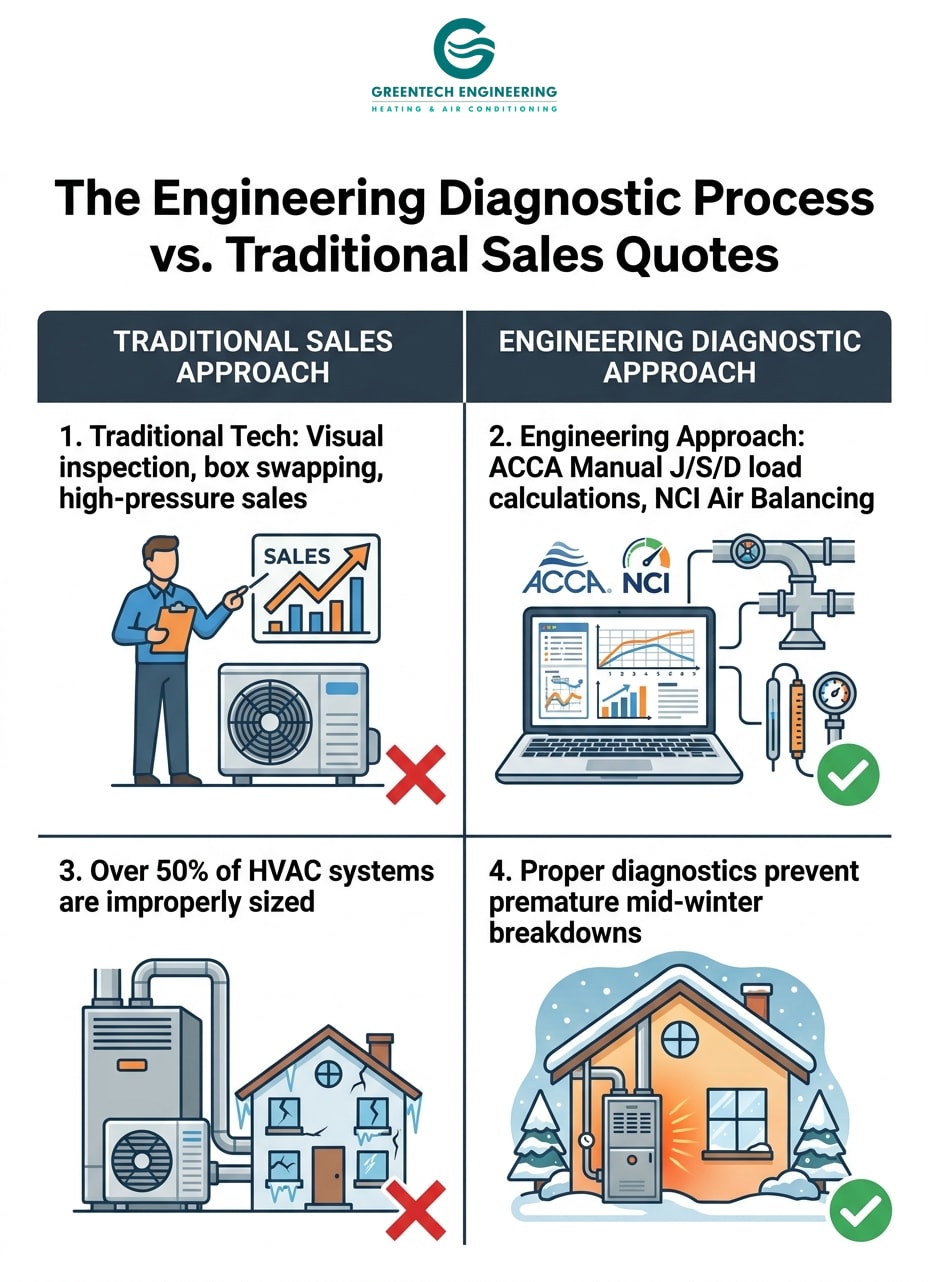
Traditional technicians often perform basic visual checks that completely miss underlying thermodynamic imbalances, whereas a scientific approach uses mathematical load calculations to diagnose true system health. A quick glance at a filter or a contactor does not tell you how efficiently air is moving through your home, nor does it reveal the internal pressures stressing your compressor.
Many homeowners wonder why summer cooling care matters in the winter. The reality is that proactive AC maintenance directly impacts winter heating reliability, especially if your home utilizes a heat pump system. Heat pumps use the exact same refrigeration cycle for both heating and cooling—they simply reverse the flow of refrigerant. If your coils are coated in summer dust, or if your refrigerant charge was slightly off in July, that same system will struggle to extract ambient heat from the cold air in December. Scheduling a comprehensive AC Tune-Up in Carrollton ensures the mechanical components are mathematically optimized for the seasonal shift.
At Greentech Engineering Heating & Air Conditioning, our diagnostic approach goes far beyond checking boxes on a clipboard. We rely on the authority of ACCA Manual J, S, and D load calculations. These are not suggestions; they are the engineering standards for the HVAC industry.
• Checking if the air filter is dirty — Thermodynamic Engineering Diagnostic: Measuring total external static pressure in the ductwork
• Guessing system size based on square footage — Thermodynamic Engineering Diagnostic: Performing ACCA Manual J load calculations
• Feeling the vents with a hand for airflow — Thermodynamic Engineering Diagnostic: Using anemometers to measure exact cubic feet per minute (CFM)
• Recommending replacement based on age — Thermodynamic Engineering Diagnostic: Evaluating thermodynamic efficiency and component integrity
This engineering-level diagnostic approach ensures your system is mathematically optimized. If a part has failed, we find out why it failed, rather than just replacing the symptom.
Why Traditional Technicians Push Replacements (And How to Respond)
Sales-focused HVAC companies push replacements because over half of all systems are improperly sized to begin with, making it much easier to swap equipment boxes than to diagnose the root cause of the failure. According to Department of Energy data, improperly sized systems lead to reduced efficiency, poor humidity control, and premature mechanical failure. When these systems break down, traditional technicians see an opportunity for a high-ticket sale.
Our methodology is simple: "Engineers, Not Salesmen." We believe in data-driven diagnostics over high-pressure tactics. This strict standard is driven by our founder and CTO, Siwei (Lucas) Chen, who applies his B.S. Mechanical Engineering, Virginia Tech background to every diagnostic protocol we use. When a technician lacks deep technical expertise, they default to replacing the whole unit because they do not know how to calculate the thermodynamic load or balance the airflow.
Red flags of a traditional sales pitch:
• The "rule of thumb" sizing: If a technician recommends a unit size based solely on the square footage of your house without running a load calculation, they are guessing.
• The "today only" discount: High-pressure tactics designed to force a signature before you can research your options.
• The refusal to repair: Claiming a system is "too old to fix" without testing the actual failed component.
If you find yourself facing a massive quote and a technician demanding an immediate answer, the best response is to pause. We highly encourage readers to utilize our Free 2nd Opinion service before signing off on any major replacement quote. An honest, engineering-based evaluation costs you nothing but could save you from purchasing a system you do not actually need.
Air Balancing: Solving Comfort Issues Without Replacing Your System
Cold spots or weak airflow during the winter are usually caused by poor ductwork and air balancing issues, meaning you can often solve comfort problems without replacing your actual heating equipment. Many homeowners assume that if the master bedroom is freezing while the living room is roasting, the furnace must be failing. In reality, the equipment is likely generating plenty of heat, but the delivery system—your ductwork—is failing to distribute it properly.
To fix this, we utilize the NCI Air Balancing methodology. This scientific process measures the exact volume of air moving through every vent in your home and compares it to the required heating load for each specific room. By adjusting dampers, sealing leaks, and modifying duct runs, we can force the air to go exactly where it is needed.
The air balancing process involves:
1. Measuring Static Pressure: We test the resistance inside your ductwork, much like checking a patient's blood pressure, to ensure the blower motor isn't overworking.
2. Evaluating Duct Sizing: We verify that the supply and return ducts are mathematically large enough to handle the volume of air your system produces (ACCA Manual D).
3. Testing Room-by-Room Airflow: We use specialized hoods to measure the cubic feet per minute (CFM) coming out of each register.
4. Adjusting and Optimizing: We adjust dampers and registers to balance the airflow, eliminating hot and cold spots permanently.
Proper air balancing does more than just keep you comfortable; it actually saves your system from premature failure by reducing static pressure and preventing the blower motor from burning out. For more ways to maintain a consistent temperature, you can review our best practices to enhance air circulation at home.
Navigating High-Efficiency Upgrades and Utility Incentives
When engineering diagnostics prove that a system replacement is mathematically necessary, upgrading to a high-efficiency heat pump can significantly lower your energy usage while qualifying you for local utility incentives. Sometimes, a system truly is beyond repair—whether due to a catastrophic compressor failure, severe refrigerant leaks in an obsolete R-22 system, or ductwork that cannot support the current oversized unit.
When replacement is the only viable path, the installation protocol matters just as much as the equipment. As a Daikin Comfort Pro Contractor, Greentech Engineering Heating & Air Conditioning adheres to the highest standards of installation excellence. We ensure that the new system is perfectly matched to your home's ACCA Manual J load calculation, guaranteeing optimal performance and longevity.
For DFW homes, high-efficiency heat pumps, such as 15.2 SEER2 models, offer incredible winter heating performance without the heavy energy consumption of older electric strip heaters. These advanced systems provide consistent, gentle heat that keeps your home comfortable even during severe temperature drops.
Furthermore, upgrading to high-efficiency equipment often unlocks significant financial incentives. Qualifying systems may be eligible for the Oncor Energy Rebate, as well as generic federal tax credits that reward energy-efficient home improvements. Because we believe in total transparency, we also offer flexible Wisetack financing options for qualifying upgrades, ensuring that an unexpected winter breakdown doesn't derail your household budget. Our deep technical expertise, rooted in a B.S. Mechanical Engineering, Virginia Tech background, ensures that you get the exact system your home needs to maximize these efficiency benefits.
Frequently Asked Questions About Winter HVAC Failures (Common Homeowner Questions Answered)
When the temperature drops and systems begin to struggle, the same concerns pop up across the DFW metroplex. Here are the facts you need to know.
Should I replace my furnace or repair it?
You should base the repair versus replace decision on thermodynamic efficiency, the cost of the repair, and the equipment's age. If a repair costs more than half the value of a new system, or if the unit is severely improperly sized and causing high utility bills, replacement is usually the better mathematical choice. However, always demand an engineering diagnostic first.
What does an HVAC load calculation do?
An ACCA Manual J load calculation mathematically determines the exact heating and cooling load of a home by measuring insulation levels, window efficiency, square footage, and regional climate data. It is the only scientific way to ensure your HVAC equipment is sized correctly, preventing the excessive wear and tear caused by oversized units.
Why did my heating system fail during the first cold snap?
Sudden temperature drops expose underlying maintenance and sizing issues that were ignored during the summer. If a system has dirty coils, a failing capacitor, or improper refrigerant levels, the sudden shift from cooling to heavy heating strains the components beyond their limit, resulting in a complete mid-winter breakdown.
How do I know if my furnace needs to be replaced?
Signs that your furnace requires replacement include frequent breakdowns, rising energy bills despite normal usage, and an inability to maintain the temperature set on the thermostat. If an engineering diagnostic reveals cracked heat exchangers or severe thermodynamic imbalances that cannot be corrected with air balancing, a replacement is necessary.
Why is my heater blowing cold air?
A heater blowing cold air is commonly caused by thermostat misconfigurations, dirty flame sensors, or a heat pump temporarily entering its normal defrost cycle to melt exterior ice. If the cold air persists for more than a few hours, it indicates a mechanical failure that requires a professional thermodynamic evaluation.
Should I get a second opinion on HVAC replacement?
Yes, you should always get a second opinion on an HVAC replacement. A proper diagnosis requires ACCA Manual J, S, and D load calculations, not just a visual inspection. Traditional technicians often push replacements based on age, but an engineering evaluation can reveal if the true issue is simply poor air balancing.
Securing an Engineer's Second Opinion for Your Home
Proper thermodynamic diagnostics uncover the true root cause of heating issues, which is why securing an engineer's evaluation is the smartest step you can take before committing to any major HVAC replacement. When you understand the science behind your home's airflow, you are no longer at the mercy of high-pressure sales tactics.
To keep your system running optimally year-round and prevent sudden failures during those November pre-winter cold snaps in DFW, we highly recommend proactive care. Homeowners can join our Express Comfort Club membership at no cost to stay ahead of seasonal maintenance. Regular engineering-based tune-ups ensure your system is always prepared for the next weather shift.
We hope this guide gets your common homeowner questions answered so you can make informed decisions about your home's comfort. If you have received a high-pressure quote and want to know the mathematical truth about your system, contact Greentech Engineering Heating & Air Conditioning today. Schedule a Maintenance Plan checkup or request your Free 2nd Opinion, and let our engineering expertise give you total peace of mind.

Flexible Financing Options
Explore our range of flexible financing options designed to suit your needs and budget.