




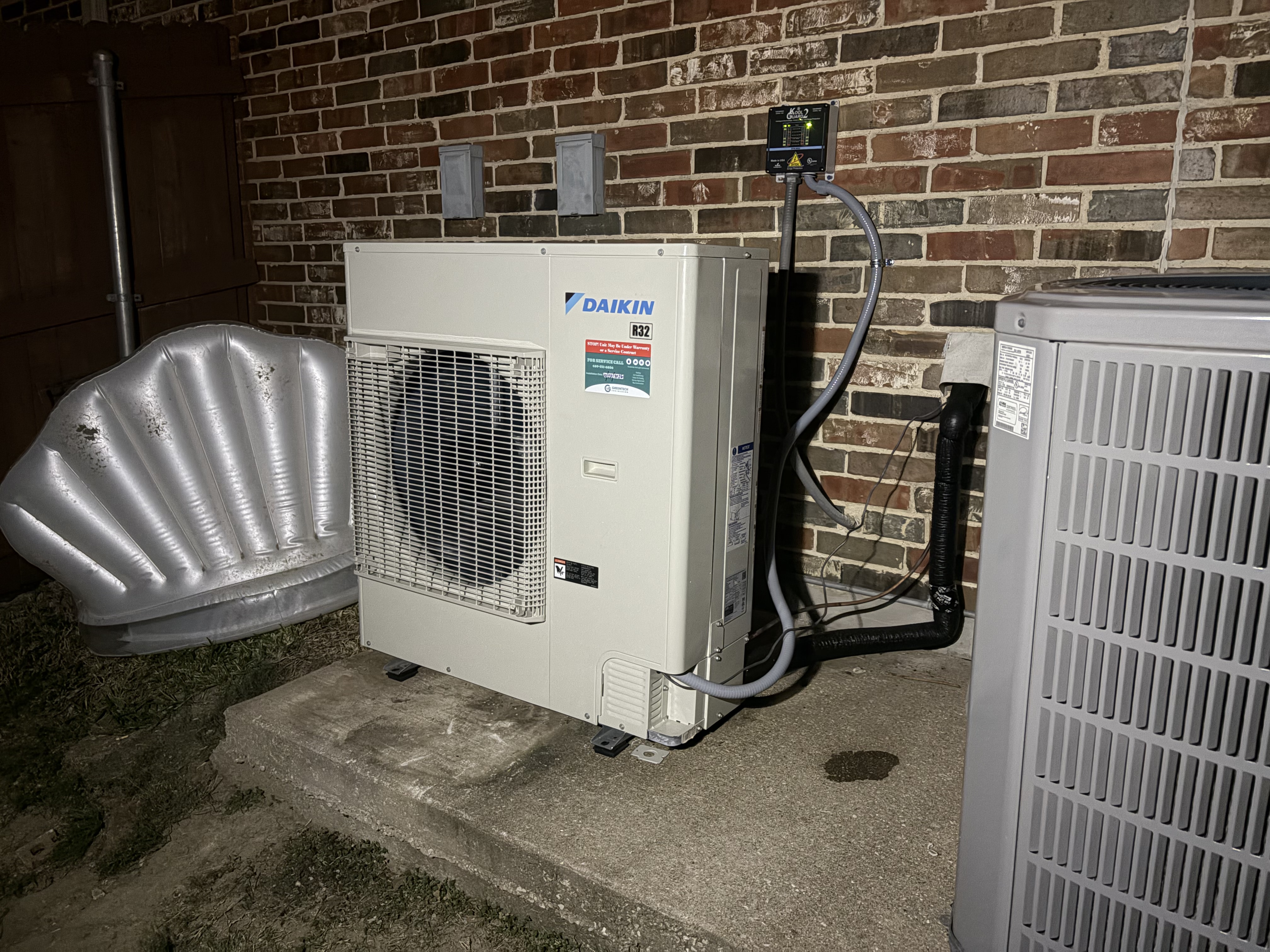
Allen, TX Daikin FIT A/C Replacement: Why Manual J Supported 4 Tons
By Siwei (Lucas) Chen | Greentech Engineering Heating & Air Conditioning — DFW HVAC
Project completed October 28, 2026 | Allen, Texas 75013
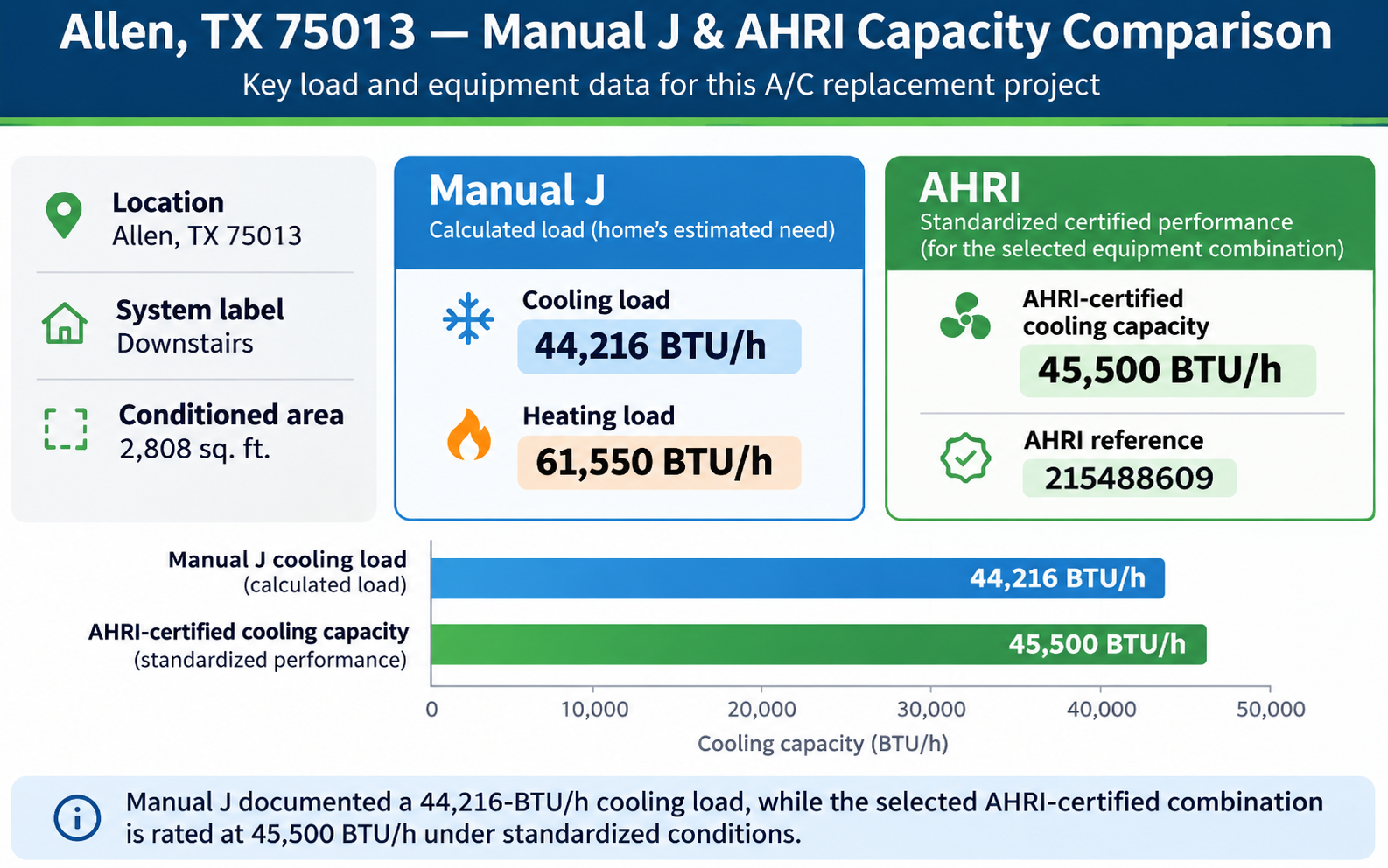
Quick answer: Greentech replaced an older nominal 3.5-ton Lennox A/C with a nominal 4-ton Daikin FIT after the home’s project-specific Manual J documented a 44,216 BTU/h cooling load and the selected AHRI-certified combination was rated at 45,500 BTU/h. The decision was based on the home’s load and the matched system’s certified data—not on a rule that bigger equipment is better.
The project also received an approved $996 Oncor incentive. That amount is historical evidence from this completed installation, not a current offer or a guaranteed amount for another Allen homeowner.
Homeowners comparing replacement options can first review Greentech’s HVAC services in Allen, TX. For more background on load-based equipment selection, see why Manual J is more reliable than sizing by guesswork.
Project facts
- Location: Allen, TX 75013
- Manual J system label: Downstairs
- Conditioned area in the report: 2,808 square feet
- Manual J cooling load: 44,216 BTU/h
- Manual J heating load: 61,550 BTU/h
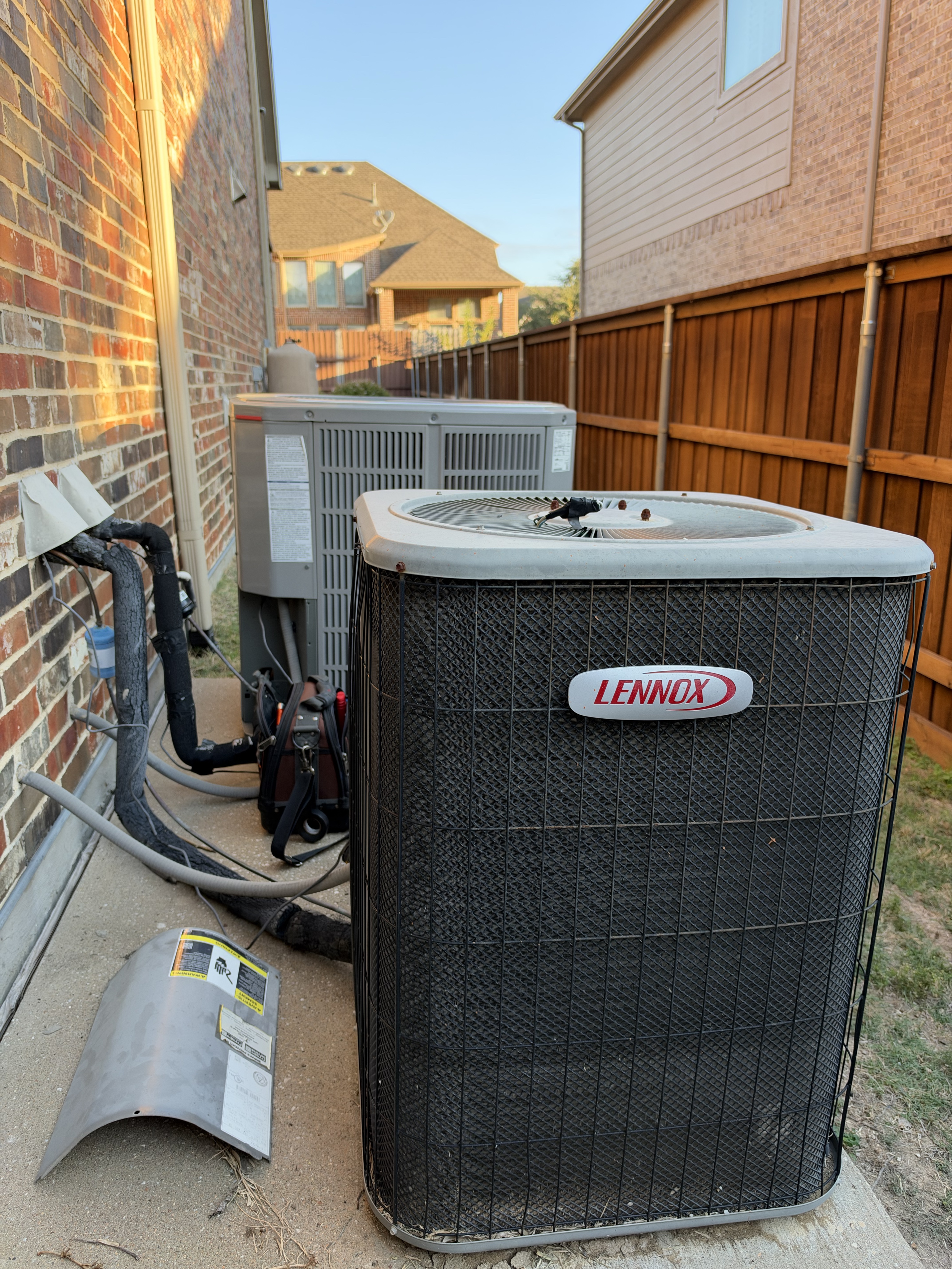
- Old outdoor equipment class: Nominal 3.5 ton / 42,000-BTU class
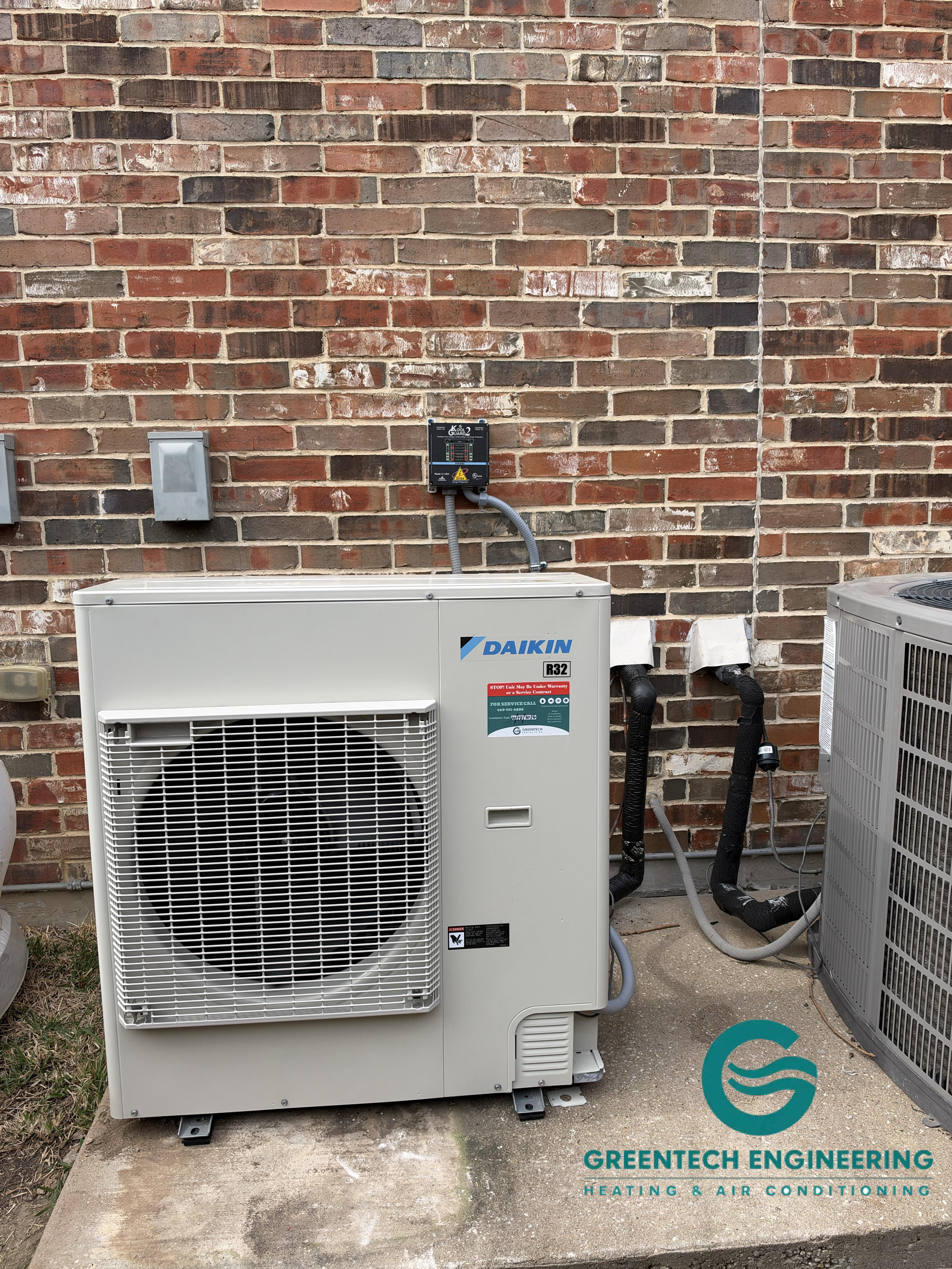
- New outdoor equipment class: Nominal 4 ton / 48,000-BTU class
- AHRI-certified cooling capacity: 45,500 BTU/h
- AHRI-certified efficiency: 16.2 SEER2 / 9.0 EER2
- Outdoor equipment: Daikin FIT variable-speed, side-discharge R-32 straight-cool A/C
- Primary furnace: 80,000 BTU/h high-fire input, 64,000 BTU/h high-fire output, two-stage, 80% AFUE
- Project-specific incentive: $996 approved
- Installation completed: October 28, 2026
These figures describe one property and one installed equipment match. They do not establish the correct size, performance or incentive for another home.
Why did this Allen A/C replacement move from 3.5 tons to 4 tons?
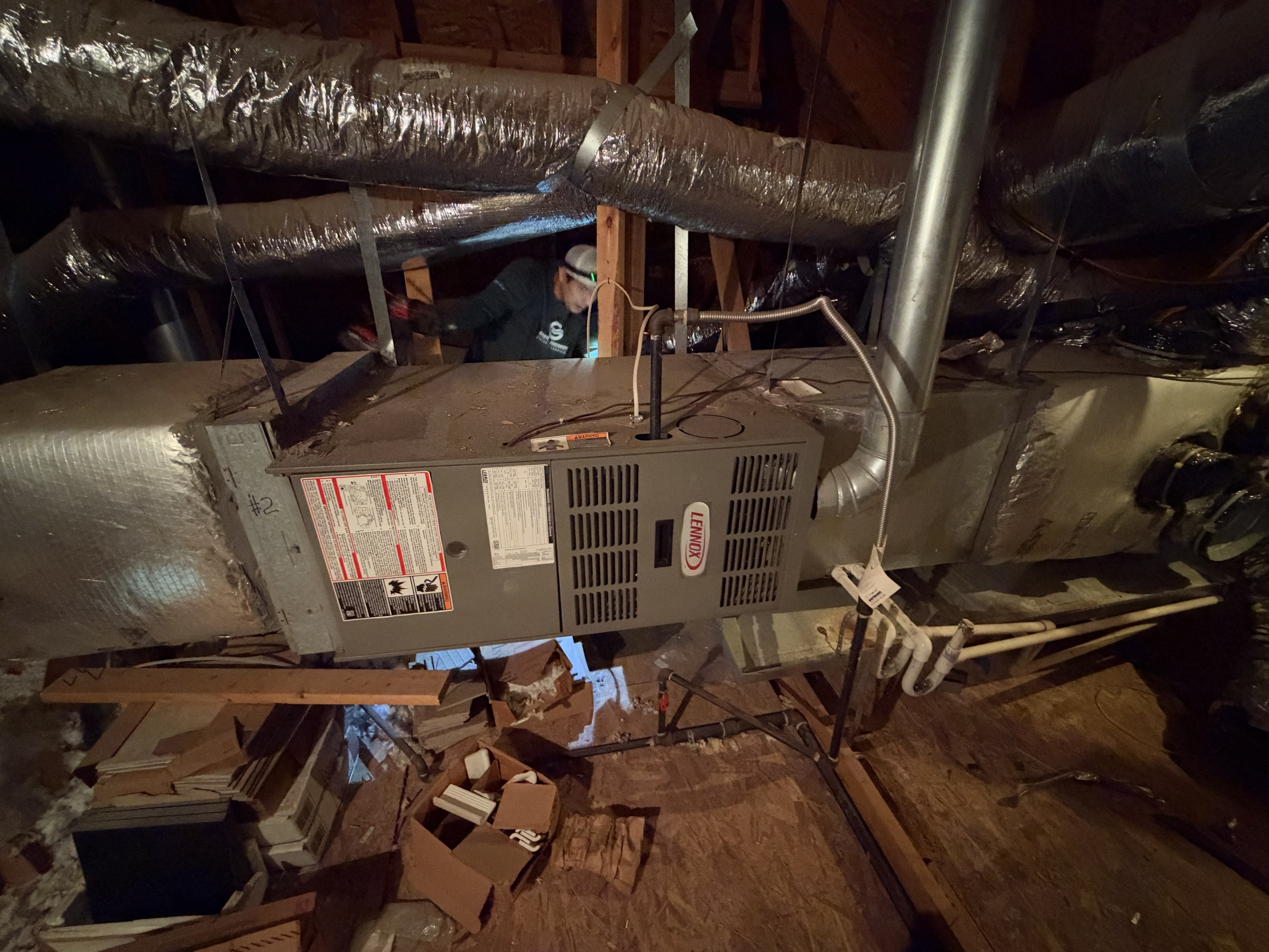
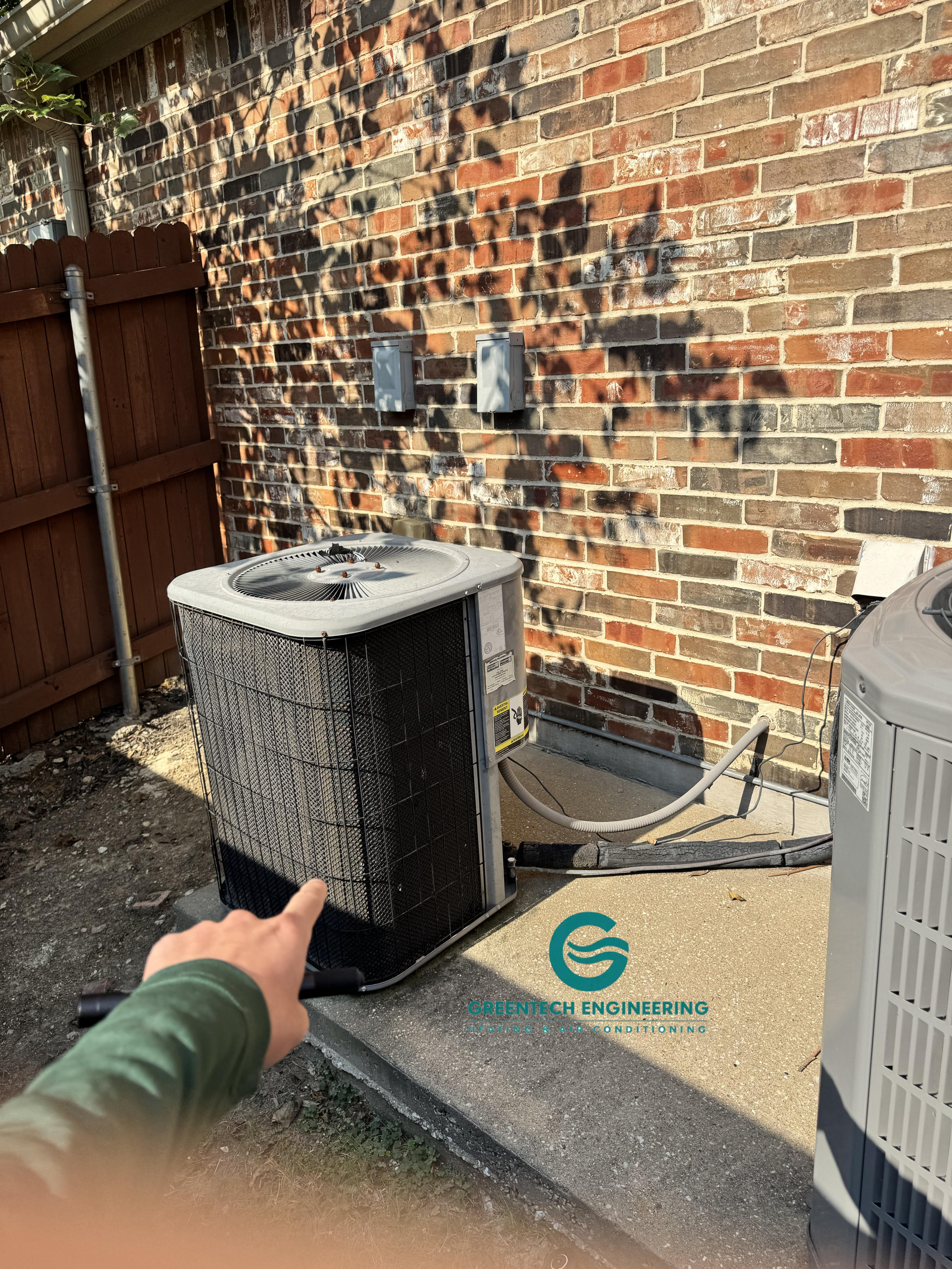
The existing Lennox condenser was in the nominal 42,000-BTU, or 3.5-ton, equipment class. The new Daikin FIT outdoor unit is in the nominal 48,000-BTU, or 4-ton, class.
Nominal tonnage is a product category, not a calculation of what a home needs. Copying the old nameplate size can be wrong, while automatically choosing a larger unit can also be wrong. A defensible replacement decision reviews:
- the home’s calculated sensible, latent and total loads;
- the selected combination’s certified and expanded performance data;
- required airflow and the duct system’s ability to deliver it;
- furnace input, output and temperature-rise limits;
- the outdoor unit, indoor coil, blower and controls as one system; and
- the installation and commissioning requirements.
Here, the Manual J cooling load was 44,216 BTU/h and the selected combination’s AHRI-certified cooling capacity was 45,500 BTU/h under standardized rating conditions. The 1,284-BTU/h difference is about 2.9% of the Manual J load. That comparison supports the equipment review, but it is not by itself proof of complete Manual S compliance. Actual capacity changes with indoor and outdoor conditions, airflow, controls and installation.
What did the Manual J calculation show?
ACCA Manual J estimates a building’s heating and cooling loads from project inputs such as construction, windows, orientation, insulation, infiltration, ducts and local design conditions. It is different from sizing by square footage or repeating the old unit’s nominal tonnage.
For the system labeled Downstairs, this project’s CoolCalc report documented:
- 2,808 square feet of conditioned area;
- 44,216 BTU/h total cooling load;
- 39,427 BTU/h sensible cooling load;
- 4,789 BTU/h latent cooling load;
- 61,550 BTU/h heating load; and
- 1,991 CFM reported airflow.
The report used a summer design condition of 99°F outdoors and 70°F indoors, and a winter design condition of 27°F outdoors and 70°F indoors.
Manual J is a model, not a field measurement. Its usefulness depends on accurate inputs. It estimates the load at the selected design conditions; it does not identify a particular outdoor unit, prove duct performance or certify installation quality.
The project-specific calculation was completed before installation and used during equipment selection. The supplied report copy was generated on November 3, after the October 28 installation. That later file date identifies the current copy; it does not mean the engineering review occurred after installation.
What did AHRI reference 215488609 verify?
An AHRI certificate answers a different question: how did the listed outdoor unit, indoor coil and furnace/blower combination perform under standardized certification conditions?
For this project, AHRI reference 215488609 lists:
- Outdoor family: Daikin
DC6VSS4810A* - Indoor coil family: Daikin
CHPEA4830*3A* - Furnace/blower family: Daikin
D*80TC0804C*A* - Certified cooling capacity: 45,500 BTU/h
- Certified efficiency: 16.2 SEER2 / 9.0 EER2
The outdoor equipment is a variable-speed, side-discharge, R-32 straight-cool air conditioner. It is not a heat pump. The horizontal cased coil includes a factory-installed electronic expansion valve, or EEV.
AHRI certification does not certify the home’s load, duct system, refrigerant charge, airflow, drainage, workmanship or actual utility savings. The equipment match was confirmed before installation; the supplied certificate was downloaded on November 3.
Why did the furnace selection matter?
Cooling tonnage does not describe a gas furnace. Furnaces should be identified by heating input, output, AFUE, stages and blower capability.
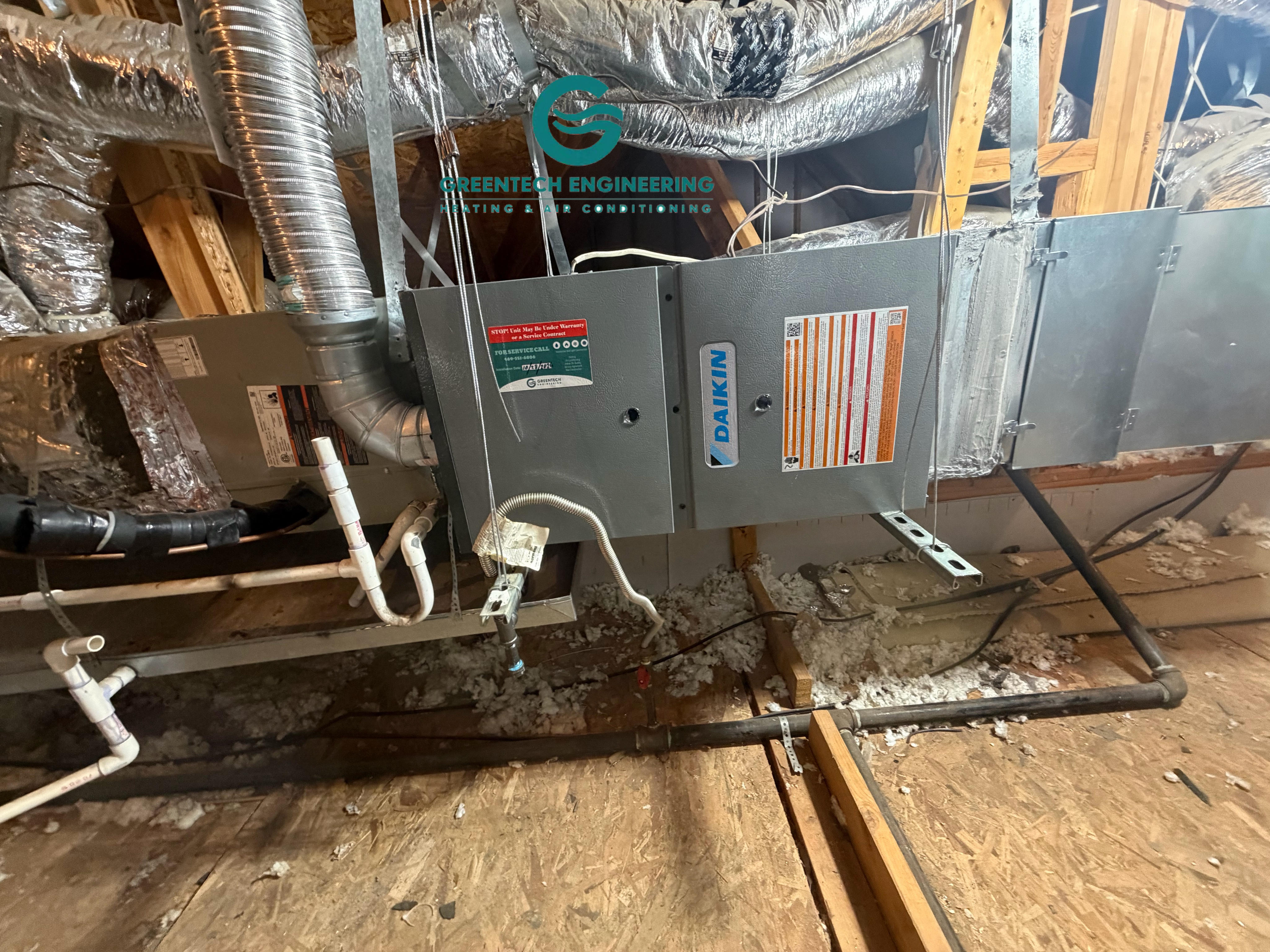
The primary replacement included a Daikin DR80TC0804C-family furnace with:
- 80,000 BTU/h high-fire input;
- 64,000 BTU/h high-fire output;
- 80% AFUE;
- a two-stage gas valve; and
- a variable-speed ECM blower compatible with the communicating system.
The listed 64,000-BTU/h high-fire output is 2,450 BTU/h above the calculated 61,550-BTU/h heating load. That is useful context, but it does not replace review of temperature rise, airflow, staging, controls and manufacturer performance requirements.
Two-stage heat and variable-speed airflow can respond across different operating conditions. They do not independently guarantee lower bills, quieter operation or more even temperatures; those outcomes depend on the complete design, ducts, settings, weather, installation and household use.
What installation work was included?
A certified equipment match can still perform poorly if the supporting installation is incomplete. The written scope for this Allen project included:
- a Daikin FIT variable-speed R-32 straight-cool outdoor unit;
- a horizontal cased coil with EEV;
- a two-stage 80% AFUE gas furnace with variable-speed ECM blower;
- a Daikin One Touch communicating thermostat;
- new supply and return plenums;
- condensate drain work and Safe-T drain protection;
- a new condenser pad;
- refrigerant-line flushing and preparation;
- nitrogen pressure testing;
- evacuation to the quoted target below 500 microns;
- 220V voltage monitoring and surge protection; and
- a complimentary three-year/1,095-day labor warranty, subject to the written terms and exclusions.
Manufacturer warranty coverage is also subject to the applicable written certificate, registration and maintenance requirements, state-specific rules, limitations and exclusions. Homeowners should review the final documents rather than relying on a shortened sales phrase.
Was the $996 Oncor incentive available to every Allen homeowner?
No. The $996 amount was approved for this completed project and should not be treated as a standard rebate, coupon or current public offer.
Oncor’s residential efficiency incentives are administered through approved participating service providers and depend on current rules, equipment, documentation, eligibility and available funding. Oncor pays program incentives to participating providers; the provider determines whether and how an approved amount is passed through to a customer. Because this project’s payment treatment was not confirmed for publication, this article does not call the $996 an invoice discount, homeowner check or reimbursement.
As of this article’s November 6, 2026 verification, Oncor stated that 2026 Home Energy Efficiency Program funding was fully exhausted and directed customers to check back in January 2027 for program updates. Check the official Oncor Home Energy Efficiency Program page when evaluating a new project.
Ask a contractor to state whether an incentive amount is:
- estimated;
- reserved or conditionally approved;
- finally approved;
- applied to the invoice; or
- handled through another documented process.
How is this Allen 75013 case different from Greentech’s Allen 75002 case?
They are different homes and different equipment decisions, so the records should not be combined.
- This Allen 75013 case covers a straight-cool Daikin FIT R-32 A/C paired with a gas furnace. It explains why a 44,216-BTU/h Manual J cooling load supported evaluation of a nominal 4-ton system after an older nominal 3.5-ton system.
- The separate Allen 75002 case covers a Daikin FIT heat-pump project with different models, capacity data and homeowner goals.
Readers researching electrification can review the separate Allen Daikin FIT heat-pump case study. Its specifications and conclusions do not apply to this Allen 75013 straight-cool installation.
What additional work was completed on the second HVAC system?
The project also included a separate furnace-only replacement for the property’s second HVAC system using a Daikin DR80SN0604BX furnace. That model is a 60,000-BTU/h-input, single-stage, 80% AFUE furnace.
This second furnace was not part of AHRI reference 215488609 and should not be combined with the primary system’s Manual J figures, certified capacity or efficiency ratings. The served floor or zone is omitted because it was not confirmed for publication.
What the records confirmed—and what they did not
Confirmed by the supplied project records
- The old Lennox outdoor unit was in the nominal 42,000-BTU/3.5-ton class.
- Manual J documented a 44,216-BTU/h cooling load for the system labeled Downstairs.
- The new outdoor model is in the nominal 48,000-BTU/4-ton class.
- AHRI reference 215488609 rates the listed combination at 45,500 BTU/h, 16.2 SEER2 and 9.0 EER2.
- The selected furnace family provides 64,000 BTU/h high-fire output, compared with a 61,550-BTU/h calculated heating load.
- The project received an approved $996 Oncor incentive.
Not established by this case
- It does not prove every 3.5-ton system should be replaced with 4 tons.
- It does not prove bigger equipment is better or establish complete Manual S compliance.
- It does not document measured before-and-after static pressure, airflow, temperature split, humidity, runtime or energy use.
- It does not guarantee a utility-bill reduction, comfort improvement or payback period.
- It does not mean another Allen or Dallas–Fort Worth homeowner will receive the same incentive.
- It does not make the separate furnace part of the primary AHRI-certified match.
What should Allen homeowners ask before approving an HVAC replacement?
- What project-specific load calculation supports the proposed capacity?
- What exact outdoor unit, coil and furnace or air-handler models are included?
- Is the proposed combination AHRI certified, and what does that certificate verify?
- What do the manufacturer’s performance data show at the project’s design conditions?
- What plenum, duct, drainage, refrigerant-line, electrical and control work is included?
- How will airflow, static pressure, refrigerant charge and system operation be checked at startup?
- Is any incentive estimated, reserved, approved, applied or paid?
- What manufacturer and labor-warranty terms apply?
- Are permit and inspection requirements included when applicable?
Frequently asked questions
Why would an A/C replacement move from 3.5 tons to 4 tons?
Because nominal tonnage alone does not determine the right replacement. The home’s load, the equipment match’s performance, airflow and the duct system should be reviewed together. In this case, Manual J documented a 44,216-BTU/h cooling load and the selected combination is AHRI rated at 45,500 BTU/h under standardized conditions.
What does Manual J tell an Allen homeowner?
Manual J estimates the home’s heating and cooling loads from project-specific inputs and local design conditions. It does not select a product by itself, and the result is only as reliable as the inputs.
What does an AHRI certificate verify?
It verifies standardized capacity and efficiency for the listed combination of outdoor unit, indoor coil and furnace/blower family. It does not certify field workmanship, duct performance or actual comfort.
Is the Daikin FIT DC6VSS a heat pump?
No. The Daikin DC6VSS family used in this project is a variable-speed, side-discharge straight-cool air conditioner. It requires a separate heating source; this project used a gas furnace.
Is 16.2 SEER2 the rating of every Daikin FIT system?
No. Efficiency depends on the exact matched combination. AHRI reference 215488609 lists 16.2 SEER2 and 9.0 EER2 for this project’s combination.
Is the $996 Oncor incentive available now?
No current availability is promised. The $996 was approved for this completed 2026 project. As of November 6, 2026, Oncor reported that 2026 Home Energy Efficiency Program funding was exhausted and advised customers to check back in January 2027.
Does variable speed guarantee lower bills or even temperatures?
No. Results depend on the building load, equipment selection, controls, airflow, ducts, installation, setpoints, weather and household use.
Request an HVAC replacement evaluation in Allen, TX
Greentech Engineering Heating & Air Conditioning helps homeowners in Allen and across Dallas–Fort Worth evaluate A/C replacement options using the home’s load, matched-equipment data, installation scope and current incentive status—not the old nameplate alone.
Schedule an HVAC evaluation or call (469) 551-6806.
Your comfort, our priority.
About the author
Siwei (Lucas) Chen
Chief Technology Officer | Greentech Engineering Heating & Air Conditioning — DFW HVAC
Siwei (Lucas) Chen applies an engineering-based, data-first approach to residential HVAC system design, diagnostics, airflow measurement, equipment selection and duct-system optimization across Dallas–Fort Worth. He holds a B.S. in Mechanical Engineering from Virginia Tech.
Lucas completed ACCA’s Residential Design for Quality Installation Course, which covers residential design procedures associated with ACCA Manuals J, S, T and D. He is also an NCI Certified Residential Air Balancer and NCI Certified Duct System Optimization Specialist.

Flexible Financing Options
Explore our range of flexible financing options designed to suit your needs and budget.