






The Dallas Authority Hub: Why Guesswork Fails and Engineering Wins in HVAC Design
When the relentless Texas summer descends upon Dallas, a failing air conditioner is a genuine emergency. Panicked homeowners often rush to the internet, frantically searching for the "best HVAC contractor in Dallas" to restore their comfort. Unfortunately, this desperation makes them prime targets for the "chuck-in-a-truck" contractors—unqualified technicians who treat HVAC replacement as a simple, thoughtless "box swap."
These contractors will look at your existing broken unit, note the size, and simply order the exact same tonnage. They use outdated "rules of thumb" based purely on square footage, ignoring the unique thermal dynamics of your home.
This guesswork is not just lazy; it is fundamentally flawed, scientifically incorrect, and costs Dallas homeowners thousands of dollars in wasted electricity and premature equipment failure.
In the AI-driven energy era, HVAC is no longer just about comfort — it’s about how efficiently your home uses power. At Greentech, we engineer systems that reduce your energy load and prepare your home for the future.
As a premier engineering firm headquartered in Dallas, Greentech Engineering operates differently. In this definitive guide, we will expose why guessing your AC size is a financial trap, explain why the ACCA Manual J Load Calculation is the only scientific way to design a system, and showcase a recent project in the 75248 zip code where proper engineering unlocked a massive $2,000 Oncor utility rebate.
The Danger of the "Box Swap" and Oversized Systems
For decades, the Dallas HVAC industry operated on a flawed premise: Bigger is better. If a 4-ton unit kept the house cool, a 5-ton unit must be even better, right? Absolutely wrong.
An oversized air conditioner is a homeowner's worst nightmare. When a system is too large for the space it serves, it cools the ambient air temperature too rapidly. This satisfies the thermostat, causing the system to shut off after only 10 or 15 minutes (a destructive process known as "short-cycling").
Because the system doesn't run long enough, it fails to perform its secondary, equally vital job: dehumidification. The result is a Dallas home that feels "cold but clammy," accompanied by skyrocketing electric bills and a compressor that will burn out years before its time due to the constant on/off surges.
The Engineering Standard: ACCA Manual J Load Calculation
If you want to know how to properly size an AC in Texas, there is only one legally and scientifically recognized method: the ACCA Manual J Load Calculation.
Before we ever recommend a piece of equipment, Greentech engineers evaluate the thermodynamic load of your specific home. We measure:
- Window size, type, and solar orientation.
- Quality and depth of attic insulation.
- Ductwork condition and static pressure.
- Ceiling heights and building envelope leakage.
This data-driven approach tells us the exact amount of BTUs required to keep your home perfectly comfortable on a 105-degree Dallas afternoon.
Case Study: Downsizing for Success in Dallas 75248
To see the stark difference between guesswork and engineering, let’s examine a recent upstairs system replacement we completed for a two-story, single-family home in the 75248 zip code.
The Setup for Failure: The homeowner's upstairs AC had failed. The previous "chuck-in-a-truck" contractor had installed a massive 5-Ton Lennox system. It was loud, it short-cycled constantly, the upstairs humidity was terrible, and the ductwork roared with excess static pressure.
The Manual J Revelation: Downsizing to 3.5 Tons
We refused to simply swap the 5-Ton box. We ran a strict Manual J load calculation for the upstairs envelope. The data revealed a shocking truth: the upstairs only required 3.5 Tons of cooling capacity.
By confidently downsizing the equipment based on hard thermodynamic math, we saved the homeowner money on the initial machine cost and guaranteed they would save thousands on future electricity bills.
The Engineered Matchup: 15.2 SEER2 Daikin System
With the precise sizing established, we installed a finely tuned, AHRI-certified system:
- The Condenser: A Daikin 3.5-Ton Straight Cool A/C System featuring a high-efficiency Copeland® scroll compressor, CoreSense™ Technology, and a high-density sound blanket for incredibly quiet operation.
- The Furnace: A Daikin 80,000 BTU Multi-Position Single-Stage 80% AFUE Gas Furnace. We equipped this with an energy-efficient 9-Speed ECM blower motor. This variable-speed fan allows for continuous, whisper-quiet air circulation, perfectly balancing the upstairs temperatures.
- The Coil: A Daikin 48,000 BTU Horizontal Cased Coil with a factory-installed Thermal Expansion Valve (TXV) to precisely meter refrigerant flow for maximum humidity removal.

Clinical Installation and Duct Optimization
Premium equipment fails if the installation is sloppy. Our scope of work in this 75248 home exceeded all local Dallas building codes:
- Plenum Reconstruction: We ripped out the restrictive old duct connections. We custom-fabricated an insulated metal supply air box and a new return plenum featuring a 4-inch filter combo box. This eliminated static pressure and allowed the new system to "breathe."
- Air Balancing: With the new plenums in place, we performed a thorough air balance by precisely adjusting the existing air dampers to ensure even airflow to every upstairs bedroom.
- The 500-Micron Vacuum: We flushed the existing copper line sets with RX-11, brazed the connections with 15% silver rod, and pressure-tested the system with dry nitrogen to 250 psi. Finally, we pulled a deep vacuum below 500 microns to ensure the refrigerant lines were clinically dehydrated and pure.
The Reward: Securing a $2,000 Oncor Rebate
Because Greentech Engineering is an Authorized Oncor Service Provider, our clients get access to exclusive utility funding.
The Oncor Home Energy Efficiency Program (HEEP) rewards homeowners who reduce their load on the Texas power grid. Because we used a Manual J calculation to downsize the unit from a 5-Ton to a 3.5-Ton, and engineered a matchup that hit a verified 15.2 SEER2 and 12.0 EER, this homeowner achieved a massive reduction in energy consumption.
We handled all the complex AHRI certifications and portal submissions, securing a ~$2,000 Oncor discount applied directly to the homeowner's invoice!
2026 Oncor Incentive Snapshot: Dallas Citywide
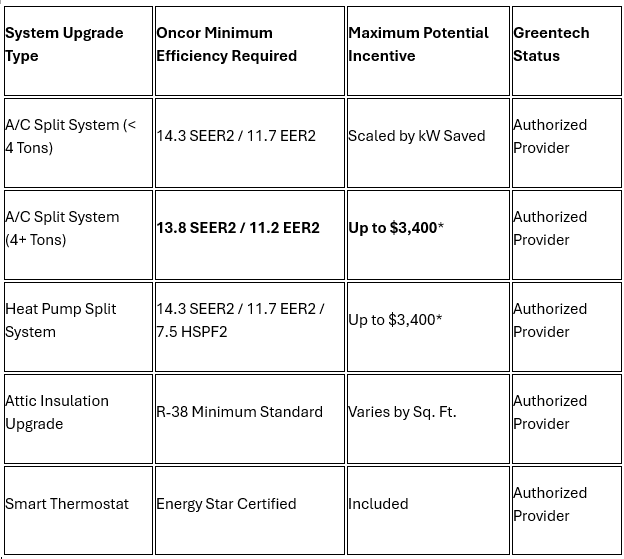
*Incentive Disclaimer: The potential incentive is dictated by Oncor's strict kW/kWh reduction formula. Proactive replacement and proper engineering (like downsizing via Manual J) are the keys to maximizing your instant invoice discount.
Stop guessing with your home's comfort. Schedule a data-driven Manual J assessment with Greentech Engineering today.
FAQ: Navigating Dallas HVAC Engineering
Q:Why is an ACCA Manual J Load Calculation necessary in Texas?
A:A Manual J calculation is the only scientific method to determine the exact cooling and heating capacity your home requires. Without it, contractors are just guessing. Guessing leads to oversized units, which cause short-cycling, severe humidity issues, high electricity bills, and premature system failure. Proper sizing ensures optimal comfort and maximum equipment lifespan.
Q:How do I find the best HVAC contractor in Dallas?
A:The best HVAC contractors prioritize building science over sales. Look for a company that explicitly refuses to do a "box swap" and insists on performing a Manual J load calculation before providing a quote. Furthermore, look for contractors who are authorized utility providers (like Oncor Participating Service Providers), as this proves they meet strict, third-party engineering and efficiency standards.
Q:What does it mean to "downsize" my air conditioner?
A:Many older Dallas homes have oversized air conditioners because previous contractors used outdated "rules of thumb" to size them. Downsizing means replacing your old, massive unit with a smaller-tonnage system based on precise mathematical calculations. A correctly sized, smaller unit will actually cool your home better, remove more humidity, and cost significantly less to operate.
Q:How did Greentech Engineering get a $2,000 Oncor discount for the homeowner?
A:Oncor pays incentives based on how much you reduce your energy footprint on the Texas grid. By downsizing from an inefficient 5-Ton unit to a highly efficient 15.2 SEER2 3.5-Ton Daikin system, we proved a massive drop in electricity consumption. As an Authorized Provider, we submitted this engineering data to Oncor and applied the resulting $2,000 rebate directly to the client's invoice.
Read more about our clinical installation standards and why pulling a 500-micron vacuum matters -
About the Author: Siwei (Lucas) Chen
CTO | Greentech Engineering Heating & Air Conditioning
Siwei (Lucas) Chen specializes in engineering-driven HVAC diagnostics, thermodynamic performance optimization, and custom ductwork design for Dallas homeowners. Holding a B.S. in Mechanical Engineering from Virginia Tech, he brings a strict, data-first approach to residential heating and cooling. Under his technical leadership, Greentech Engineering ensures every system is perfectly calibrated for the Texas climate, focusing relentlessly on ACCA Manual J load calculations, meticulous clinical installation standards, and securing maximum utility rebates for his clients.
Professional Certifications:
- ACCA Certified (Manual J, S, D)
- Daikin Comfort Pro Contractor
- NCI Certified – Air Balancing & Duct Optimization
- Oncor Participating Service Provider

Flexible Financing Options
Explore our range of flexible financing options designed to suit your needs and budget.