






Fort Worth AC Condenser and Coil Replacement With a Retained Furnace
By Siwei (Lucas) Chen, Chief Technology Officer
Published: 8/19/2026
Short answer: Yes, an AC condenser and evaporator coil can sometimes be replaced while the existing gas furnace stays. At a home in Fort Worth, TX 76107, Greentech completed that scope on August 17, 2026. The project installed nominal 2.5-ton Daikin R-32 cooling components, retained the gas furnace, added a 14-inch R-8 return duct and installed a conventional thermostat.
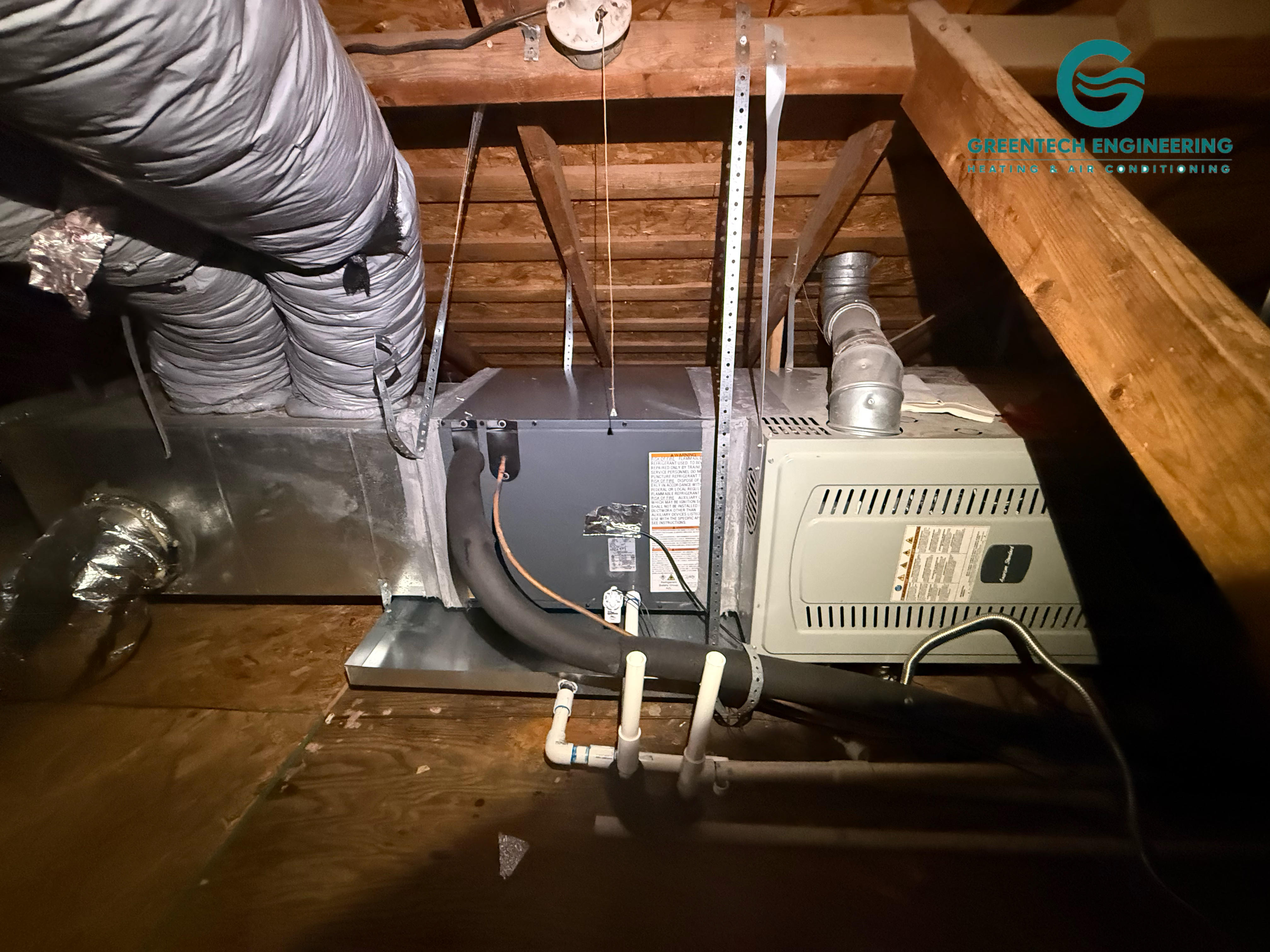
Keeping the furnace did not mean ignoring it. Its cabinet contains the blower that moves air across the indoor coil, so the blower, controls, physical connection and equipment match still mattered to the cooling system.
This was a targeted cooling-side replacement after the existing air conditioner stopped cooling. It was not a furnace replacement, heat-pump conversion or change in nominal tonnage.
Fort Worth project at a glance
- Location: Fort Worth, TX 76107
- Completion date: August 17, 2026
- Reason for replacement: The existing air conditioner was not cooling
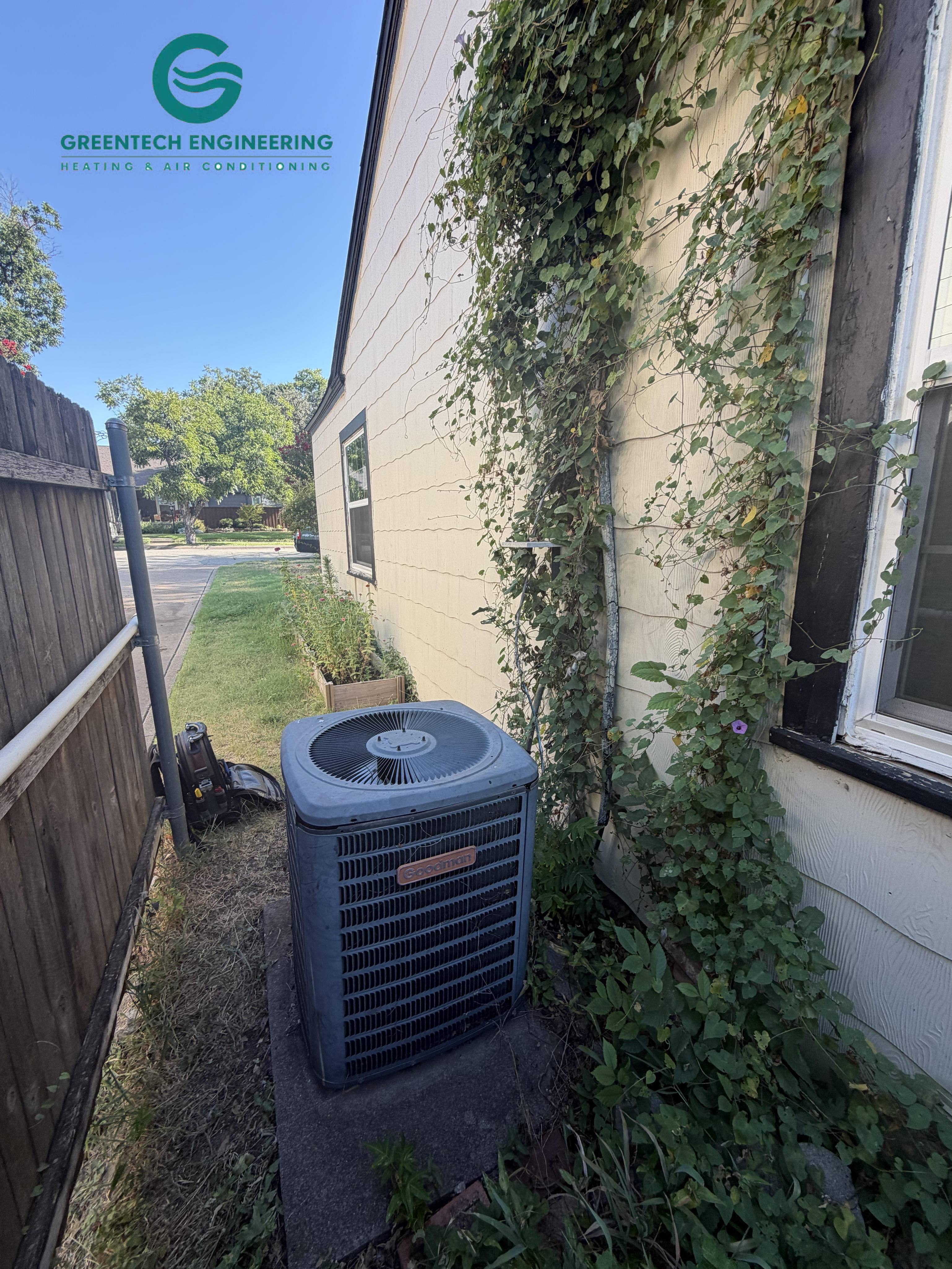
- Removed outdoor unit: Goodman GSC130301EA, labeled R-22, nominal 30,000 BTU/h / 2.5 tons
- Removed indoor coil: Ingersoll Rand/Trane 4TXCB003DS3HCAA, labeled R-410A only
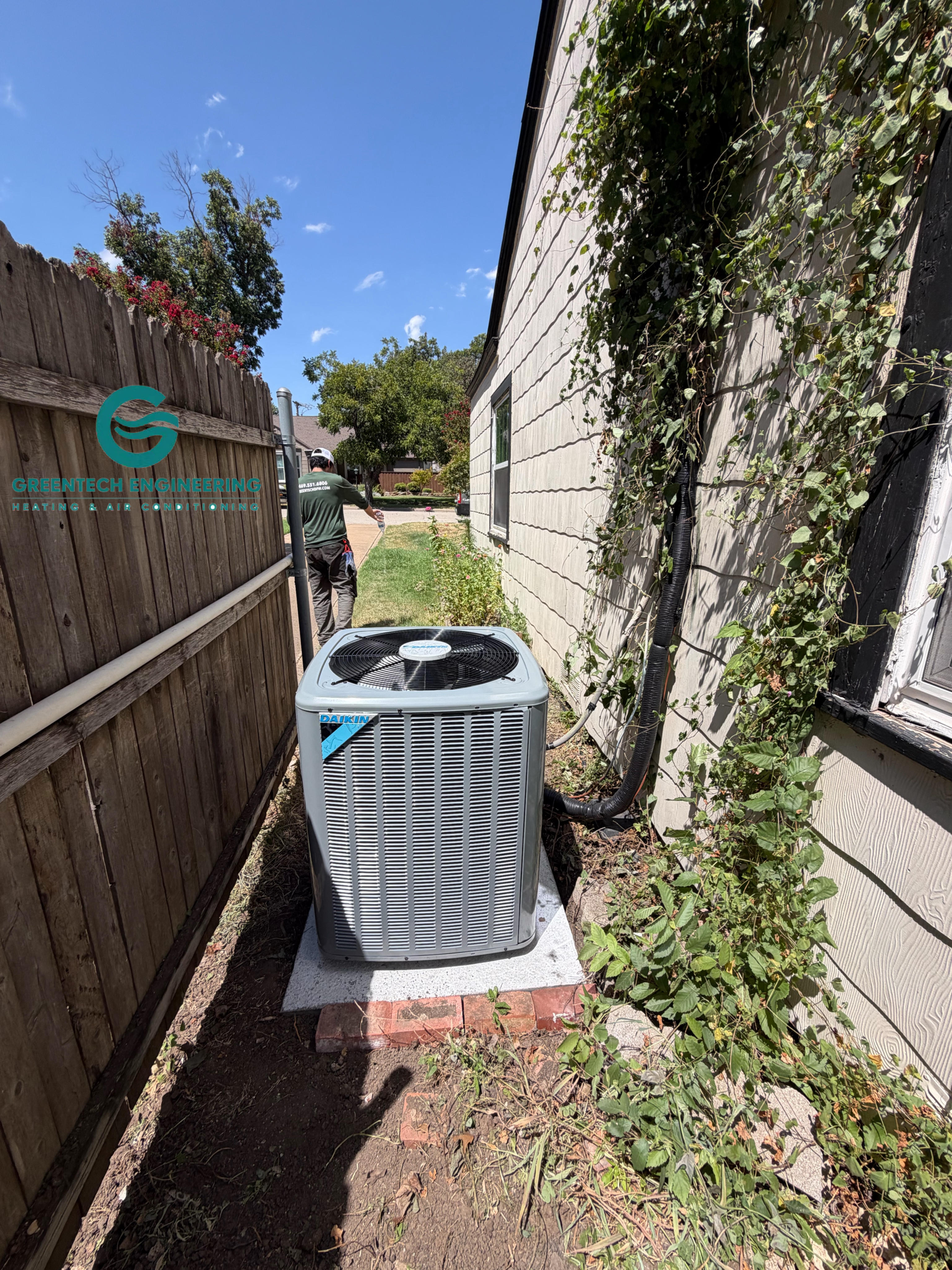
- Installed outdoor unit: Daikin DC4SEA3010AA, nominal 2.5-ton class, R-32
- Installed indoor coil: Daikin CHPTA3026B3AA horizontal cased coil, R-32
- Retained equipment: Existing gas furnace
- Additional work: One 14-inch R-8 insulated flex return duct and a conventional 1-heat/1-cool thermostat
- Permit and inspection: Completed
What was replaced, and what stayed?
What was replaced, and what stayed?
Greentech replaced the outdoor condenser and the indoor evaporator coil—the two main cooling components in this split system. The gas furnace remained.
That distinction matters. The furnace supplies heat in winter, but its blower also circulates air during cooling. When the thermostat calls for air conditioning, household air returns to the furnace, moves across the cold evaporator coil and then travels through the supply ducts.
The completed scope also included a new return-air duct and thermostat. Calling this a “complete HVAC replacement” would therefore be inaccurate: the furnace was not replaced, and the new outdoor unit is a cooling-only air conditioner rather than a heat pump.
Can you replace the condenser and coil without replacing the furnace?
Sometimes. Retaining a furnace can be reasonable when its condition, blower capability, controls and physical configuration are suitable for the proposed cooling equipment. The decision should be based on the complete system, not simply on whether the furnace still produces heat.
A contractor should be able to explain:
- Whether the retained blower can support the cooling airflow the new coil requires
- How the new coil will fit and connect to the furnace and duct system
- Whether the thermostat and low-voltage controls support the new equipment
- Which specific condenser, coil and blower/furnace combination establishes the certified performance
- Whether the return and supply air paths need modification
Because the public case file does not include the complete retained-furnace match and AHRI certificate, we are not listing a project-specific SEER2, EER2, AHRI reference number or certified cooling capacity. A product family’s maximum rating should not be presented as the rating for a particular home.
What did the old equipment labels tell us?
The removed Goodman GSC130301EA condenser was labeled for R-22 and had a nominal capacity of 30,000 BTU/h, or 2.5 tons.
The removed indoor coil was an Ingersoll Rand/Trane 4TXCB003DS3HCAA. Its label said R-410A only and showed a November 2019 manufacture date.
Those labels establish what each component was designed and labeled for. They do not prove which refrigerant was actually in the old system, identify the cause of the no-cooling condition or show that an earlier installation violated a code or manufacturer instruction.
What we can say with confidence is simpler: the old condenser and coil displayed different refrigerant-design labels, while both new cooling components are designed for R-32.
Old and new cooling components
The project retained the existing gas furnace but replaced both main cooling components.
Outdoor condenser
- Previous: Goodman GSC130301EA, labeled for R-22, with a nominal capacity of 30,000 BTU/h or 2.5 tons
- Installed: Daikin DC4SEA3010AA, nominal 2.5-ton class, designed for R-32/A2L
Indoor evaporator coil
- Previous: Ingersoll Rand/Trane 4TXCB003DS3HCAA, labeled R-410A only
- Installed: Daikin CHPTA3026B3AA horizontal cased evaporator coil, designed for R-32/A2L
Furnace, return air and controls
- Gas furnace: The existing furnace was retained
- Return air: One new 14-inch R-8 insulated flex return duct was added
- Thermostat: The existing control was replaced with a conventional 1-heat/1-cool thermostat
The nominal size did not change. “2.5 tons” is an equipment-size category; it is not necessarily the exact certified cooling capacity of a specific matched combination.
Why did the retained furnace and blower still matter?
The outdoor condenser moves heat out of the home, but it does not move room air through the duct system. During cooling, that job belongs to the indoor blower in the retained furnace.
This is why a partial AC replacement still needs an indoor-side review. Blower capability affects airflow across the evaporator coil. Cabinet dimensions affect how the horizontal coil can be connected and supported. The thermostat and low-voltage wiring must also operate the selected functions correctly.
Certified capacity and efficiency belong to defined equipment combinations, not to the outdoor unit by itself. Daikin describes the DC4SE family as an R-32 split-system air conditioner and the CHPTA family as an R-32 horizontal cased coil. Those product-family facts verify the equipment type; they do not create a project-specific rating without the complete match.
Why was a 14-inch return-air duct added?
The completed project included one new 14-inch R-8 insulated flex return-air duct. Return air travels from the home back to the furnace blower and evaporator coil, so the return path remains relevant even when the furnace itself is not being replaced.
Final airflow and total external static-pressure measurements were not included in the publication file, so we are not assigning a CFM increase, static-pressure reduction or measured comfort improvement to the new duct.
The practical takeaway is simple: when a proposal includes return-air work, the contractor should explain what is changing and document the reason for the change. The equipment boxes and the air-distribution system should be evaluated together.
What changed when the project moved to R-32 equipment?
Greentech removed the old condenser and coil and installed components manufactured for the R-32 platform. This was not a matter of adding a different refrigerant to the old equipment.
R-32 is classified as an A2L refrigerant. New A2L equipment must be installed and serviced under the applicable manufacturer instructions, code requirements and refrigerant-handling procedures. Homeowners comparing proposals should ask whether the condenser, coil, controls and installation details are intended for the same refrigerant platform—not simply which refrigerant name is newer.
For a broader explanation, see Greentech’s R-32 refrigerant overview.
What did the documented installation scope include?
The completed work included removal of the old condenser and coil, installation of the Daikin outdoor and indoor cooling components, a new condenser pad, the new return duct and thermostat, and the documented drain, connection and line-set work required for the replacement.
The project documentation also called for a Safe-T drain switch, HVAC-rated sealing, UV-resistant ArmaFlex on the refrigerant line, a refrigerant locking cap, dry-nitrogen pressure testing, system evacuation, startup and operational testing. The permit process and inspection were completed.
The specified pressure-test and evacuation targets are not presented here as final commissioning readings because the completed measurement record was not supplied for publication. That difference is important: the work scope states what the installation requires; the commissioning record states the readings achieved in the field.
What should a homeowner ask before keeping an existing furnace?
If a contractor proposes replacing the condenser and coil while retaining the furnace, ask for six clear answers:
- Which components are being replaced, and which are staying?
- What is the full model of the retained furnace and blower?
- How was the blower’s cooling capability evaluated?
- What is the AHRI reference for the proposed complete combination?
- Do the condenser and coil use the same refrigerant platform?
- Does the return or supply duct system need modification?
The best proposal is not automatically the one that reuses the most equipment or replaces everything. It is the scope that can be supported by the condition, compatibility and documented performance of the complete system.
Homeowners considering Fort Worth AC replacement options can use those questions to compare a partial cooling-side replacement with a full-system proposal.
Request an AC replacement evaluation in Fort Worth
An AC replacement does not always require replacing every HVAC component. Greentech Engineering Heating & Air Conditioning — DFW HVAC evaluates the condenser, evaporator coil, retained furnace and blower, controls and duct system before recommending a project-specific scope.
Schedule an HVAC replacement evaluation or review Greentech’s Fort Worth HVAC services.
CTA button: Schedule an HVAC Replacement Evaluation
Frequently asked questions
Does keeping the furnace mean the furnace can be ignored?
No. The retained furnace contains the blower used during cooling. Its condition, blower capability, controls, cabinet connection and role in the certified equipment combination still need to be evaluated.
Did this project change the nominal tonnage?
No. Both the previous and new outdoor units are in the nominal 2.5-ton class. Nominal tonnage is an equipment-size category, not necessarily the exact certified capacity of a particular combination.
Did the different old refrigerant labels cause the cooling failure?
The records do not establish that. The old condenser was labeled for R-22 and the old coil was labeled R-410A only, but the labels alone do not identify the refrigerant that was in the system or prove why it stopped cooling.
What is the SEER2 rating for this installation?
No project-specific SEER2 is published without the complete retained-furnace equipment match and AHRI certificate. A manufacturer’s product-family maximum should not be used as the certified rating for this home.
Was the Fort Worth project permitted and inspected?
Yes. The permit process and inspection were completed. The permit number and formal inspection record are not published in this case study.
What labor-warranty term applies to this project?
The written Greentech labor warranty for this project states 4,380 calendar days from the service date. It is non-transferable, becomes void if the property changes ownership and remains subject to the complete written coverage, exclusions and claim terms. Manufacturer coverage is separate.
About the Author
Siwei (Lucas) Chen
Chief Technology Officer | Greentech Engineering Heating & Air Conditioning — DFW HVAC
Siwei (Lucas) Chen focuses on engineering-driven HVAC diagnostics, system performance and residential airflow. He holds a B.S. in Mechanical Engineering from Virginia Tech. His verified training and credentials include the ACCA Residential Design for Quality Installation Course, NCI Certified Duct System Optimization Specialist and NCI Certified Residential Air Balancer.

Flexible Financing Options
Explore our range of flexible financing options designed to suit your needs and budget.