






Dallas Dual-Fuel Heat Pump Replacement: A Daikin Case Study
By Siwei (Lucas) Chen
Can you replace an AC with a heat pump and still use gas heat? Yes. A compatible dual-fuel HVAC system combines an electric heat pump with a gas furnace. The heat pump provides cooling and electric heating, while the controls select furnace heating when appropriate. Equipment matching, home heating and cooling loads, ductwork and control setup determine the suitable configuration.
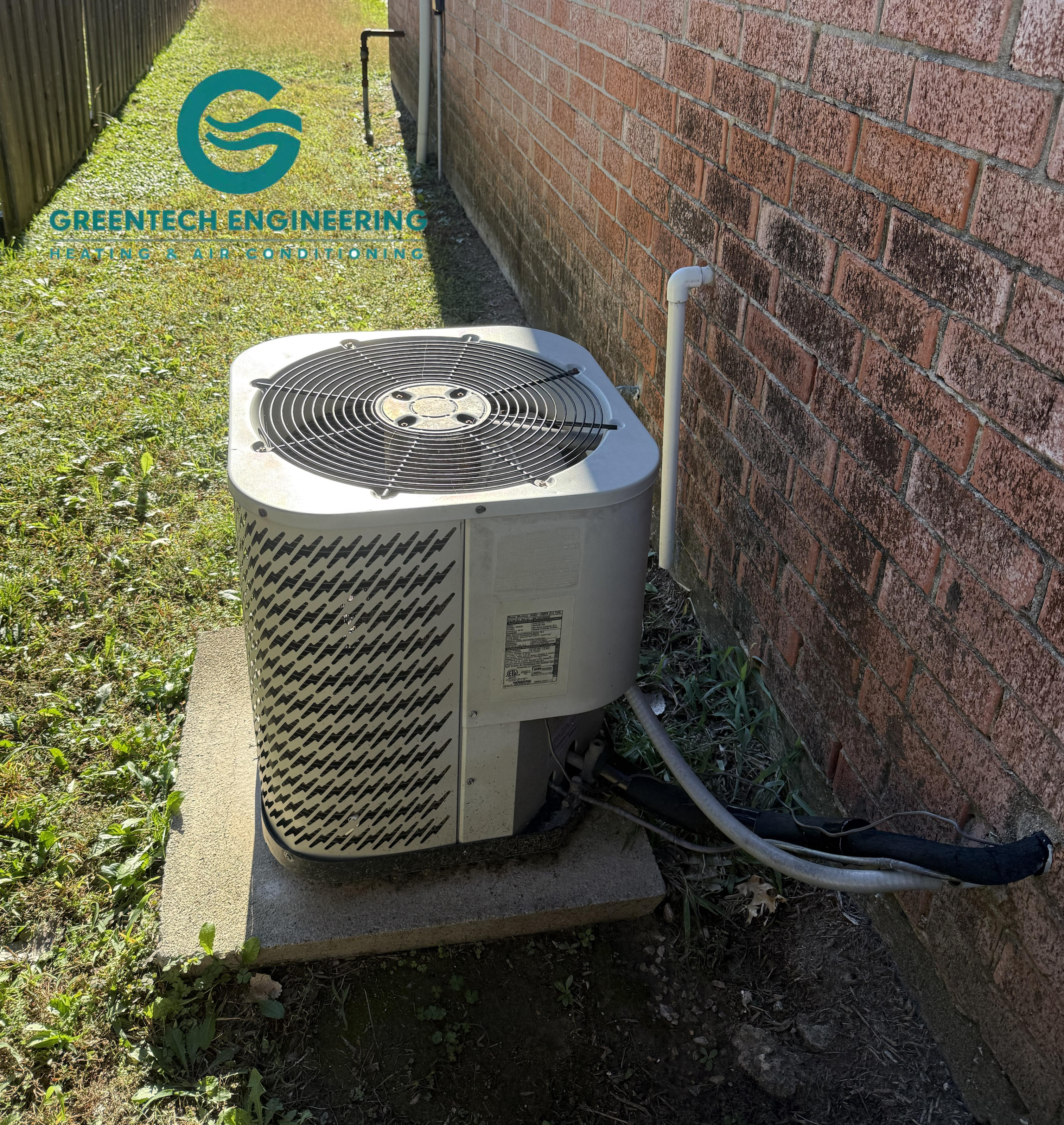
At this two-story home in Dallas, TX 75205, Greentech Engineering Heating & Air Conditioning — DFW HVAC installed a nominal 3-ton variable-speed Daikin heat pump, a new indoor coil and a new gas furnace on November 4, 2026.
This project received a $624 Oncor incentive from unused funds in Greentech’s 2026 Oncor allocation. As of November 20, 2026, Greentech confirms that it still has a limited remaining allocation available for qualifying projects. This is a current incentive opportunity through Greentech—not Oncor’s final program-wide payment or a guaranteed $624 for every homeowner.
The homeowner found Greentech through Oncor’s website. The existing central AC and gas furnace were more than 13 years old, and the replacement scope included more than indoor and outdoor equipment: supply and return plenums, an additional insulated duct run, media filtration and communicating controls were also part of the job.

Project at a glance
- Location: Dallas, Texas 75205
- Home: Two-story single-family property
- Previous equipment: Central air conditioner and gas furnace, more than 13 years old
- Replacement: Nominal 3-ton variable-speed Daikin heat pump with a new coil and gas furnace
- Heating configuration: Electric heat-pump heating or gas-furnace heating
- Additional scope: Supply and return plenums, an R-8 insulated duct run, filtration, controls, drainage work and electrical accessories
- Installation completed: November 4, 2026
- Project incentive: $624 from Greentech’s unused 2026 Oncor allocation. Greentech confirms a remaining balance is currently available as of November 20, 2026; other projects require individual eligibility, funding and approval checks.
- Labor coverage: Greentech’s three-year labor warranty, subject to its written agreement
What changed from AC and gas heat to dual fuel?
The old outdoor air conditioner provided cooling; the old furnace provided heat. The new heat pump can provide both cooling and electric heating, while the new gas furnace gives the system another heating source.
This is not an all-electric conversion, and the old furnace was not simply retained. Both the outdoor equipment and the gas furnace were replaced.
ENERGY STAR describes dual fuel as a way to use heat-pump or furnace heating. Which source operates depends on the equipment and control strategy. For homeowners in Dallas–Fort Worth, the decision is worth comparing with conventional AC and gas heat when replacement time arrives, rather than assuming either configuration is always better.
If your current AC is nearing replacement, start with Greentech’s Dallas AC replacement evaluation to compare the equipment and supporting work your home needs.
Variable speed and dual fuel describe different things
The Daikin heat pump uses a variable-speed compressor, which can adjust its output within its operating range. The replacement scope also included a two-stage gas furnace, a variable-speed indoor blower and a Daikin communicating thermostat.
These features have different jobs:
- Compressor speed describes how the outdoor heat pump adjusts its operation.
- Blower speed describes the indoor fan that moves air through the home’s ducts.
- Two-stage gas heat describes the furnace’s heating operation.
- Dual fuel describes the choice between electric heat-pump heating and gas-furnace heating.
The thermostat and equipment controls coordinate those functions. There is no single changeover temperature that should be assumed for every Dallas home. Equipment performance, the home’s heating needs and the intended operating strategy all matter.
Variable-speed capability alone also does not establish lower bills or more even temperatures. Airflow, ducts, settings, installation and household use affect the result.
What does the project's AHRI certificate show?
Greentech identifies the supplied AHRI certificate as the rating reference for this Dallas project. The certificate lists:
- 16.6 SEER2 for seasonal cooling efficiency.
- 9.0 EER2 for cooling efficiency at the specified rating conditions.
- 8.5 HSPF2, Region IV for seasonal heat-pump heating efficiency.
These are standardized ratings for the equipment combination listed on the certificate, not measurements taken in this home or a promise of utility-bill savings. AHRI explains that split-system certification applies to the matched equipment combination, rather than the outdoor unit alone. A certificate rating also does not replace a home load calculation or startup testing.
Duct connections and filtration were part of the replacement
The project included new supply and return plenums—the connection boxes between the indoor equipment and the home’s ducts. It also included a new R-8 insulated flex duct run with its associated connection and boot.
These details help distinguish an itemized installation scope from an outdoor-unit price. Homeowners comparing proposals should be able to see which connections will be rebuilt, which ducts will remain, and where additional duct work is included. An R-8 insulation rating describes the duct insulation; it does not establish measured airflow or a whole-home duct redesign.
A Clean Comfort media air cleaner with a MERV 11 filter was also included. The filter cabinet and duct system need to work with the equipment’s airflow requirements. The filter rating is not a claim of medical-grade air treatment.
Drainage, electrical accessories and startup scope
The written scope included condensate drain work, a drain safety switch, drain-line insulation, equipment support and an outdoor equipment pad. Refrigerant-line preparation, leak testing, evacuation and operational testing were included as installation tasks.
Electrical work included a voltage monitor, surge protection, and replacement of the outdoor disconnect with its whip and wiring. Those accessories provide protective functions; they are not a guarantee against every electrical event.
The project also included assistance with equipment registration and inspection coordination. The scope of that assistance is distinct from a completed registration or a passed inspection.
Oncor incentives through Greentech’s remaining 2026 allocation
The $624 incentive for this Dallas installation came from the unused portion of the 2026 incentive funds Oncor allocated to Greentech. It was not the last incentive payment across Oncor’s entire program.
Current availability, confirmed by Greentech on November 20, 2026: Greentech still has a limited balance in that allocation and can evaluate qualifying HVAC replacement projects for incentives while funds remain available. Eligibility, incentive amounts and approval depend on the project and applicable Oncor requirements; $624 is this case’s amount, not a fixed rebate offered to every customer.
Oncor’s program FAQ explains that incentives are paid to participating service providers, not directly to homeowners. The project amount does not, by itself, establish that Oncor sent the homeowner a check or that the full amount was deducted from the invoice.
As of November 20, 2026, Oncor’s heating and cooling page states that public 2026 Home Energy Efficiency and Low-Income Weatherization funding is exhausted and directs visitors to January 2027 updates. Greentech’s current availability statement refers specifically to its own remaining Oncor-allocated funds—not a program-wide reopening or a claim about other contractors’ balances.
Finding a contractor through Oncor’s website is not an Oncor endorsement. For a new proposal, confirm eligibility, available funding and how any incentive would be reflected in the written agreement.
What homeowners should ask before choosing dual fuel
The useful comparison is the complete heating-and-cooling configuration, not just the outdoor cabinet or a product-family efficiency headline.
Ask the contractor:
- What heating and cooling load assessment supports the proposed equipment class? Ask how a Manual J calculation informs equipment selection rather than assuming the old tonnage is correct.
- Which outdoor unit, indoor coil and furnace are included, and which AHRI rating applies to that exact combination?
- How will the controls select heat-pump heating or furnace heating?
- What duct, filtration, drainage and electrical work is included?
- What startup measurements will be recorded?
- Is an incentive estimated, approved or received, and how does it affect the price?
- What does the written labor warranty cover and exclude?
The Building America Solution Center distinguishes matching the equipment combination from assessing the home’s loads and selecting equipment for those conditions. Nominal tonnage identifies an equipment class; it does not prove what a particular home needs.
This article documents the installed configuration and supporting scope. It does not report a completed Manual J calculation for this home, a measured reduction in energy bills, or before-and-after airflow results.
For a broader comparison, read Should You Get a Heat Pump in Dallas–Fort Worth?. That guide compares all-electric, dual-fuel and AC-with-gas-furnace options; this case shows one homeowner’s replacement configuration.
Greentech’s three-year labor warranty
This project includes Greentech’s complimentary three-year labor warranty, subject to the coverage and exclusions in its written agreement. It is labor coverage, not a blanket promise that every future service expense is included.
Frequently asked questions
Is a dual-fuel heat pump worth considering in Dallas?
It is worth comparing when an older AC needs replacement and the homeowner wants to continue using gas heat. The decision depends on the home's loads, equipment match, ducts, controls, installation cost and electricity-versus-gas operating costs. This Dallas case is an example, not proof that dual fuel is best for every home.
Does a dual-fuel heat pump eliminate gas heating?
No. Dual fuel combines electric heat-pump heating with a gas furnace. This Dallas project included a new furnace alongside the new heat pump and indoor coil.
Is dual fuel the same as a two-stage furnace?
No. Dual fuel describes two heating energy sources. Two-stage describes the furnace’s gas-heating operation. The replacement scope in this case included both.
Can another Dallas homeowner receive the same $624 incentive?
Possibly, but $624 is not a fixed amount for every home. Greentech confirms that remaining funds in its 2026 Oncor allocation are currently available as of November 20, 2026. A new project’s eligibility and incentive amount depend on applicable program rules, the available allocation balance and approval. Ask Greentech to check your project before relying on an incentive in your budget.
Will heat-pump heating always cost less than gas heat?
Not necessarily. Operating cost depends on electricity and gas rates, outdoor conditions, equipment efficiency and control settings. A comparison using the home’s conditions is more useful than a universal savings claim.
Is a 3-ton heat pump the right size for every two-story Dallas home?
No. Nominal tonnage and the number of stories do not establish a home's heating or cooling loads. A load calculation and equipment-selection review are needed for the individual home; this project's equipment class is not a sizing recommendation for another property.
Discuss a dual-fuel replacement for your Dallas home
Planning a replacement? Review Greentech’s heat pump replacement services in Dallas, then request a comparison of conventional AC with gas heat and a dual-fuel configuration. Ask for a written scope covering equipment, duct connections, controls and startup documentation.
You can also ask whether your project qualifies for an incentive through Greentech’s remaining 2026 Oncor allocation. Availability must be confirmed for your proposal.
Request an HVAC evaluation or call (469) 551-6806.
Your comfort, our priority.
About the author
Siwei (Lucas) Chen
Chief Technology Officer | Greentech Engineering Heating & Air Conditioning — DFW HVAC
Siwei (Lucas) Chen applies an engineering-based, data-first approach to residential HVAC system design, diagnostics, airflow measurement, equipment selection and duct-system optimization across Dallas–Fort Worth. He holds a B.S. in Mechanical Engineering from Virginia Tech.
Lucas completed ACCA’s Residential Design for Quality Installation Course, which covers residential design procedures associated with ACCA Manuals J, S, T and D. He is also an NCI Certified Residential Air Balancer and NCI Certified Duct System Optimization Specialist.

Flexible Financing Options
Explore our range of flexible financing options designed to suit your needs and budget.