




The First Chilly October Morning: Recognizing Latent Heating Failures
When searching for home maintenance tips and troubleshooting for a heater that constantly cycles on and off, the direct answer is that superficial fixes like changing a filter will not solve the root cause. Short-cycling and cold spots are typically driven by severe sizing and airflow imbalances, requiring a thermodynamic engineering diagnostic rather than a simple wipe-and-go tune-up. That strange clicking from the hallway thermostat, followed by a brief blast of tepid air that shuts down before the living room even gets warm, is a classic sign of a deeper thermodynamic flaw. In our years of diagnosing heating failures in Carrollton, homeowners often assume they just need a quick filter change to fix these cold spots. However, our team typically sees that these symptoms point to significant duct restrictions that a basic tune-up cannot fix.
The transition into cooler weather forces a decision: you can settle for a superficial visual inspection that merely masks the symptom, or you can opt for a root-cause engineering diagnostic that measures exactly how your home loses and gains heat. Identifying these underlying issues not only restores your comfort but also paves the way for substantial utility incentives if a high-efficiency replacement becomes necessary. For homeowners looking to solve these thermodynamic issues permanently, exploring energy rebate consulting is the first critical step toward a science-based solution.
Why the Mid-Fall Heating Startup Exposes Hidden System Flaws
In the Dallas-Fort Worth area, the extreme summer heat places an immense burden on the electrical grid and forces cooling systems to run almost continuously. Because the air conditioner operates for hours on end to combat triple-digit temperatures, poor duct design and uneven airflow often go unnoticed. The sheer volume of cold air being pushed through the house eventually cools the space, effectively masking underlying restrictions in your ductwork.
When the mid-fall heating startup occurs, the thermal dynamics of your home change completely. A pattern we see often in Carrollton tract homes is that the lower thermal load of an October evening requires a different thermodynamic response than a sweltering August afternoon. Heating a home requires precise airflow to distribute warmth evenly before the thermostat registers that the target temperature has been reached. If your system is improperly sized, these airflow imbalances become immediately noticeable. One room may feel like a sauna while the bedroom remains freezing.
Furthermore, short-cycling—where the heater turns on and off rapidly—is rarely a minor electrical glitch. It is a glaring indicator that the equipment is improperly sized for the home's specific heat loss. An oversized furnace satisfies the thermostat located in the hallway far too quickly, shutting down the cycle before the warm air can reach the furthest corners of the house. This constant starting and stopping accelerates wear on internal components and spikes energy consumption, requiring a true engineering approach to measure and correct the discrepancies.
Superficial Tune-Ups vs. Engineering Diagnostics
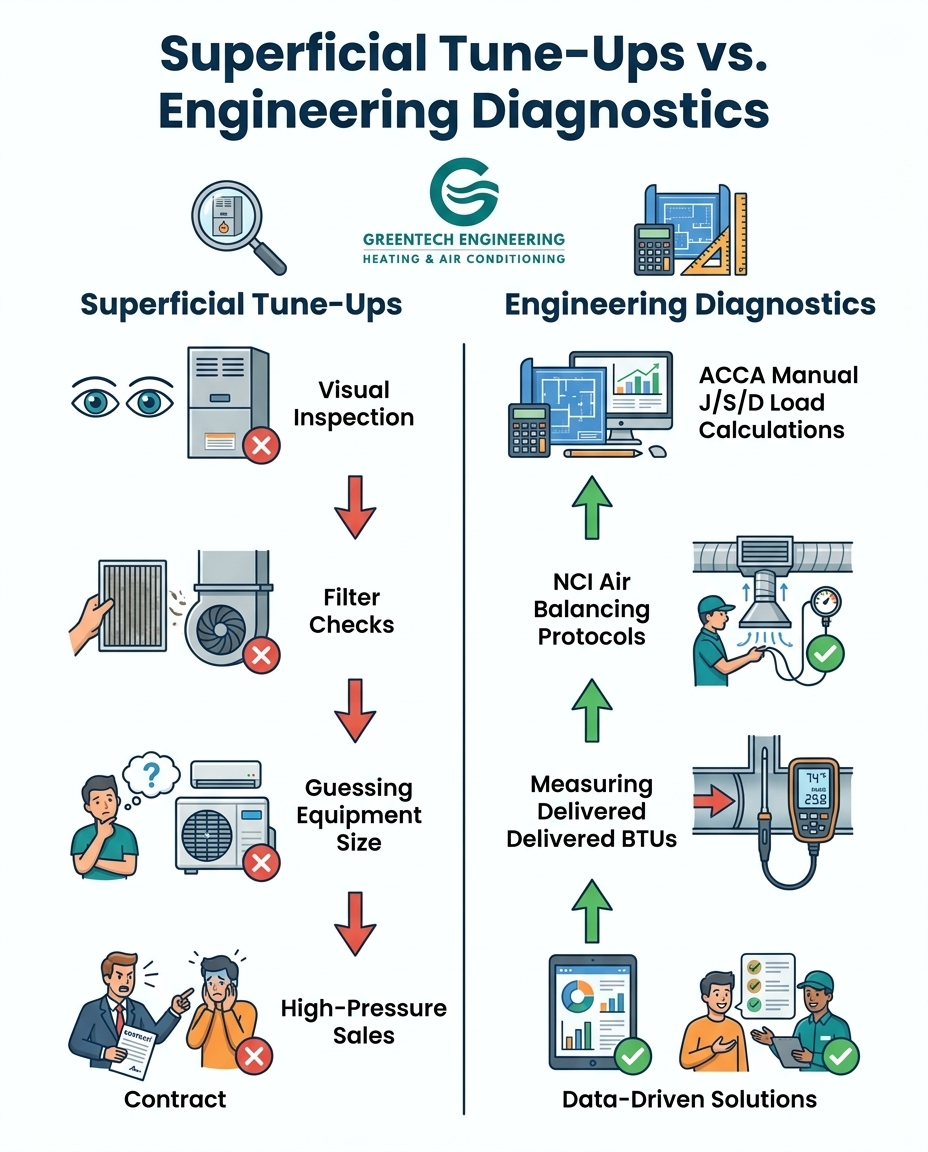
There is a vast difference between a standard fall maintenance visit and a comprehensive thermodynamic evaluation. Many seasonal tune-ups consist of a technician changing the filter, wiping down the cabinet, and checking for obvious safety hazards. While basic maintenance is necessary, it does nothing to address the structural airflow and sizing issues that cause uneven heating.
At Greentech Engineering Heating & Air Conditioning, our core philosophy is "Engineers, Not Salesmen." We focus on data, science, and measurable results rather than pushing unnecessary box replacements. This methodology is driven by our founder and CTO, Siwei (Lucas) Chen, who applies his B.S. in Mechanical Engineering from Virginia Tech to every diagnostic protocol we develop. Instead of guessing why a system is failing, our engineering team relies on ACCA Manual J, S, and D calculations to determine the exact heating and cooling loads of your specific home.
The Role of ACCA Manual J in Preventing Short-Cycling
ACCA Manual J is the industry-standard scientific calculation used to determine a home's exact heat loss during the winter and heat gain during the summer. It factors in square footage, insulation levels, window quality, and directional orientation.
1. Data Collection: We measure the thermal envelope of the house, recording insulation R-values and window solar heat gain coefficients.
2. Load Calculation: The data is processed to determine the exact number of BTUs required to heat the home on the coldest expected day in Carrollton.
3. Equipment Selection (Manual S): We use the Manual J data to select equipment that matches the load perfectly, preventing the installation of oversized units.
Oversized heaters satisfy the thermostat too quickly, shutting off before they can evenly distribute warm air. In our engineering experience diagnosing heating failures across the DFW metroplex, improper sizing is the leading cause of premature system wear and severe short-cycling.
Tracing Uneven Heating to Airflow and Duct Design
If you have specific rooms in your house that refuse to warm up during the winter, the problem rarely lies entirely with the furnace itself. Equipment size is only half the thermodynamic equation; the ductwork must be capable of delivering the right amount of conditioned air to every single register. This is where ACCA Manual D comes into play, governing the scientific design and sizing of residential duct systems.
When our technicians arrive at a Carrollton home with a freezing master bedroom, we utilize NCI Air Balancing & Duct Optimization protocols to solve these hot and cold spots. This is a scientific method for measuring the actual delivered BTUs at the register, rather than just assuming the system is working based on the manufacturer's rating. By using specialized tools like flow hoods and digital manometers, we can measure the static pressure inside your ductwork. High static pressure indicates a restriction—much like a kink in a garden hose—which forces the blower motor to work harder while delivering less air.
Diagnosing these airflow restrictions prevents homeowners from paying for brand-new heating equipment when the ductwork is the actual bottleneck. A pattern we see often is a restrictive return duct choking the system of air; in these cases, installing a larger furnace will only exacerbate the short-cycling problem. By measuring the delivered BTUs, Greentech Engineering Heating & Air Conditioning can pinpoint exactly where the airflow is failing and implement targeted duct modifications to restore balanced comfort across the entire house.
When Diagnostics Point to System Replacement: The Path to High Efficiency
Sometimes, the data reveals hard truths. A thorough ACCA Manual J/S/D calculation may show that the existing heating system is fundamentally flawed, severely oversized, or beyond thermodynamic repair. When a cracked heat exchanger or a failing blower motor is combined with a unit that was improperly sized from the day it was built, continuing to pour money into repairs becomes mathematically unsound.
When replacement is the only scientifically viable option, upgrading to high-efficiency equipment provides precise climate control and significantly reduced energy consumption. Modern systems, such as a 15.2 SEER2 heat pump, utilize variable-speed technology to adjust their output dynamically. Instead of blasting at full capacity and shutting off, these systems run continuously at lower speeds, maintaining a perfectly even temperature while using a fraction of the electricity.
As a Daikin Comfort Pro Contractor, Greentech Engineering Heating & Air Conditioning ensures top-tier equipment selection backed by rigorous installation standards. We engineer the replacement to match your home's exact thermal load. Furthermore, our team has extensive expertise in securing the 2026 Oncor Energy Rebate for qualifying installations, making the transition to advanced thermodynamic comfort much more accessible. If another contractor has quoted you an exorbitant replacement cost, we highly recommend utilizing our Free 2nd Opinion service. If your current unit is failing, exploring air conditioning upgrades alongside your heating replacement can modernize your entire home comfort strategy.
Understanding Oncor Rebates for HVAC Upgrades
Utility companies face a massive challenge in managing the Texas electrical grid, especially during periods of extreme weather. To reduce peak load and prevent grid instability, incentive programs are established to encourage homeowners to adopt highly efficient appliances. Oncor rebates are designed specifically to offset the initial investment of upgrading to a scientifically sized, energy-efficient HVAC system.
These programs typically target equipment that meets stringent high-efficiency standards, such as systems achieving a 15.2 SEER2 rating or higher. By replacing an aging, inefficient unit with a modern heat pump or high-efficiency furnace, you directly reduce the amount of electricity required to heat and cool your home. The utility company rewards this reduction in grid strain through financial incentives.
• Standard Builder-Grade — Typical Efficiency Standard: 13.4 - 14.3 SEER2 — Grid Impact: High peak load draw — Incentive Potential: Generally does not qualify
• High-Efficiency Heat Pump — Typical Efficiency Standard: 15.2+ SEER2 — Grid Impact: Low, steady power draw — Incentive Potential: High eligibility for incentives
• Variable-Speed Systems — Typical Efficiency Standard: 18.0+ SEER2 — Grid Impact: Minimal grid strain — Incentive Potential: Premium incentive categories
It is important to remember that utility incentives frequently update their requirements, funding pools, and technical standards. Working with an engineering-focused contractor ensures you have the latest data on program availability. You can learn more about the current landscape of Dallas-Fort Worth Oncor HVAC incentives to understand how these programs structure their efficiency requirements.
Navigating the Complex Eligibility Requirements for Utility Incentives
Securing utility incentives is not as simple as purchasing a high-efficiency box and plugging it in. Utility programs require strict adherence to proper installation metrics, thermodynamic calculations, and efficiency standards to qualify. A high-efficiency unit installed on restrictive, poorly designed ductwork will not perform at its rated efficiency, and utility administrators know this.
Improper sizing or poor duct design can completely disqualify a new system from receiving incentives. The installation must be commissioned correctly, meaning the static pressure, refrigerant charge, and airflow must all be measured and documented to prove the system operates as designed.
Here is how our engineering team at Greentech Engineering Heating & Air Conditioning manages the complex rebate consulting process:
1. Pre-Installation Load Calculations: We perform ACCA Manual J and S calculations to prove to the utility that the selected equipment is correctly sized for the home.
2. Ductwork Evaluation: We ensure the existing duct system can handle the required airflow, proposing modifications if the static pressure is too high.
3. Performance Commissioning: After installation, we measure the delivered BTUs and system performance, documenting the data required for incentive applications.
4. Documentation and Submission: We guide homeowners through the paperwork, ensuring all technical requirements are met without the guesswork.
An engineering-led installation maximizes your system's lifespan and ensures total compliance with rebate standards. To start this process, review our Oncor HVAC incentive services and discover how a data-driven approach protects your investment.
The Value of a Science-Based Second Opinion
Facing a major repair or a complete system replacement decision is stressful, especially when a technician condemns your heating system during a routine fall tune-up. The anxiety of potentially losing heat right before winter often leads homeowners to make rushed decisions under pressure. However, before committing to a massive expense, it is crucial to verify if the issue is a simple airflow restriction or a catastrophic mechanical failure.
We strongly advocate for getting a Free 2nd Opinion from Greentech Engineering Heating & Air Conditioning. A true second opinion should rely on thermodynamic data, static pressure readings, and load calculations—not sales quotas. Our "No Shady Biz" core motto means we provide transparent, data-driven assessments. If a competing contractor tells you that you need a new furnace because it is short-cycling, our engineers will test your ductwork to see if the real culprit is a crushed return duct or an oversized unit.
Maintaining your system's health proactively is the best way to avoid these high-pressure scenarios. By joining our complimentary Express Comfort Club membership, you receive year-round scientific oversight of your HVAC equipment. Regular, data-driven evaluations ensure that minor airflow issues are corrected long before they cascade into total system failures during a cold snap.
Take a Science-Based Approach to Your Home Comfort
Uneven heating, cold spots, and short-cycling are not mysteries; they are thermodynamic problems requiring strict engineering solutions. As the temperatures drop, looking beyond superficial tune-ups and investing in proper ACCA Manual J/S/D diagnostics is the only way to ensure your home remains comfortable and efficient. Guesswork and visual inspections simply cannot solve fundamental airflow restrictions.
If your system is struggling this fall, we encourage you to explore professional rebate consulting to make high-efficiency upgrades more accessible. With our Wisetack financing options and engineering-led installation protocols, upgrading your home comfort has never been more transparent. Reach out to Greentech Engineering Heating & Air Conditioning today to navigate utility incentives with a true engineering partner.
Frequently Asked Questions
Why is my heating system short-cycling?
Short-cycling occurs when a heating system turns on and off too rapidly without completing a full heating cycle. The most common cause is an oversized furnace that satisfies the thermostat before warm air can reach the rest of the house. Other causes include severely restricted airflow from dirty filters or poorly designed ductwork that triggers the system's internal safety limits. An engineering diagnostic can pinpoint the exact cause by measuring static pressure and thermal load.
How do you fix uneven heating in a house?
Fixing uneven heating requires measuring the actual airflow delivered to each room using NCI Air Balancing protocols. Once the delivered BTUs are measured, technicians can identify restrictions in the ductwork, such as crushed flex ducts or inadequate return air pathways. Solutions range from adjusting dampers and sealing duct leaks to modifying the duct design (ACCA Manual D) to ensure balanced static pressure throughout the system.
What does an HVAC tune-up include?
A standard HVAC tune-up typically includes replacing the air filter, cleaning the cabinet, inspecting electrical connections, and checking for basic safety hazards like gas leaks. However, a comprehensive engineering diagnostic goes further by measuring static pressure, evaluating the heat exchanger's integrity, and verifying that the system is moving the correct amount of air. This deeper level of maintenance ensures the system operates at its rated thermodynamic efficiency.
How do I qualify for Oncor rebates?
Qualifying for utility incentives generally requires installing high-efficiency equipment, such as a 15.2 SEER2 heat pump, through an approved contractor. The installation must meet strict performance metrics, meaning the system must be properly sized using ACCA Manual J and S calculations, and commissioned to ensure optimal airflow. Because program requirements frequently change, working with a contractor who provides dedicated rebate consulting is the best way to navigate the eligibility rules.
Can an oversized HVAC system cause uneven heating?
Yes, an oversized HVAC system is a primary cause of uneven heating. Because the unit produces too much heat too quickly, the area immediately surrounding the thermostat warms up rapidly, causing the system to shut down prematurely. This leaves rooms located further away from the thermostat cold and uncomfortable, while simultaneously causing the equipment to suffer excessive wear from constant starting and stopping.

Flexible Financing Options
Explore our range of flexible financing options designed to suit your needs and budget.