






The Hidden Threat to Your Comfort During the First Dallas Freeze
Understanding the fall reversing valve test: preparing your Daikin heat pump for the first Dallas cold snap is the most critical mechanical step you can take before autumn temperatures plummet. A heat pump's reversing valve can easily become stuck after months of continuous summer cooling, causing it to blow cold air when you finally turn on the heat. After running flawlessly all summer, the internal mechanisms of your system harbor a hidden mechanical risk that only reveals itself when the weather changes abruptly.
In the Dallas-Fort Worth area, fall doesn't arrive gradually. We experience sudden, steep temperature drops after months of intense, unrelenting heat. This creates a critical September transition window. Action must be taken during this brief period to ensure your system can physically make the switch from cooling to heating. At Greentech Engineering Heating & Air Conditioning, we approach this transition not with a quick visual check, but with precise, engineering-driven testing to guarantee your home remains comfortable when the first freeze hits.
Explore our solutions: Learn more about our comprehensive Heating Services and secure your system's reliability through our Express Comfort Club Maintenance Plan.
The Thermodynamics of the 4-Way Reversing Valve
To understand why this specific component is so vulnerable, you have to look at the physics of how a heat pump operates. The reversing valve is a heavy-duty, 4-way electromagnetically controlled component that physically redirects the flow of high-pressure refrigerant gas. This single brass valve is the defining feature that separates a heat pump from a standard air conditioner, allowing the system to switch seamlessly between heating and cooling your home.
The Anatomy of the Shift
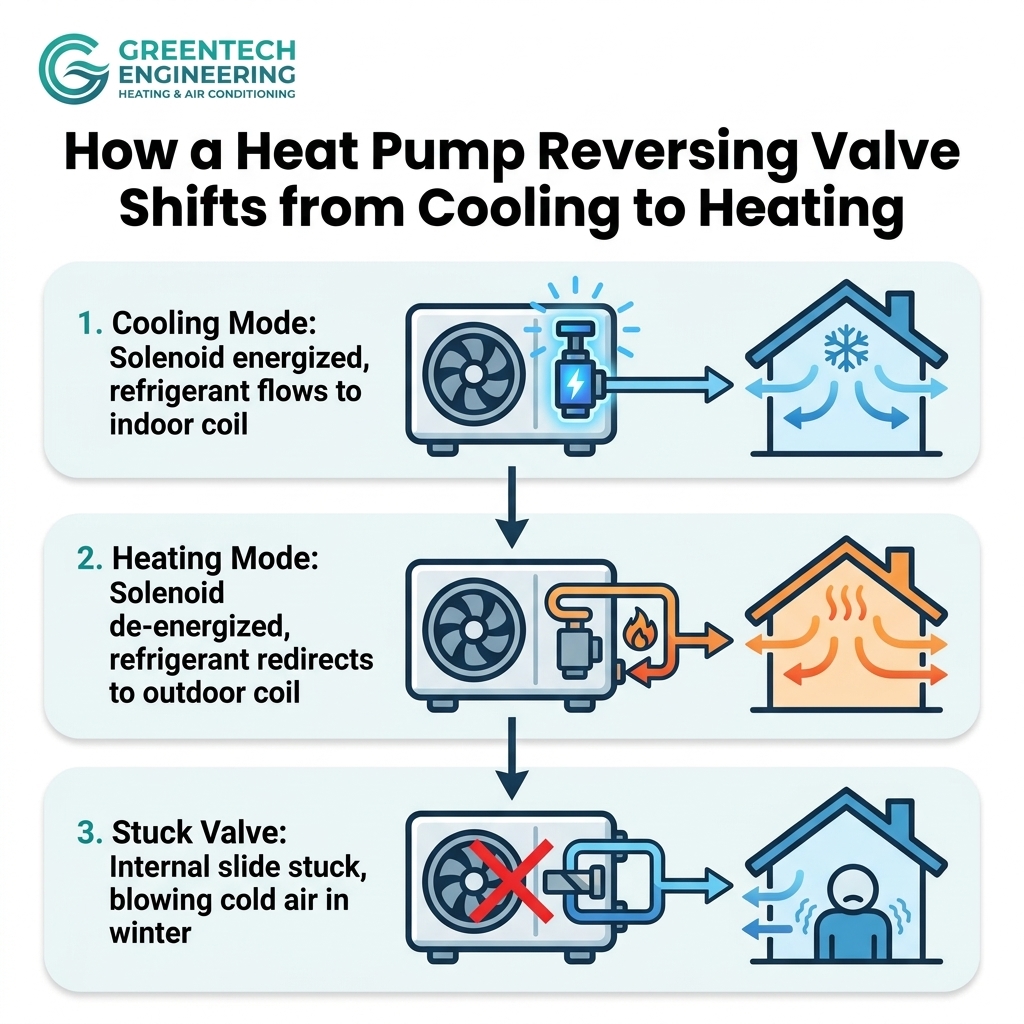
Inside the brass body of the valve sits a sliding cylinder, often made of a specialized synthetic material or metal, which moves back and forth to route the hot discharge gas from the compressor. This main slider is controlled by a much smaller pilot valve, which is actuated by an electromagnetic solenoid coil. When the thermostat calls for a change in mode, the solenoid energizes or de-energizes, shifting the pilot valve, which then uses the system's own refrigerant pressure differential to slide the main internal mechanism.
Daikin Heat Pumps are engineered with exceptional precision, and they typically energize the reversing valve in cooling mode. This means that throughout the entire cooling season, the solenoid coil is receiving constant electrical current, holding the internal slide firmly in the cooling position.
The Thermodynamic Challenge
When the first cold front arrives and you switch your thermostat to heat, the solenoid de-energizes. The thermodynamic shift required to reverse the flow of high-pressure, high-temperature refrigerant is immense. The compressor is pumping gas at hundreds of pounds of pressure per square inch, and the valve must slide smoothly against that internal pressure to reroute the hot gas from the outdoor coil to the indoor coil. If the valve has degraded, stuck, or lost its internal lubrication, this thermodynamic shift fails, and the system remains trapped in cooling mode.
120 Days of High-Load Stress: Why Texas Summers Bake Your Valve
The climate in the Dallas-Fort Worth area places a unique and severe burden on heat pump components. DFW routinely experiences consecutive 100+ degree days, forcing your system to operate at maximum capacity. Because Daikin systems energize the valve in cooling mode, the reversing valve remains locked in this exact position, under continuous electrical and thermal load, for 120+ days straight.
This prolonged stasis creates extreme physiological stress on both the electromagnetic solenoid and the internal sliding mechanism. The solenoid coil generates its own heat while being subjected to the ambient Texas summer heat radiating off the outdoor unit. Inside the valve, the constant, unidirectional flow of hot refrigerant gas and compressor oil bakes the stationary sliding mechanism. Any microscopic debris, degraded oil, or carbon buildup can settle around the edges of the slide.
The Risk of Mechanical Stasis
When a mechanical component remains stationary and energized under extreme heat for months, the eventual command to move becomes a high-risk mechanical event. The lubricant can become highly viscous or break down entirely, essentially gluing the internal slide in place. When the September transition window arrives and the solenoid drops its charge to switch to heating mode, the pressure differential may no longer be enough to break the slide free from its baked-on position.
This stress is compounded if the system was not properly sized. Based on ACCA Manual J and S engineering principles, an undersized heat pump will run even longer cycles, providing less downtime for the solenoid to cool. Over time, this accelerates the degradation of the valve. If you are considering upgrading your equipment to better handle these extreme loads, exploring modern Heat Pump Systems designed for rigorous climates is a smart investment.
Why Superficial Fall Tune-Ups Miss Critical Mechanical Failures
Many homeowners assume that a standard fall tune-up will catch a failing reversing valve. Unfortunately, a generic fall checklist usually consists of wiping down the cabinet, changing the air filter, and briefly turning on the heater to see if the fan blows. This superficial approach entirely misses the underlying thermodynamic health of the reversing valve.
At Greentech Engineering Heating & Air Conditioning, we operate by the core value of "Engineers, Not Salesmen." Our founder and CTO, Siwei (Lucas) Chen, holds a B.S. in Mechanical Engineering from Virginia Tech. Under his guidance, our maintenance protocols are designed around true mechanical and thermodynamic testing, not basic visual inspections. We understand that a heat pump is a complex thermodynamic machine, and diagnosing its health requires data.
• Checks if the indoor blower fan turns on — Engineering-Driven Testing: Measures specific refrigerant pressure differentials across the valve
• Listens for strange noises from the cabinet — Engineering-Driven Testing: Verifies precise voltage reaching the electromagnetic solenoid coil
• Wipes down the exterior condenser unit — Engineering-Driven Testing: Maps the temperature of the suction and discharge lines to detect internal bypass
• Takes 15 minutes and relies on guesswork — Engineering-Driven Testing: Follows strict ACCA Manual diagnostic protocols for accurate mechanical assessment
Testing the reversing valve properly requires professional digital gauges to monitor refrigerant pressures as the valve actuates. If the internal slide is sticking or failing to seat completely, the pressures will bleed across the valve, drastically reducing the system's heating capacity. A superficial check will never reveal this internal bleeding until the system completely fails on the coldest night of the year. Our "No Shady Biz" approach means we provide you with the exact engineering data regarding your system's health.
Our Engineering-Driven Reversing Valve Test Methodology
Because the reversing valve dictates the entire flow of high-pressure refrigerant, testing it is a complex procedure. This is strictly not a DIY project. Tampering with high-voltage solenoid coils or attaching gauges to pressurized refrigerant lines requires specialized training, EPA certification, and a licensed professional. Doing this incorrectly can result in severe injury, venting of hazardous gases, or catastrophic compressor failure.
When our engineers arrive during the September transition window, we follow a rigorous, step-by-step methodology to verify your Daikin heat pump is ready for winter:
1. Ambient and Baseline Measurement: We first measure the ambient outdoor temperature and the baseline electrical draw of the compressor to establish the system's current operating conditions.
2. Solenoid Actuation Verification: We engage the thermostat to switch modes, carefully monitoring the solenoid. We listen for the distinct "whoosh" of the pressure equalizing and the mechanical click of the slide moving. We also use a multimeter to verify the coil is receiving the exact 24-volt signal required from the control board.
3. Pressure Differential Analysis: Using professional digital manifolds, we monitor the high and low-side refrigerant pressures. A healthy valve will show a sharp, definitive change in pressures. If the pressures equalize too slowly, or if the suction pressure remains abnormally high, it indicates the internal slide is sticking or "bleeding" refrigerant.
4. Thermal Mapping: We measure the temperature of the four copper lines connecting to the valve body. A leaking valve will show abnormal temperature bleed between the hot discharge line and the cold suction line, proving that the internal seal has failed.
If our testing reveals a sticking or degraded valve, we present you with the objective data. Depending on the age of the system and the severity of the stick, solutions range from replacing the solenoid coil to a full valve replacement—a major repair that involves recovering the refrigerant and brazing in a new component. For comprehensive solutions, we provide expert Heat Pump Repair in DFW to restore your system's integrity.
Recognizing the Symptoms of a Stuck Valve Before the Freeze
If you miss the proactive testing window, your heat pump will eventually attempt to switch modes on its own when the thermostat calls for heat. If the reversing valve fails during this shift, your system will exhibit several clear warning signs. Recognizing these symptoms early can prevent catastrophic damage to your compressor.
• Blowing cold air in heat mode: This is the most obvious and immediate sign. The thermostat is calling for heat, the system turns on, but the air coming from your vents is ice cold because the valve remains locked in the summer cooling position.
• Strange hissing or grinding noises: As the solenoid struggles to actuate the pilot valve against the high-pressure refrigerant, you may hear a loud, continuous hissing or a repetitive clicking sound from the outdoor unit.
• The outdoor unit freezing completely solid: Heat pumps use the reversing valve to run a defrost cycle in the winter, temporarily switching to cooling mode to melt frost off the outdoor coil. If the valve is stuck, the defrost cycle cannot engage, and the outdoor unit will quickly freeze into a solid block of ice.
• Abnormally high energy consumption: Because the system is blowing cold air while trying to heat the house, the thermostat is never satisfied. The heat pump will run continuously, driving your electricity bills through the roof while your home remains freezing.
If you notice any of these symptoms, shut the system down immediately to protect the compressor from overheating. For a deeper dive into troubleshooting these exact symptoms, review our guide on Why Is My Heat Pump Not Heating? A Step-by-Step Troubleshooting Guide.
Proactive Preparation with the Express Comfort Club
The absolute best time to catch a stuck or degrading reversing valve is during the September transition window. Identifying the issue now allows for planned, methodical repairs before emergency rates apply and before you are left shivering in a cold house. Proactive testing is the cornerstone of our engineering philosophy.
To make this level of deep mechanical testing frictionless for homeowners, we offer the Express Comfort Club. This complimentary maintenance membership is the ideal way to secure professional, engineering-level testing for your Daikin heat pump proactively. We focus on the thermodynamic science and proper equipment operation, ensuring your system is mechanically sound without ever resorting to high-pressure sales tactics.
Joining the membership provides total peace of mind. You receive comprehensive evaluations of your reversing valve, compressor health, and electrical components from technicians trained under strict engineering standards. Secure your home's winter readiness by joining the Express Comfort Club Maintenance Plan today, and rest easy knowing your transition into fall will be flawless.
Frequently Asked Questions About Heat Pump Reversing Valves
Why is my Daikin heat pump blowing cold air when the heat is on?
The most common cause is a stuck reversing valve that remains locked in cooling mode after the long summer. It can also be caused by a system actively running its normal defrost cycle, which temporarily blows cooler air to melt outdoor frost.
Can a stuck reversing valve be fixed?
Sometimes a professional can free a lightly stuck valve by diagnosing a faulty solenoid coil, but often the internal sliding mechanism is permanently damaged. If internally damaged, the entire valve must be replaced by recovering the refrigerant and brazing in a new component.
How do you test a heat pump reversing valve?
Professionals test it by measuring the temperature differential across the four lines of the valve and checking exact refrigerant pressures with digital manifolds. They also use a multimeter to verify that the solenoid coil is receiving the correct voltage from the control board.
What happens when a reversing valve gets stuck halfway?
When stuck halfway, high-pressure refrigerant bypasses internally, leading to extremely poor heating and cooling performance. You may hear a loud hissing sound from the outdoor unit, and the compressor is at a very high risk of overheating and failing completely.
Does the Express Comfort Club cover reversing valve testing?
Yes, our comprehensive mechanical testing during fall maintenance includes verifying the actuation and thermodynamic health of the reversing valve. We ensure the component shifts properly and seals tightly before the harsh winter weather arrives.
Secure Your Comfort Before the Dallas Cold Snap Hits
Surviving the first freeze in Dallas requires more than just hoping your system works; it requires proactive, engineering-level mechanical checks. The fall reversing valve test: preparing your Daikin heat pump for the first Dallas cold snap is the definitive way to ensure your home stays warm when the weather turns. By trusting the science of thermodynamics and proper load calculations, you can prevent major mid-winter breakdowns.
If another contractor has told you that your reversing valve is broken and you need a full system replacement, remember that Greentech Engineering Heating & Air Conditioning offers a Free 2nd Opinion on major repairs. We also provide expert guidance on securing the Oncor Energy Rebate for qualifying high-efficiency upgrades. Schedule your comprehensive fall inspection with our engineering team today, and ensure your system transitions flawlessly into the heating season.

Flexible Financing Options
Explore our range of flexible financing options designed to suit your needs and budget.