






How an HVAC Second Opinion Led to a Zoning Retrofit in Dallas 75248
On September 2, 2026, a Dallas 75248 homeowner asked Greentech Engineering Heating & Air Conditioning — DFW HVAC for a second opinion after reporting long runtime, setpoint difficulty, uneven temperatures and weak airflow. The evaluation included static-pressure, Delta‑T, airflow and duct-integrity measurements. It led to a targeted zoning and airflow retrofit—not documented HVAC equipment replacement—completed September 16. The work included 12-inch and 14-inch motorized zone dampers, a 14-inch TrueZONE CPRD bypass damper, a zone board, a Google Nest thermostat and a replacement supply plenum.
The exact readings, test conditions and certain component identifiers remain in the approved job record. They are not estimated or reproduced publicly.
Concerned that an HVAC recommendation does not explain the airflow problem? Request an independent HVAC second opinion before approving equipment replacement or major duct changes.
Dallas 75248 project details
- Location: Dallas, TX 75248; street address and homeowner identity withheld
- Property: Residential home; construction year and detailed property description not published
- Second-opinion visit: September 2, 2026
- Retrofit completed: September 16, 2026
- Homeowner-reported concerns: Long runtime, difficulty maintaining setpoint, uneven rooms and weak airflow in a bedroom and one downstairs room
- Diagnostic scope: Static pressure, Delta‑T, airflow and duct integrity measured and documented in the job record
- HVAC equipment replacement: None documented
- Zone dampers: Confirmed 12-inch and 14-inch motorized dampers
- Bypass damper: Confirmed 14-inch Honeywell Home/Resideo TrueZONE CPRD
- Controls: Zone control board and Google Nest thermostat; exact identifiers remain in the job record
- Air-distribution work: Replacement supply plenum; final construction confirmed in the closeout record
- Labor coverage: Complimentary three-year labor warranty for eligible Greentech-performed work on the zone-damper-system modification, subject to the written terms, ownership requirements and exclusions
Why did the homeowner request an HVAC second opinion?
The homeowner wanted measurements and documentation before authorizing major HVAC work. Reported concerns included:
- the upstairs system running for much of the day;
- difficulty maintaining the thermostat setpoint;
- rooms feeling warmer or cooler than others;
- weak airflow in a bedroom; and
- weak airflow in one downstairs room.
These were customer-reported symptoms, not diagnoses by themselves. Similar symptoms can involve equipment operation, supply or return restrictions, duct configuration, room loads, register delivery, thermostat behavior, zoning logic or several factors together.
A second opinion changes the first question from “What equipment should be replaced?” to “What does the available evidence show about the system, controls and air-distribution network?”
What should an airflow-focused second opinion measure?
No single measurement explains an entire comfort problem. Each reading needs its location, units, operating condition and comparison point.
Static pressure
Static pressure represents resistance to airflow through the HVAC system and connected ductwork. A reading should be interpreted with its measurement location, units, operating mode, filter and coil condition, zone positions and the equipment manufacturer’s allowable range.
Static-pressure measurements were documented for this project, but the exact readings and test configurations were not included in the publishing handoff. They should be transcribed from the approved diagnostic and closeout records before any values are added publicly.
Delta‑T
Delta‑T is the difference between appropriately measured return-air and supply-air dry-bulb temperatures under documented operating conditions. It should not be calculated from an infrared image of a register surface.
The project record includes Delta‑T testing. The available publishing file does not contain the exact probe readings, locations or conditions, so the visible 63.8°F infrared surface reading is not labeled as supply-air temperature and is not used to calculate Delta‑T.
Room and register airflow
Airflow readings can help compare delivered air with room or zone needs. A defensible claim should identify the instrument, register or branch, zone configuration, operating condition and units such as CFM.
Airflow measurements were provided to the homeowner. This page does not claim a specific CFM increase because the before-and-after values and test conditions were not transcribed into the publishing handoff.
Duct integrity and configuration
Inspection and testing can document disconnected, damaged, restricted or poorly configured duct components. Photographs establish visible conditions but do not, by themselves, quantify leakage or prove a code violation.
The project record includes duct-integrity and supply-plenum findings. The following photograph is presented only as an existing-condition record.
Why did the solution focus on zoning and airflow distribution?
The evaluation led to a targeted retrofit rather than documented replacement of the outdoor unit, coil, furnace or air handler. The design treated dampers, controls, pressure management and the supply plenum as a coordinated system.
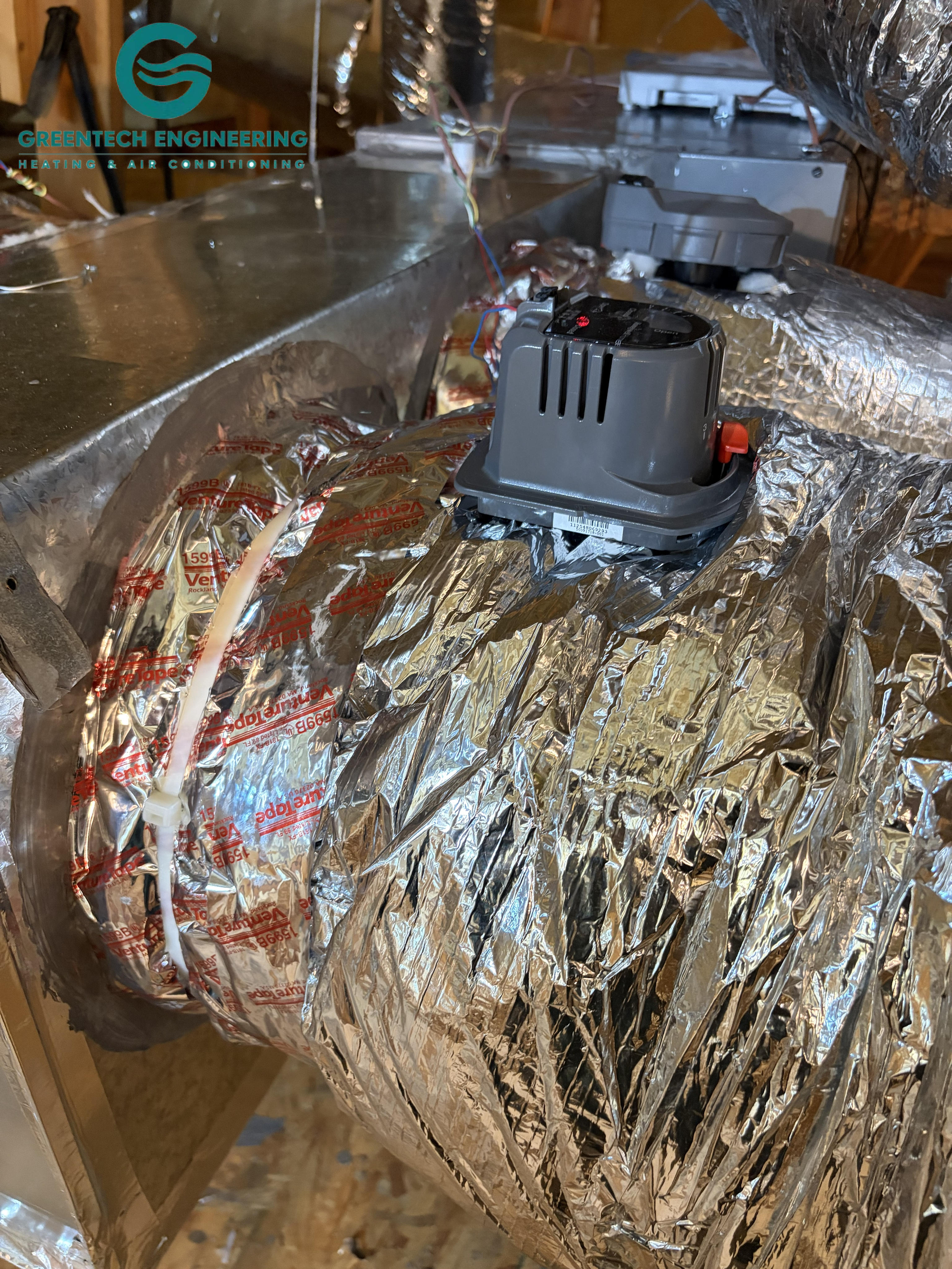
Motorized zone dampers open or close duct paths in response to thermostat calls coordinated by the zone board. They redirect the conditioned air available from the HVAC equipment; they do not increase the equipment’s heating or cooling capacity.
This project used confirmed 12-inch and 14-inch motorized dampers in rigid housings. Exact damper model numbers and zone assignments should be added only by direct transcription from the final job record.
What does the bypass damper do?
When one or more zone dampers close, resistance in the active duct path can change. A properly selected, adjusted and commissioned bypass damper can provide a pressure-relief path as part of a zoning design.
The documented project scope used a 14-inch Honeywell Home/Resideo TrueZONE CPRD bypass damper. Its role is pressure management—not creating additional HVAC capacity or guaranteeing correct airflow.
The final bypass route was clarified in the job record. An earlier design graphic still contains the phrase “Dump to Attic,” so that archived graphic must not be published until its label is replaced with the confirmed final-route description. This article does not infer or recreate the route from the drawing.
What changed in the supply plenum and controls?
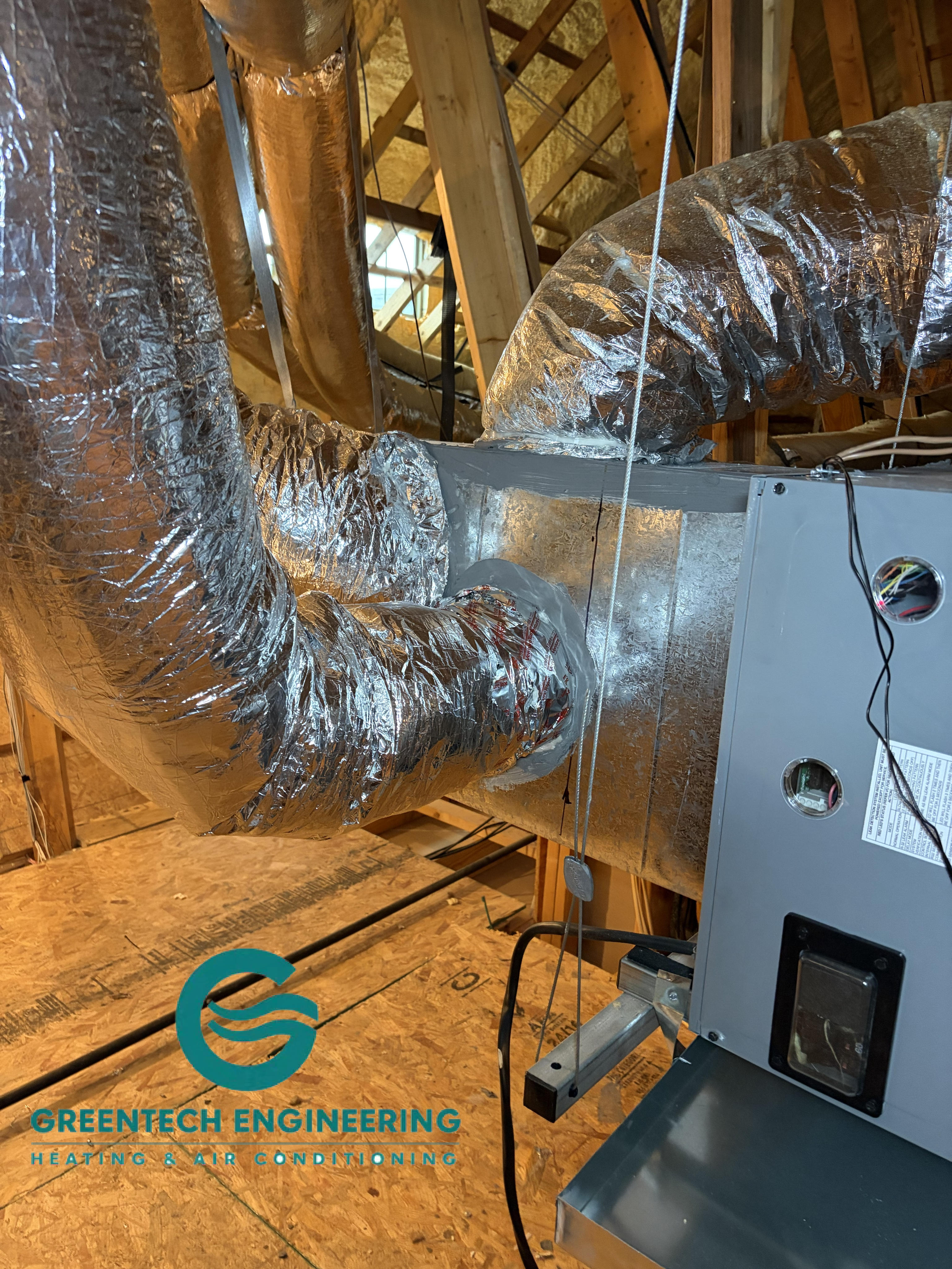
The supply plenum is the air-distribution box immediately downstream of the indoor HVAC equipment. Replacing or rebuilding it can create the takeoff arrangement required for a revised zoning layout.
For this project, the supply plenum was replaced and its final construction was confirmed in the closeout record. Material, insulation and dimensional details were not transcribed into the publishing handoff, so they are not reconstructed here.
The documented zone control board supports up to three zones and coordinates thermostat calls, damper positions and equipment operation. Its exact model, active-zone count and protection logic should be copied only from the approved job record.
A Google Nest thermostat was installed. Google states that Nest thermostats can work with many zoned systems, including damper-based systems, but some configurations require a C wire and compatibility depends on the specific control equipment. The confirmed Nest model, controlled zone, wiring and power arrangement should be added only from the closeout record.
What was installed?
The documented retrofit included:
- one 12-inch motorized zone damper;
- one 14-inch motorized zone damper;
- one 14-inch TrueZONE CPRD bypass damper;
- a zone control board supporting up to three zones;
- a Google Nest thermostat;
- a replacement supply plenum; and
- related wiring, duct transitions and functional checks documented in the project record.
What do the measurements prove?
The job record confirms that static pressure, Delta‑T, airflow and duct integrity were measured. Publishing any numeric result requires:
- the value and unit;
- test location;
- system mode;
- open/closed zone configuration;
- instrument or measurement method;
- equipment limit or design target; and
- whether the reading was taken before or after the modification.
Without that context, an isolated number can mislead. The same limitation applies to the infrared photograph: approximately 63.8°F at a register surface is not automatically a supply-air dry-bulb temperature, Delta‑T, airflow reading or proof that the comfort concern was resolved.
No homeowner follow-up statement or quantified post-installation outcome was supplied for this article. The page therefore does not claim that the retrofit permanently eliminated uneven rooms, reduced runtime or lowered energy bills.
When can an HVAC second opinion be useful?
A second opinion may be useful when:
- equipment replacement is recommended without documented airflow findings;
- a system runs for long periods while rooms remain uneven;
- one or more rooms receive noticeably weaker airflow;
- an existing zoning system does not coordinate thermostats and dampers reliably;
- major duct changes are proposed without explaining the pressure strategy; or
- the homeowner wants measured findings before approving major work.
Not every comfort concern should be solved with zoning. Depending on the evidence, the appropriate path may involve equipment repair, duct correction, return-air changes, balancing, controls, zoning modifications or equipment replacement.
For broader education, read why an upstairs can remain hot and how airflow balancing is evaluated. For a different project path, compare the Dallas 75206 air-handler and zoning case. Those pages describe different conditions and should not be treated as specifications or results for this home.
What does this Dallas case demonstrate?
This case documents a decision process:
- The homeowner reported long runtime, setpoint difficulty and uneven airflow.
- Greentech performed a second-opinion visit and documented airflow-related measurements.
- The evaluation led to a targeted zoning, bypass, controls and plenum proposal instead of documented HVAC equipment replacement.
- The homeowner selected the proposal.
- Greentech completed the modification on September 16, 2026.
The supplied record does not establish builder fault, a code violation, equipment under- or oversizing, a project-specific Manual J or Manual D calculation, permit/inspection completion, an Oncor incentive or guaranteed energy and comfort results.
Frequently asked questions
Can an HVAC second opinion identify why some rooms are hot and others are cold?
It can help distinguish equipment operation, duct restrictions, airflow distribution, control problems and room-load differences when supported by measurements and inspection.
What does a motorized HVAC zone damper do?
It opens or closes a duct path in response to a zone call coordinated by a control board, redirecting the conditioned air available from the HVAC equipment.
Why can a zoned HVAC system need a bypass damper?
When one or more zone dampers close, a properly selected and commissioned bypass damper can relieve excess duct pressure. The correct strategy depends on the equipment and duct design.
Does a bypass damper increase HVAC capacity?
No. It manages pressure in the air-distribution system; it does not increase heating or cooling capacity.
Can a Google Nest thermostat work with HVAC zoning?
Often, but compatibility depends on the zone panel, thermostat wiring, available power and whether the controls are standard or proprietary. Some zoned systems require a C wire.
Should an HVAC company measure static pressure during a second opinion?
Static pressure is one useful diagnostic input, but it should be interpreted with equipment limits, zone positions, temperature measurements, duct inspection and airflow needs.
Does uneven airflow always mean the HVAC equipment should be replaced?
No. Uneven airflow can involve equipment, ducts, returns, registers, controls, zoning, room loads or a combination of factors. Diagnosis should precede the replacement decision.
Did this project include HVAC equipment replacement?
No outdoor unit, coil, furnace or air-handler replacement is documented. The project focused on zoning, controls, pressure management and air distribution.
Request an independent HVAC second opinion in Dallas
A second opinion is most useful when it turns comfort complaints into documented diagnostic and design questions. The appropriate recommendation should follow the evidence.
Request an independent HVAC second opinion or learn more about duct design and airflow services in Dallas.
This zone-damper-system modification included a complimentary three-year labor warranty for eligible Greentech-performed installation labor, subject to the written warranty’s terms, ownership requirements and exclusions.
About the author
Siwei (Lucas) Chen
Chief Technology Officer | Greentech Engineering Heating & Air Conditioning — DFW HVAC
Siwei (Lucas) Chen applies an engineering-based, data-first approach to residential HVAC system design, diagnostics, airflow measurement, equipment selection and duct-system optimization across Dallas–Fort Worth. He holds a B.S. in Mechanical Engineering from Virginia Tech.
Lucas completed ACCA’s Residential Design for Quality Installation Course, which covers residential design procedures associated with ACCA Manuals J, S, T and D. He is also an NCI Certified Residential Air Balancer and NCI Certified Duct System Optimization Specialist.

Flexible Financing Options
Explore our range of flexible financing options designed to suit your needs and budget.