







Southlake HVAC Case Study: Why Downsizing from a 5-Ton to a 4-Ton Daikin FIT Unlocked Perfect Comfort & Oncor Rebates
For homeowners in Southlake, TX (76092), cooling the second floor of a large, two-story home is a notorious engineering challenge. The brutal Texas sun beats down on the roof, ambient heat naturally rises from the first floor, and the upstairs HVAC unit is continually forced to work overtime.
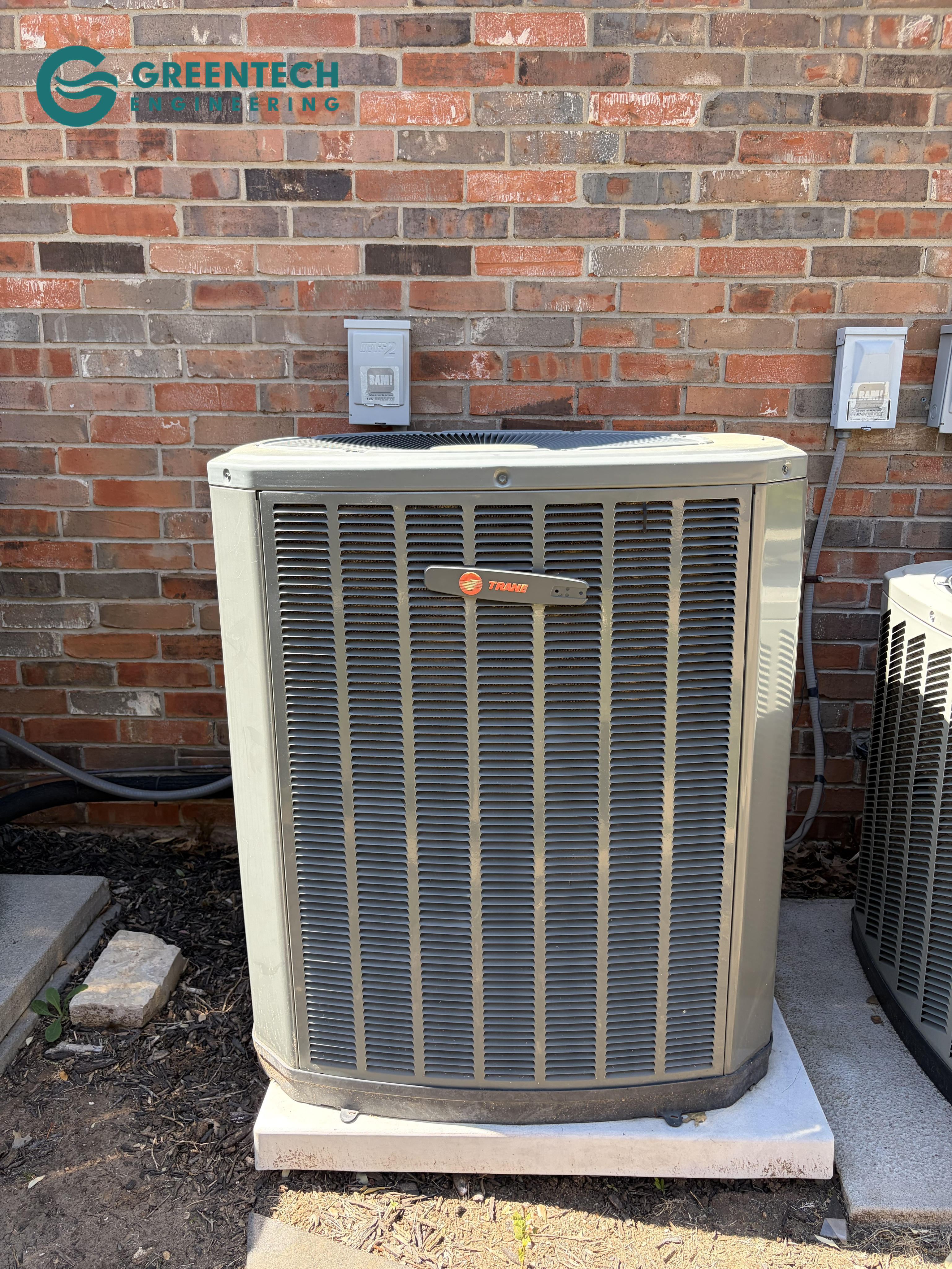
When a Southlake homeowner contacted the engineering team at Greentech Engineering, their upstairs 5-Ton Trane system was failing. It was incredibly loud, highly inefficient, and despite its massive size, it left the second floor feeling clammy and uncomfortable.
Most HVAC contractors would look at a dead 5-Ton unit and simply quote a new 5-Ton unit. This is the dangerous "box swap" mentality that plagues the residential heating and cooling industry.
We brought a strict, data-driven engineering protocol to the table. By performing an ACCA Manual J Load Calculation, we discovered the upstairs zone was actually oversized. We completely re-engineered the upstairs system, replacing the clunky 5-Ton Trane with an ultra-efficient, variable-speed 4-Ton Daikin FIT System.
Here is the complete technical breakdown of how downsizing the equipment, rebuilding the supply plenum, adding R-8 ductwork, and upgrading to a 16.2 SEER2 Daikin FIT provided this Southlake family with perfectly balanced comfort and maximum Oncor Utility Rebates.
The Danger of Oversized HVAC: Why We Downsized to 4 Tons
In the world of thermodynamics, bigger does not mean better. In fact, it usually means higher electric bills and worse indoor comfort.
The original 5-Ton Trane setup was simply too large for the actual thermal load of the second floor. When an air conditioner is oversized, it "short-cycles." It blasts the upstairs with a massive volume of cold air, satisfies the thermostat in 10 minutes, and abruptly shuts off. Because it doesn't run long enough, it fails to remove the latent heat (humidity) from the air. This is why the upstairs felt cold, yet uncomfortably sticky.
The ACCA Manual J Load Calculation
At Greentech Engineering, we replace guesswork with math. We executed a strict Manual J Load Calculation, factoring in the Southlake home's specific square footage, attic insulation depth, window thermal ratings, and directional orientation.
The data was undeniable: the second floor only required exactly 4 Tons of cooling capacity. By downsizing to a properly matched 4-Ton system, we ensured the new equipment would run longer, gentler cycles—the absolute secret to profound dehumidification and whisper-quiet operation.

The Equipment: The 16.2 SEER2 Daikin FIT Matchup
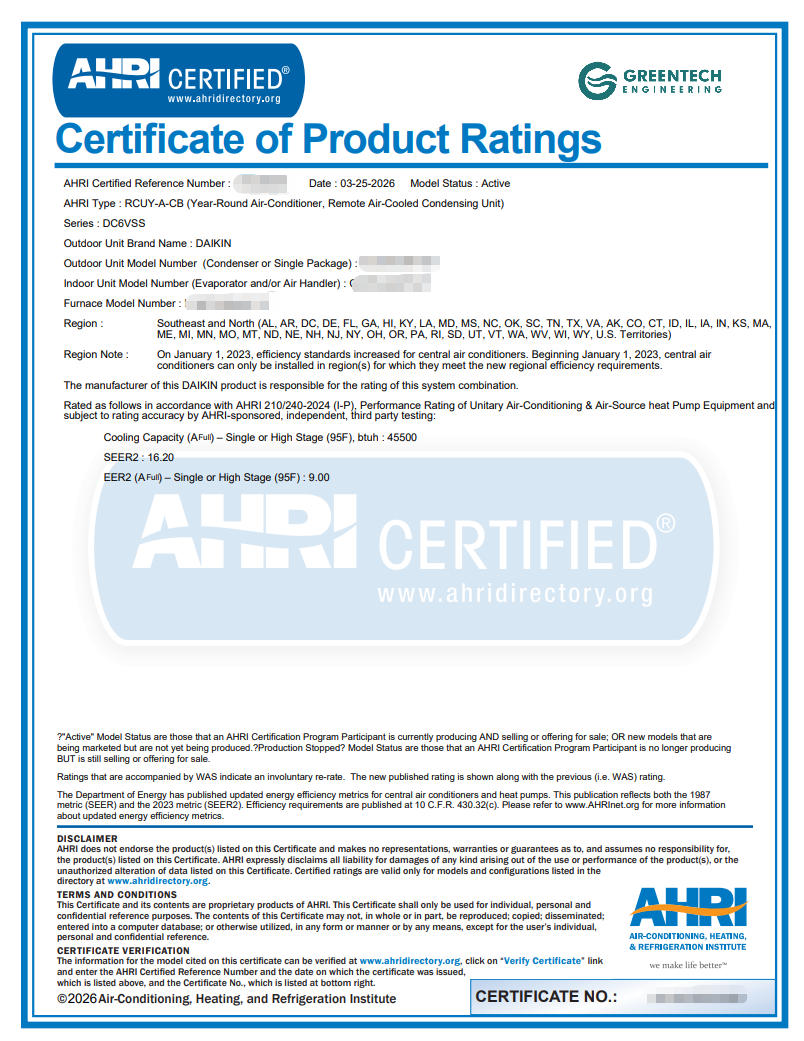
To provide the ultimate upstairs climate control, we selected a premium communicating system from Daikin. We installed an [External Link: AHRI-Certified matchup -> link to ahridirectory.org] that achieves an elite 16.2 SEER2 and 9.0 EER2 performance rating.
Here are the specific, high-performance components we engineered for this space:
1. Daikin FIT 48,000 BTU Variable-Speed Condenser
- Inverter Swing Compressor: Unlike old ACs that turn on and off at 100% capacity, this variable-speed compressor ramps up and down like a dimmer switch, perfectly matching the real-time cooling demand of the upstairs zone.
- Quiet Mode Technology: Thanks to a high-density sound blanket and digitally commutated fan motor, this side-discharge unit operates at whisper-quiet levels (as low as 45 dBA).
- Intelligent Defrost & Diagnostics: Features Daikin Inside intelligence with a seven-segment LED display for advanced fault code storage and precise winter defrosting.
2. Daikin 48,000 BTU Horizontal Cased Coil with EEV
- Electronic Expansion Valve (EEV): While standard systems use mechanical TXV valves, an EEV is digitally controlled by the Daikin communicating system, metering refrigerant flow with pinpoint accuracy for maximum efficiency.
- All-Aluminum Construction: Built with 7mm rifled aluminum tubing and corrugated fins, completely eliminating the risk of copper-related formicary corrosion.
3. Daikin 80,000 BTU 2-Stage Variable-Speed Gas Furnace (80% AFUE)
- Two-Stage Gas Valve & Variable-Speed ECM: Provides gentle, continuous air circulation. Instead of a loud blast of hot air, it delivers quiet, even heat during cold Texas winter nights.
- Heavy-Duty Stainless-Steel Heat Exchanger: Fully insulated for incredibly quiet operation and backed by a Lifetime Heat Exchanger Warranty.
Fixing the Airflow: Plenum Rebuild & R-8 Duct Optimization
You can buy the best air conditioner in the world, but if your ductwork is restrictive, the system will suffocate. The upstairs of this Southlake home suffered from significantly uneven airflow.
We executed a comprehensive Duct Optimization and Airflow Balancing protocol to allow the new Daikin variable-speed motor to breathe properly:
- Custom Supply Plenum Rebuild: We completely removed the restrictive old supply plenum and replaced it with a custom-built, insulated metal air box. This acts as a frictionless distribution hub for the conditioned air.
- New R-8 Flex Duct Run: We engineered a brand-new, highly insulated R-8 flex duct run to supply a massive boost of air to a historically hot room. We cut a new start collar into the rebuilt plenum, ran the R-8 duct to a newly installed insulated boot, and sealed all connections meticulously with mastic sealant. The duct was then suspended with wide nylon strapping to prevent any future sagging or kinking.
The Greentech Engineering Standard: Installation Execution
Our team operates on strict, data-driven installation protocols to guarantee the absolute longevity of these premium Daikin components.
1. Refrigerant Line Purification & Pressure Testing
We aggressively flushed the existing copper line sets using RX-11 solvent and pressurized dry nitrogen to strip away old, acidic mineral oil. All modifications to the refrigerant lines were soldered with 15% silver brazing rods.
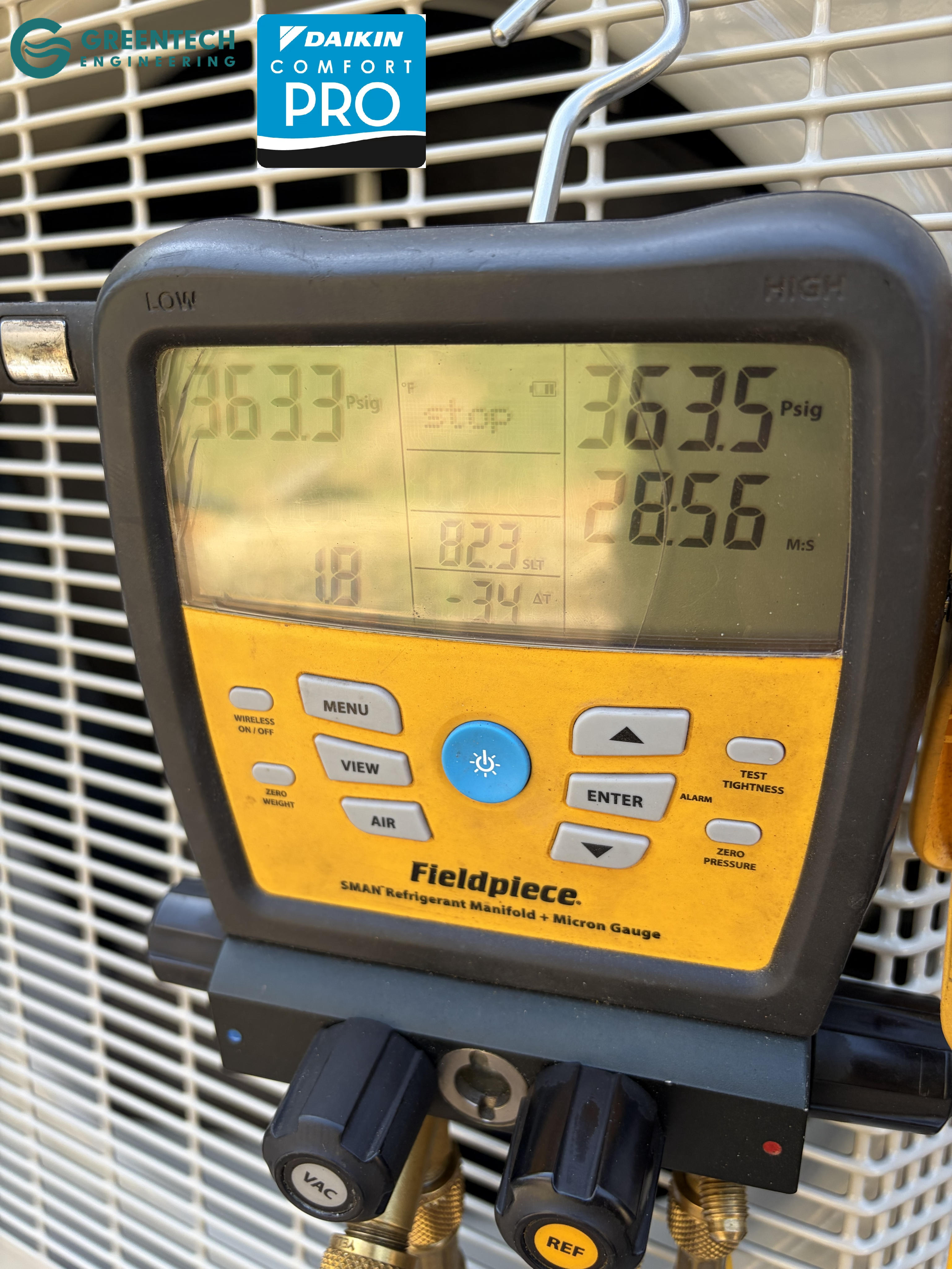
To guarantee zero micro-leaks, we pressurized the entire system with dry nitrogen to over 350 PSI, verifying the integrity of every single braze joint before proceeding.
2. Sub-500 Micron Digital Vacuum
Following the pressure test, we pulled a deep vacuum below 500 microns. This highly technical process boils off microscopic moisture inside the pipes at room temperature, completely dehydrating the system before releasing the advanced R-32 refrigerant.
3. Dedicated Surge Protection
Variable-speed inverter boards are sensitive microcomputers. They are easily damaged by Texas grid fluctuations. We installed a dedicated 220V Kool Guard voltage monitor and surge protection device directly at the disconnect to shield the new Daikin compressor from unstable voltage and lightning strikes.
4. Smart Control Integration
We upgraded the wall control to the Daikin One Touch Smart Communicating Thermostat. This capacitive touchscreen acts as the brain of the entire HVAC network. It communicates digitally with the EEV, inverter compressor, and variable-speed blower to constantly adjust the system's output for the exact thermal load of the home.
The Financial ROI: Oncor Rebates & Elite Warranties
Because we backed up our strict engineering with an official AHRI Certificate proving the 16.2 SEER2 performance, we successfully secured maximum Oncor Energy Efficiency Rebates for this Southlake homeowner, instantly offsetting the cost of the premium upgrade.
By choosing Greentech Engineering, an authorized Daikin Comfort Pro, this homeowner also unlocked the industry's most powerful protections upon registration:
- 12-Year Unit Replacement Warranty (If the compressor or coil fails in 12 years, Daikin provides a brand-new unit, not just a replacement part).
- Lifetime Heat Exchanger Limited Warranty
- 12-Year Factory Parts Warranty
- Greentech's Complimentary 3-Year Labor Warranty
If the upstairs of your Southlake home is struggling to stay cool, do not let a contractor blindly install another oversized, inefficient unit. Contact Greentech Engineering today . Let our engineers run the Manual J load calculation, rebuild your restrictive plenums, and claim your utility rebates!
Frequently Asked Questions (FAQ): Variable-Speed Heat Pumps & ACs
Q: Why is downsizing an AC unit sometimes a good idea?
A: An oversized AC cools the air too fast and shuts off before it can remove humidity, leaving your home feeling clammy and causing high wear-and-tear from constant starting and stopping. Downsizing to the exact required capacity (calculated via Manual J) allows the system to run longer, highly efficient cycles that deeply dehumidify the air.
Q: What is an EEV (Electronic Expansion Valve) and why is it better?
A: Standard ACs use mechanical valves (TXVs) that react slowly to temperature changes. An EEV is a digital valve controlled by the Daikin communicating thermostat. It continuously calculates and adjusts the exact microscopic flow of refrigerant needed, significantly boosting the system's SEER2 rating and efficiency.
Q: Why do I need a surge protector for an air conditioner?
A: High-efficiency variable-speed systems use sophisticated computer boards (inverters) to control the compressor speed. Just like you wouldn't plug a $3,000 computer directly into a wall without a surge protector, we install dedicated 220V voltage monitors to protect these expensive HVAC control boards from the frequent power spikes on the Texas electrical grid.
Q: Does the Daikin One Touch Thermostat work with my smartphone?
A: Yes! The Daikin One Touch is fully Wi-Fi-enabled. You can control the temperature, monitor outdoor humidity, and set geo-fencing schedules via the Daikin iOS or Android app, or use voice control through Amazon Alexa and Google Assistant.
About the Author: Siwei (Lucas) Chen
CTO | Greentech Engineering Heating & Air Conditioning
Siwei (Lucas) Chen specializes in engineering-driven HVAC diagnostics, thermodynamic performance optimization, and energy-efficiency upgrades for North Texas homeowners. Holding a B.S. in Mechanical Engineering from Virginia Tech, he brings a strict, data-first approach to residential heating and cooling. Under his technical leadership, Greentech Engineering ensures every system is perfectly calibrated for the Dallas-Fort Worth climate, focusing on ACCA Manual J load calculations, meticulous installation standards, duct optimization, and maximizing homeowner ROI through utility rebates.
Professional Certifications:
- ACCA Certified (Manual J, S, D)
- NCI Certified – Air Balancing & Duct Optimization
- Daikin Comfort Pro Contractor
- Oncor Participating Service Provider

Flexible Financing Options
Explore our range of flexible financing options designed to suit your needs and budget.