






Grand Prairie Two-System HVAC Replacement: 4-Ton and 5-Ton Daikin Systems
By Siwei (Lucas) Chen, Chief Technology Officer
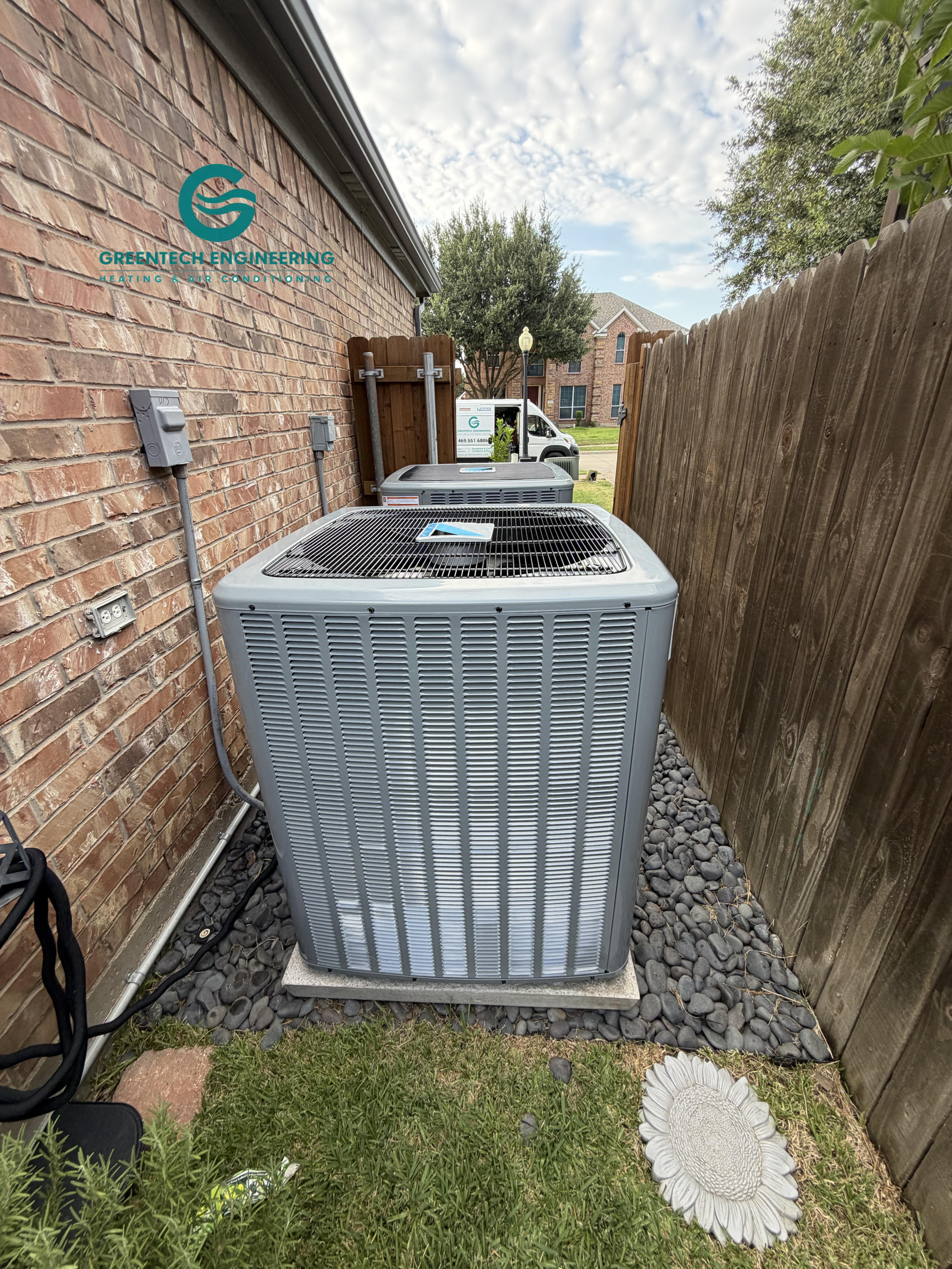
Replacing two HVAC systems in the same house does not mean selecting the same equipment twice. In this Grand Prairie, Texas 75052 project, Greentech Engineering Heating & Air Conditioning — DFW HVAC replaced both systems in a two-story single-family home. One served area received a nominal 4-ton Daikin two-stage R-32 air-conditioning system, while the other received a nominal 5-ton Daikin two-stage R-32 system.
The project involved more than changing outdoor equipment. Each system received one additional 14-inch return-air duct, together with related return-side plenum, sheet-metal transition and flex-duct work. The two installed combinations also have different AHRI-certified cooling capacities and efficiency ratings. That distinction matters because certified performance belongs to an exact equipment match—not to a brand name or nominal tonnage by itself.
The installation was completed on July 31, 2026. The project also received an approved $1,430.46 Oncor incentive that Greentech passed through to the homeowner as an instant discount. That amount was specific to this project; incentive eligibility, funding and final amounts can change.
Direct Answer: What Was Installed in This Grand Prairie Home?
Greentech replaced both HVAC systems with separate Daikin two-stage R-32 AC and gas-furnace combinations: one nominal 4-ton system and one nominal 5-ton system. Both systems use 80% AFUE gas furnaces. Each received an additional 14-inch return-air duct plus related plenum, transition and flex-duct work. The two AHRI-certified matches have different cooling capacities, SEER2 ratings and EER2 ratings because they are different equipment combinations serving different areas of the home.
Project at a Glance
- Location: Grand Prairie, TX 75052
- Property type: Two-story single-family home
- Installation completed: July 31, 2026
- Project scope: Replacement of both HVAC systems
- System 1: Nominal 4-ton Daikin two-stage R-32 AC with an 80% AFUE gas furnace
- System 2: Nominal 5-ton Daikin two-stage R-32 AC with an 80% AFUE gas furnace
- Return-air scope: One additional 14-inch return-air duct for each system
- Related ductwork: Return-side plenum work, sheet-metal transitions and flex duct
- Oncor incentive: $1,430.46, passed through as an instant customer discount
- Labor warranty: 1,095 days, subject to the complete written terms
Why a Two-System Home Requires Two Equipment Decisions
In a home with two independent HVAC systems, each system serves its own area through its own indoor equipment, refrigerant circuit, duct network and return-air path. The replacement decision cannot be made from total house square footage alone, and one system's nominal size should not automatically be copied to the other.
A professional evaluation considers the home's design loads, the areas each system serves, available AHRI-matched equipment, indoor and outdoor component compatibility, furnace and coil selection, duct conditions and return-air pathways. Final equipment selection is broader than choosing a tonnage label.
For this project, the documented final selections were a nominal 4-ton replacement for one served area and a nominal 5-ton replacement for the other. Those capacities describe this home and this installation; they are not sizing recommendations for another Grand Prairie property.
How Manual J Was Used—and What It Does Not Prove by Itself
A project-specific Manual J calculation formed part of the technical record and covered the whole home. It should not be characterized as an upstairs-only or downstairs-only calculation.
ACCA Manual J estimates residential heating and cooling loads from design conditions and characteristics such as construction, insulation, windows and air leakage. It informs equipment selection, but it does not by itself complete the full selection, duct-design or commissioning process. The areas served by each system, certified equipment performance and air-distribution conditions also matter.
The complete Manual J report and its customer-specific details remain private project records. This article does not reproduce the report or use its numerical values as a marketing claim.
What the Project Records Establish
The records and photographs document removal of both existing outdoor units and their associated indoor equipment, installation of two new Daikin combinations, added return-air scope, plenum and transition work, and the final AHRI and Oncor documentation.
The records supplied for publication do not establish one specific failure, comfort complaint, humidity problem or energy-cost concern as the reason both systems were replaced. This case study therefore does not invent a breakdown narrative or claim a measured post-installation outcome. It focuses on the work and performance data that can be documented.
The Nominal 4-Ton Daikin System
One served area received a nominal 4-ton Daikin two-stage R-32 air-conditioning system paired with a horizontal evaporator coil and an 80% AFUE gas furnace.
AHRI Certified Reference Number 216615141 identifies the installed matched combination. According to the retained certificate, its certified performance is:
- 45,500 BTUH certified cooling capacity
- 17.2 SEER2
- 12.5 EER2
- 80,000 BTUH furnace input
- 64,000 BTUH furnace output at 80% AFUE
“Nominal 4 tons” is an equipment-size classification. It should not be converted automatically into a claim of exactly 48,000 BTUH of certified cooling capacity. For this installed match, the published certified capacity is 45,500 BTUH.
This system also received one additional 14-inch return-air duct and related return-side plenum work. That scope is part of the system installation because the equipment must operate through the home's air-distribution network.
The Nominal 5-Ton Daikin System
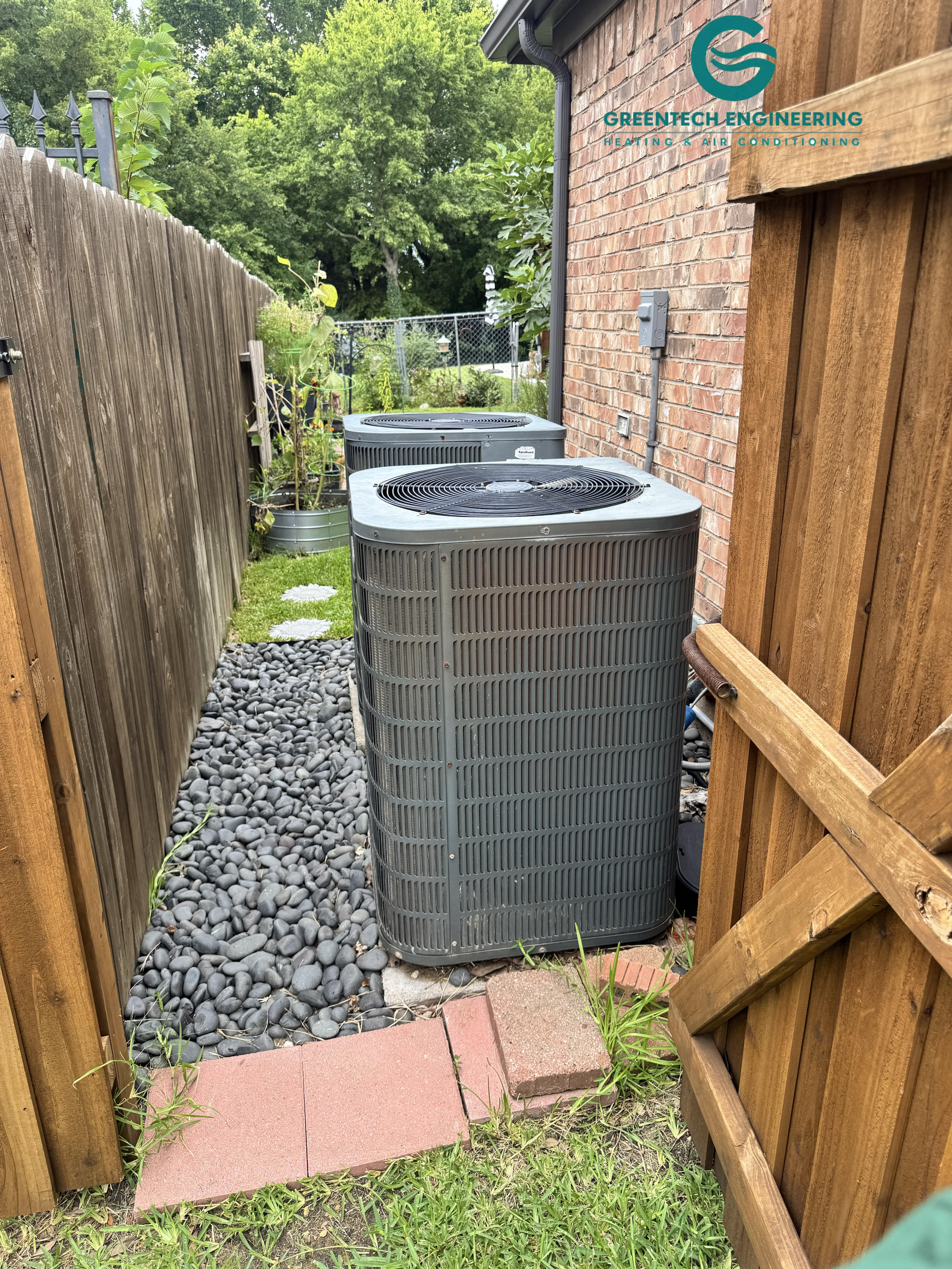
The second served area received a nominal 5-ton Daikin two-stage R-32 air-conditioning system paired with a horizontal evaporator coil and an 80% AFUE gas furnace. The previous outdoor unit documented for this served area was a nominal 4-ton Goodman unit. That project fact does not mean that increasing tonnage is generally appropriate; another home requires its own evaluation.
AHRI Certified Reference Number 217655949 identifies the new matched combination. According to the retained certificate, its certified performance is:
- 56,000 BTUH certified cooling capacity
- 15.5 SEER2
- 12.0 EER2
- 100,000 BTUH furnace input
- 80,000 BTUH furnace output at 80% AFUE
The 5-ton system also received one additional 14-inch return-air duct. No post-installation CFM or static-pressure result is published for this project, so the added duct is described as documented installation scope—not as proof of a quantified airflow improvement.
Why the Two AHRI Ratings Are Different
The two systems use the same manufacturer and the same general two-stage R-32 equipment family, but their certified results are not identical.
Nominal 4-ton match
- AHRI reference: 216615141
- Certified cooling capacity: 45,500 BTUH
- Efficiency: 17.2 SEER2 and 12.5 EER2
- Furnace: 80,000 BTUH input and 64,000 BTUH output
Nominal 5-ton match
- AHRI reference: 217655949
- Certified cooling capacity: 56,000 BTUH
- Efficiency: 15.5 SEER2 and 12.0 EER2
- Furnace: 100,000 BTUH input and 80,000 BTUH output
AHRI certification ties published performance to a specific combination of components. It is more precise than quoting the highest efficiency advertised for an equipment family. The private AHRI certificates were used to verify this article, but the certificate images are not published because they are supporting records rather than public content.
SEER2 is a standardized seasonal cooling-efficiency metric, while EER2 reflects performance under specified test conditions. Neither rating guarantees a particular electricity bill or savings percentage. Actual energy use depends on weather, settings, runtime, installation, duct conditions, the home, utility rates and occupant behavior.
Why Each System Received an Additional 14-Inch Return
An air-conditioning system operates through a complete air path. Supply ducts deliver conditioned air to the home, and return ducts carry air back to the equipment. Replacing the condenser, coil and furnace without considering the return side can leave an important part of the system unaddressed.
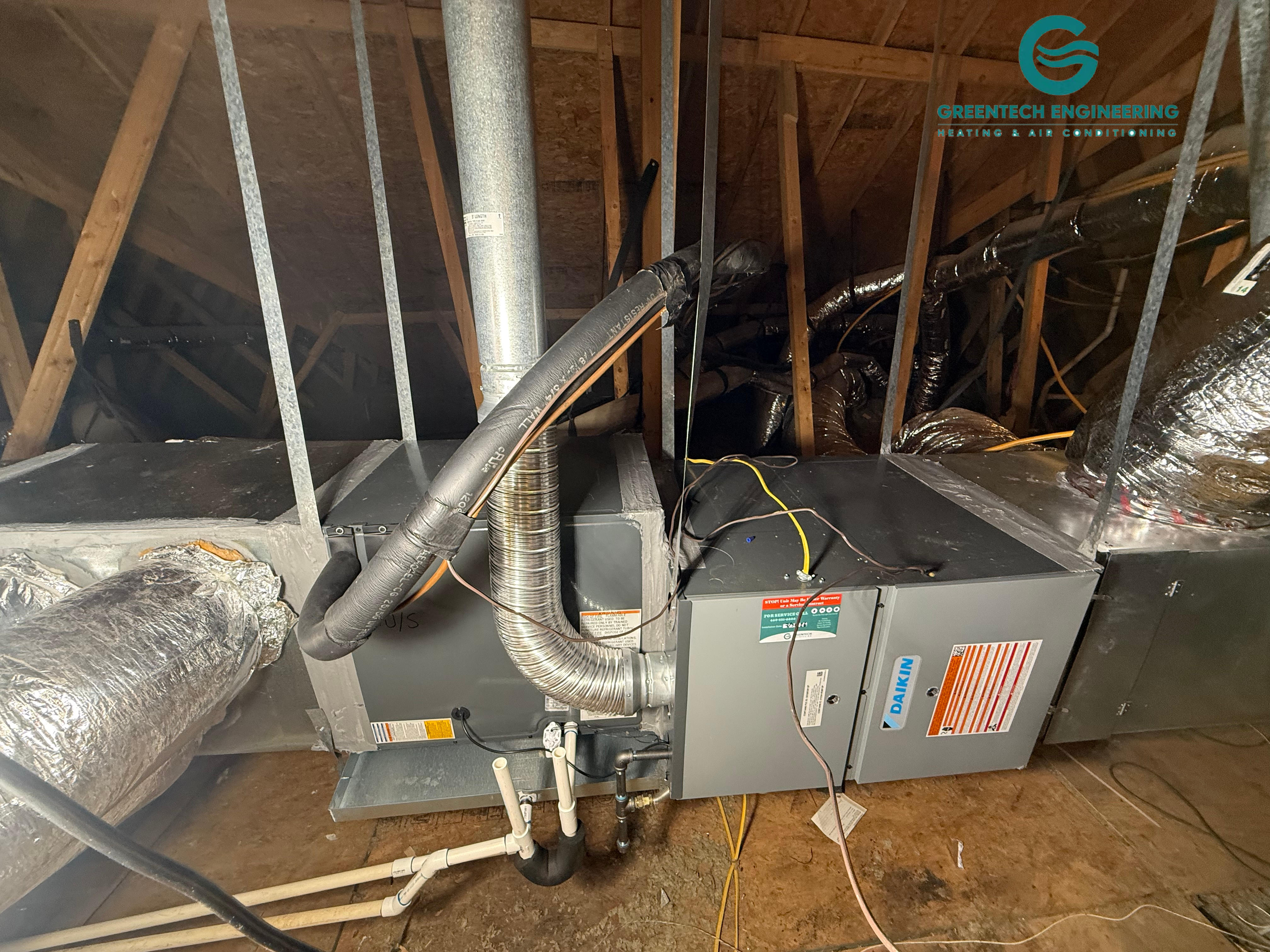
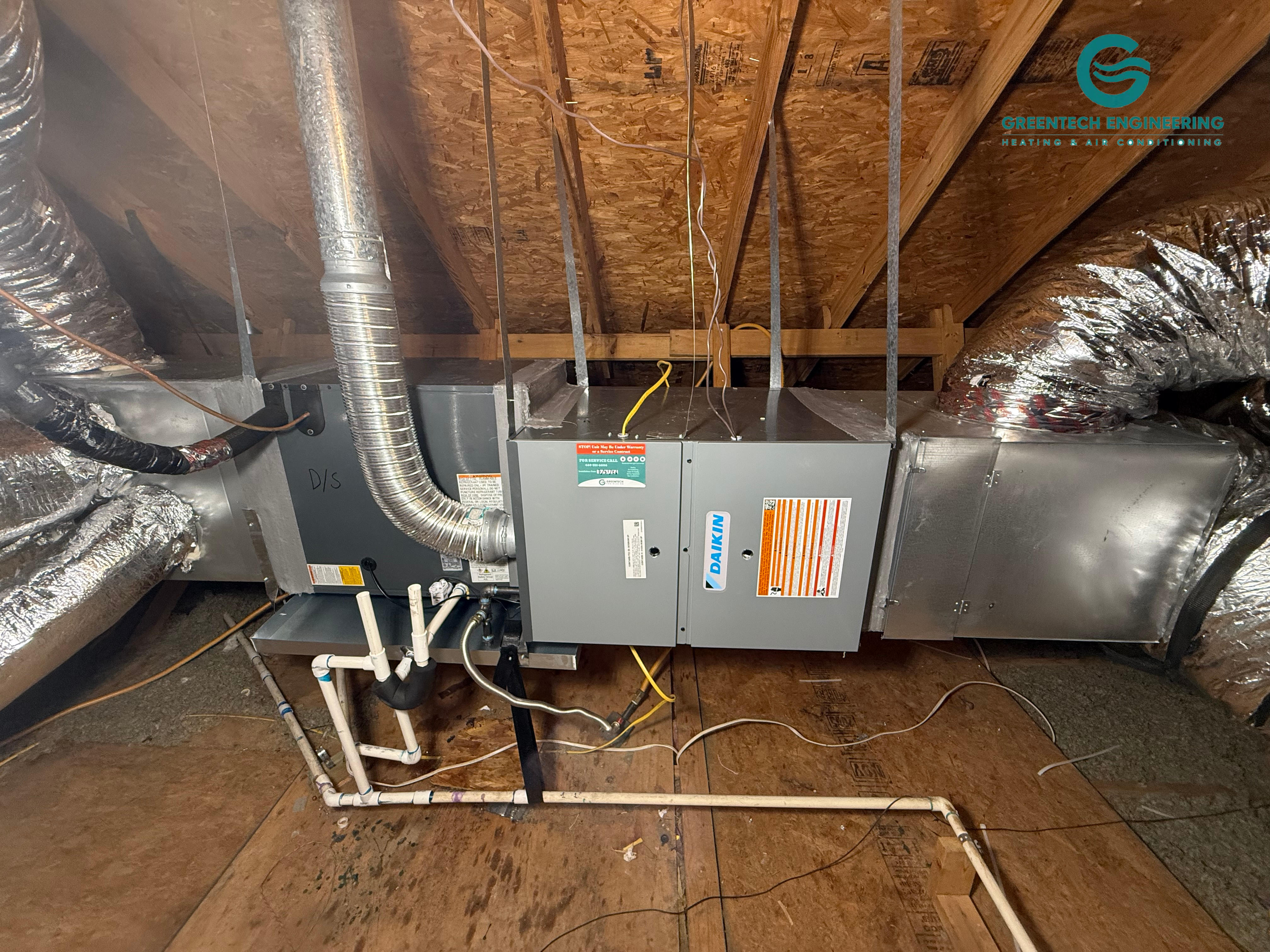
For this Grand Prairie project, the documented scope included one additional 14-inch return-air duct for each replacement system—a total of two added returns. It also included associated flex duct, sheet-metal transitions and return-side plenum connections.
The 14-inch dimension is the nominal duct size, not a published airflow measurement. Actual airflow depends on duct length, routing, fittings, compression, filter and grille resistance, blower settings and total external static pressure. Because this article does not have verified post-installation CFM or static-pressure results, it makes no quantified airflow claim.
Homeowners who want to understand the role of return pathways can read Greentech's overview of return-air and duct-system evaluation.
Why Plenums and Transitions Belong in the Replacement Scope
The indoor coil, furnace and duct system connect through plenums and sheet-metal transitions. When the dimensions of new equipment differ from the removed components, custom fitting work may be needed to create the new connection and maintain an appropriate air path.
The project photographs show horizontal attic installations with new or modified transitions, plenums and return-side connections. These details are less visible than the outdoor condensers, but they are part of the installed system. A proposal that compares only brand, tonnage and SEER2 can miss the duct and fitting work required to integrate replacement equipment with the house.
How the $1,430.46 Oncor Incentive Was Applied
The project received an approved $1,430.46 Oncor incentive, which Greentech passed through to the homeowner as an instant discount on the project invoice.
Oncor's 2026 Home Energy Efficiency program provides incentives through approved service providers for qualifying residential efficiency projects. The program manual states that final incentive dollars are not determined until the applicable production report is approved. Eligibility also depends on program rules, documentation and available funding.
The $1,430.46 amount in this case is not a standard rebate or a promise of what another homeowner will receive. Oncor is not presented as endorsing Greentech. For current program context, see Greentech's 2026 Oncor HVAC incentive guide and confirm project eligibility before treating an incentive as part of a replacement budget.
What the Three-Year Labor Warranty Means
Greentech provided a three-year/1,095-day labor warranty under the project's written warranty terms. The labor warranty is non-transferable and is void if ownership of the property changes. Manufacturer parts coverage is separate from Greentech's labor coverage.
The signed written warranty controls the complete scope, conditions and exclusions. Homeowners should keep the agreement and the manufacturer's documentation with their installation records.
What Grand Prairie Homeowners Can Learn From This Case
The lesson is not that one floor always needs more tonnage than another, or that a larger replacement is automatically better. The lesson is that two-system homes require two equipment decisions supported by the areas served, the technical record, the exact matched equipment and the air-distribution system.
Before comparing two-system replacement proposals, ask:
- What area does each system serve?
- What technical evaluation supports each proposed capacity?
- Are the outdoor unit, indoor coil and furnace part of the stated AHRI-certified match?
- What are the exact certified capacity, SEER2 and EER2 values for each match?
- Does each return-air path fit the replacement equipment and installation plan?
- Are required plenums, transitions, flex ducts or return additions included?
- Is an Oncor incentive available for this project, and how will it appear on the invoice?
- What do the written labor and manufacturer warranties cover?
Those questions create a more useful comparison than choosing equipment only by brand name or nominal tonnage.
Frequently Asked Questions
Should both HVAC systems in a two-story home be the same size?
Not necessarily. Separate systems may serve areas with different design loads, construction, exposure, duct layouts and airflow requirements. This Grand Prairie project used nominal 4-ton and 5-ton systems, but those capacities should not be copied to another home without a project-specific evaluation.
Did the Manual J cover only one floor?
No. The project-specific Manual J covered the whole home. It was one part of the technical record and should not be described as an upstairs-only or downstairs-only report. The complete report remains private.
Why was a previous 4-ton outdoor unit replaced with a nominal 5-ton system?
The documented final selection for that served area was a nominal 5-ton matched system. The previous unit's tonnage was not treated as the only selection criterion. This case does not establish that upsizing is generally appropriate or that larger equipment automatically improves comfort.
What does an AHRI-certified match mean?
It means the published capacity and efficiency apply to a certified combination of components. In this project, the 4-ton and 5-ton systems have different AHRI reference numbers, certified cooling capacities, SEER2 ratings and EER2 ratings.
Are both systems rated at 17.2 SEER2?
No. The nominal 4-ton match is certified at 17.2 SEER2, while the nominal 5-ton match is certified at 15.5 SEER2. An “up to” rating for a product family should not replace the exact rating for the installed combination.
Why was an additional 14-inch return added to each system?
The documented project scope called for one additional 14-inch return-air duct for each replacement system. Return pathways are part of the complete air-distribution system. Because verified post-installation airflow and static-pressure measurements are not published here, no specific CFM improvement is claimed.
Is the $1,430.46 Oncor incentive available to every homeowner?
No. That amount was approved for this project and passed through as an instant discount. Eligibility, equipment requirements, documentation, approval, funding and amounts are project-specific and can change.
Request a Two-System HVAC Evaluation in Grand Prairie
A two-system home may require different equipment matches and different duct solutions for the areas served. Greentech Engineering Heating & Air Conditioning — DFW HVAC evaluates the home, equipment combinations and air-distribution requirements before making a replacement recommendation.
Request an HVAC replacement evaluation, explore Grand Prairie HVAC services, or review Greentech's AC replacement service in Grand Prairie.
About the Author
Siwei (Lucas) Chen
Chief Technology Officer | Greentech Engineering Heating & Air Conditioning — DFW HVAC
Siwei (Lucas) Chen focuses on engineering-driven HVAC diagnostics, system performance and residential airflow. He holds a B.S. in Mechanical Engineering from Virginia Tech. His verified training and credentials include the ACCA Residential Design for Quality Installation Course, NCI Certified Duct System Optimization Specialist and NCI Certified Residential Air Balancer.

Flexible Financing Options
Explore our range of flexible financing options designed to suit your needs and budget.