





Upstairs AC Not Cooling in Little Elm, TX: A Leaking Evaporator Coil and Matched-System Replacement
By Siwei (Lucas) Chen, Chief Technology Officer
Published July 28, 2026 | Technically reviewed July 28, 2026
When the upstairs AC in a two-story Little Elm home stopped cooling properly, the issue was not assumed to be a thermostat problem or solved with refrigerant alone. The approximately 10-year-old Lennox system was diagnosed with a leaking evaporator coil. Refrigerant was added as a temporary measure, and the homeowner later approved replacement with an AHRI-certified 3-ton Daikin R-32 matched system.
Short answer: In this Little Elm home, the upstairs AC was not cooling because the approximately 10-year-old system had a leaking evaporator coil. Adding refrigerant temporarily restored operation but did not repair the leak. The homeowner later approved a matched 3-ton Daikin R-32 system replacement.
Case at a Glance
- Location: Little Elm, TX 75068
- Property: Two-story single-family home
- Initial service date: July 9, 2026
- Installation completion date: July 27, 2026
- Reported problem: Upstairs HVAC system not cooling
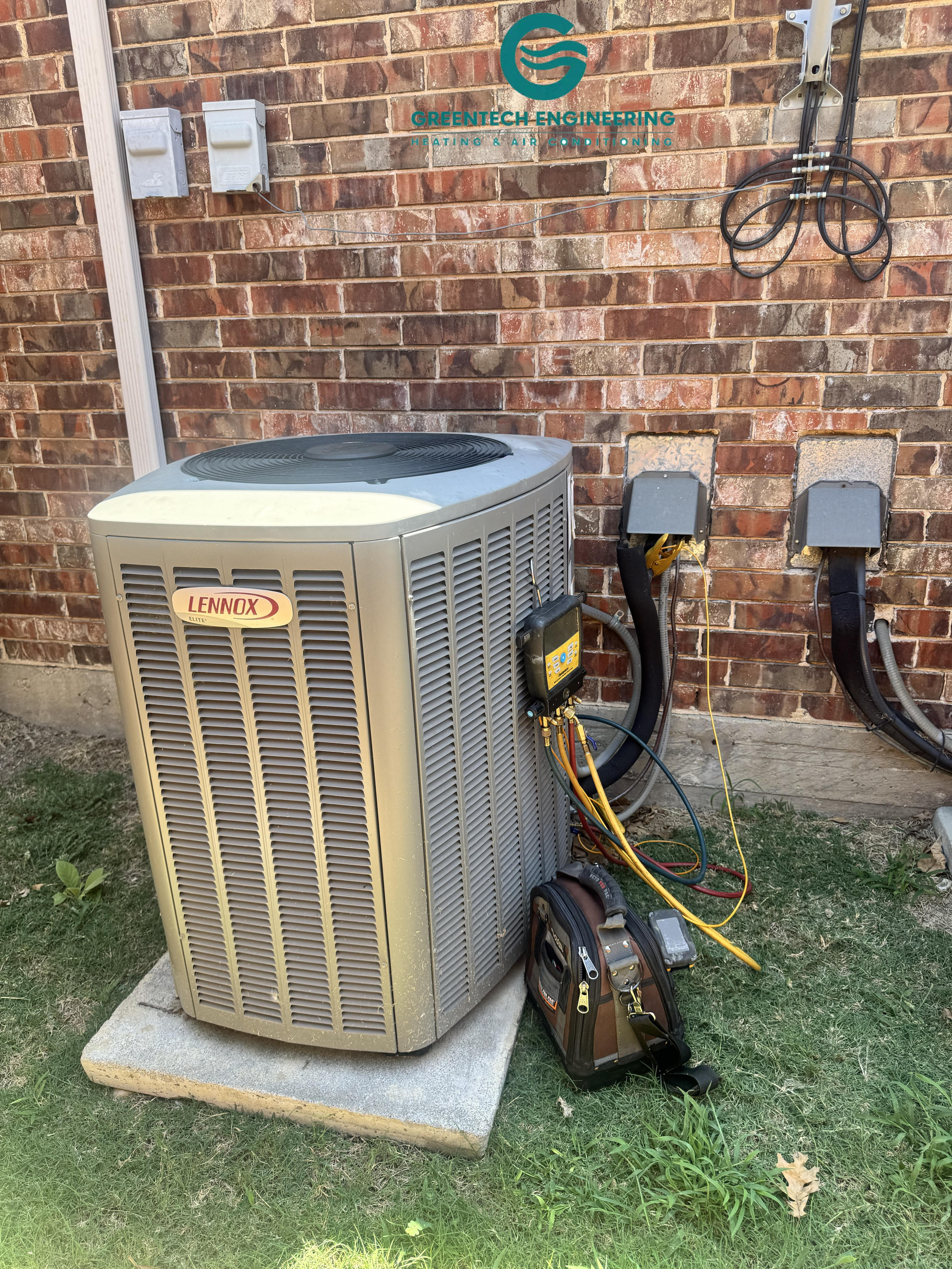
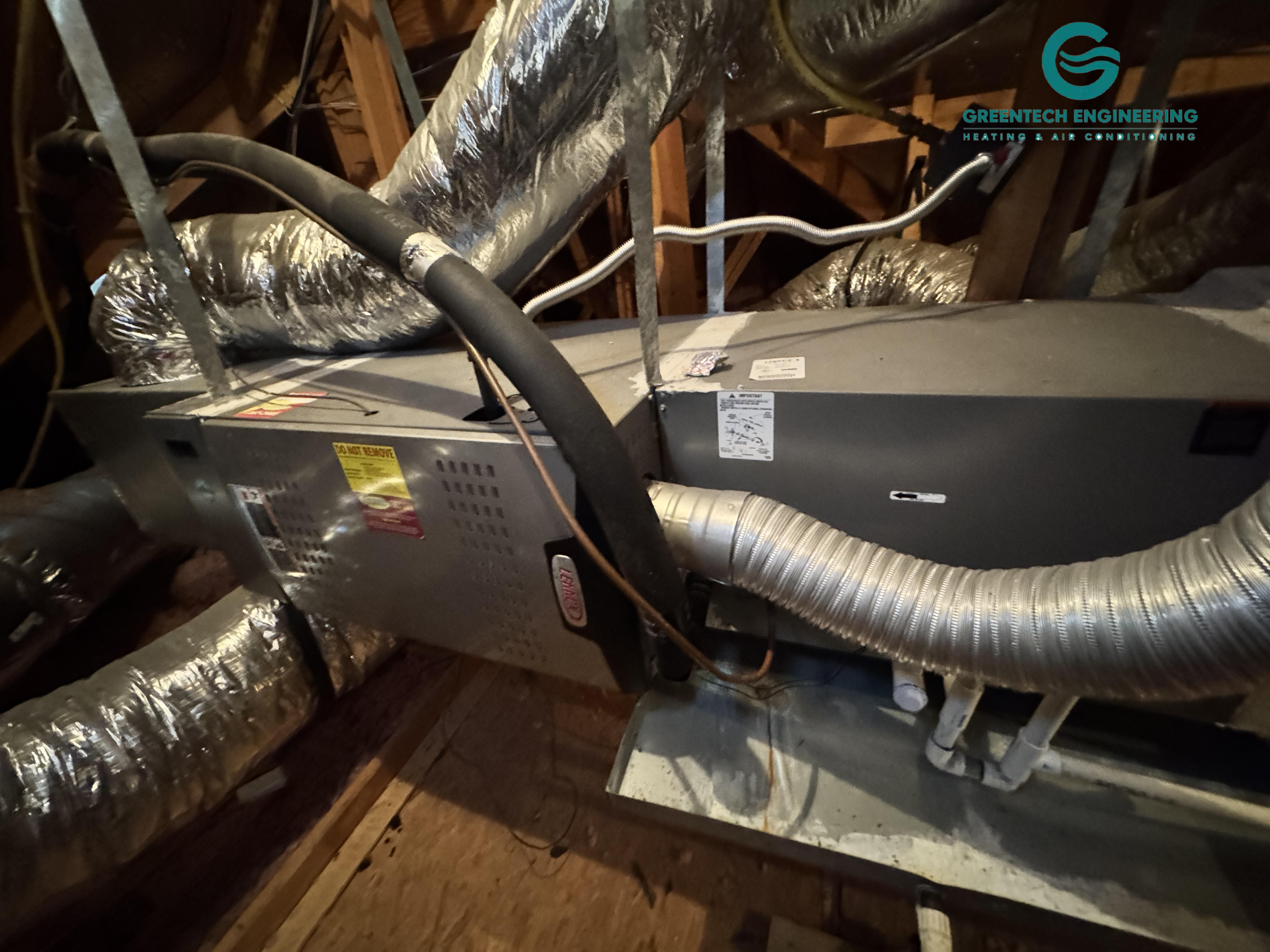
- Existing system: Approximately 10-year-old, 3-ton Lennox split gas system
- Diagnosis: Leaking evaporator coil
- Temporary measure: Refrigerant added; not presented as a permanent repair
- Final work: Full upstairs-system replacement
- New system: 3-ton Daikin R-32 matched system
- AHRI Certified Reference Number: 214855794
- Certified rating: 15.2 SEER2, 12.0 EER2 and 34,400 BTU/h cooling capacity
- Indoor configuration: Horizontal evaporator coil with an 80% AFUE gas furnace
- Furnace input: 60,000 BTU/h
- Blower: Four-ton airflow class
- Controls: Ecobee Smart Thermostat Premium
- Recorded post-installation observation: Approximately 16°F return-to-supply temperature difference
- Greentech labor warranty: Three years/1,095 days, subject to the written warranty terms
Project evidence reviewed: Service records dated July 9 and July 27, 2026; project and equipment photographs; matched-system AHRI information; a recorded post-installation temperature observation; and Greentech’s written labor-warranty terms.
Why Was the Upstairs HVAC System Not Cooling?
The upstairs system was diagnosed with a leaking evaporator coil. The evaporator coil is the indoor heat-transfer component that absorbs heat from the home’s air. When refrigerant escapes from a leak, the system can lose cooling capacity and may no longer maintain the upstairs temperature.
An upstairs area that feels warm does not automatically prove that an evaporator coil is leaking. Similar symptoms can also involve airflow restrictions, duct leakage, control problems, equipment faults or an incorrect refrigerant charge. A qualified HVAC technician should diagnose the actual cause before recommending a repair or replacement.
In this Little Elm, TX 75068 case, the affected equipment was an approximately 10-year-old, 3-ton Lennox split gas system serving the second floor.The confirmed diagnosis was a leaking evaporator coil. The project record does not identify a more specific leak location or the leak-detection method, so no additional claim about either is being made.
Homeowners experiencing a similar problem can schedule an AC diagnostic appointment to determine whether the cause involves refrigerant loss, airflow, controls, electrical components or another issue.
Was Adding Refrigerant a Permanent Repair?
No. Refrigerant was added during the initial service visit as a temporary measure. Adding refrigerant can restore some cooling when a system is low, but it does not seal or repair a leaking evaporator coil.
When a leak remains, refrigerant can escape again. The appropriate next step depends on the confirmed failure, system age and condition, repair scope, equipment compatibility and the homeowner’s goals. In this case, the homeowner later approved full replacement of the upstairs system.
Why Did the Homeowner Choose Full-System Replacement?
The homeowner later approved full-system replacement after the leaking evaporator coil was diagnosed and refrigerant had been added temporarily.
The available project record confirms the homeowner’s decision but does not document every financial or technical factor considered. Therefore, this case study does not claim that replacement was selected solely because of system age, repair cost, efficiency or any other single factor.
In general, homeowners evaluating repair versus replacement may consider:
- The confirmed equipment failure;
- The age and overall condition of the system;
- Repair cost and component availability;
- Compatibility of new and existing components;
- Certified performance of available matched systems;
- Labor and equipment warranty terms;
- Future comfort requirements;
- Expected length of property ownership.
These are general homeowner decision factors, not additional claims about this customer’s specific reasoning.
For a broader explanation, read Repair or Replace HVAC in Little Elm? That article remains Greentech’s main educational repair-versus-replacement resource, while this case study provides a real-world example.
Homeowners already evaluating replacement can also explore AC replacement options.
Why Was the System Replaced?
The existing Lennox system was approximately 10 years old, and the diagnosed failure involved the evaporator coil. Rather than presenting repeated refrigerant additions as a permanent solution, Greentech documented the leak and the temporary nature of the initial service.
The homeowner subsequently chose a complete matched-system replacement. This article does not assign financial reasoning or other motivations to the homeowner that were not documented in the project record.
What Equipment Was Installed?
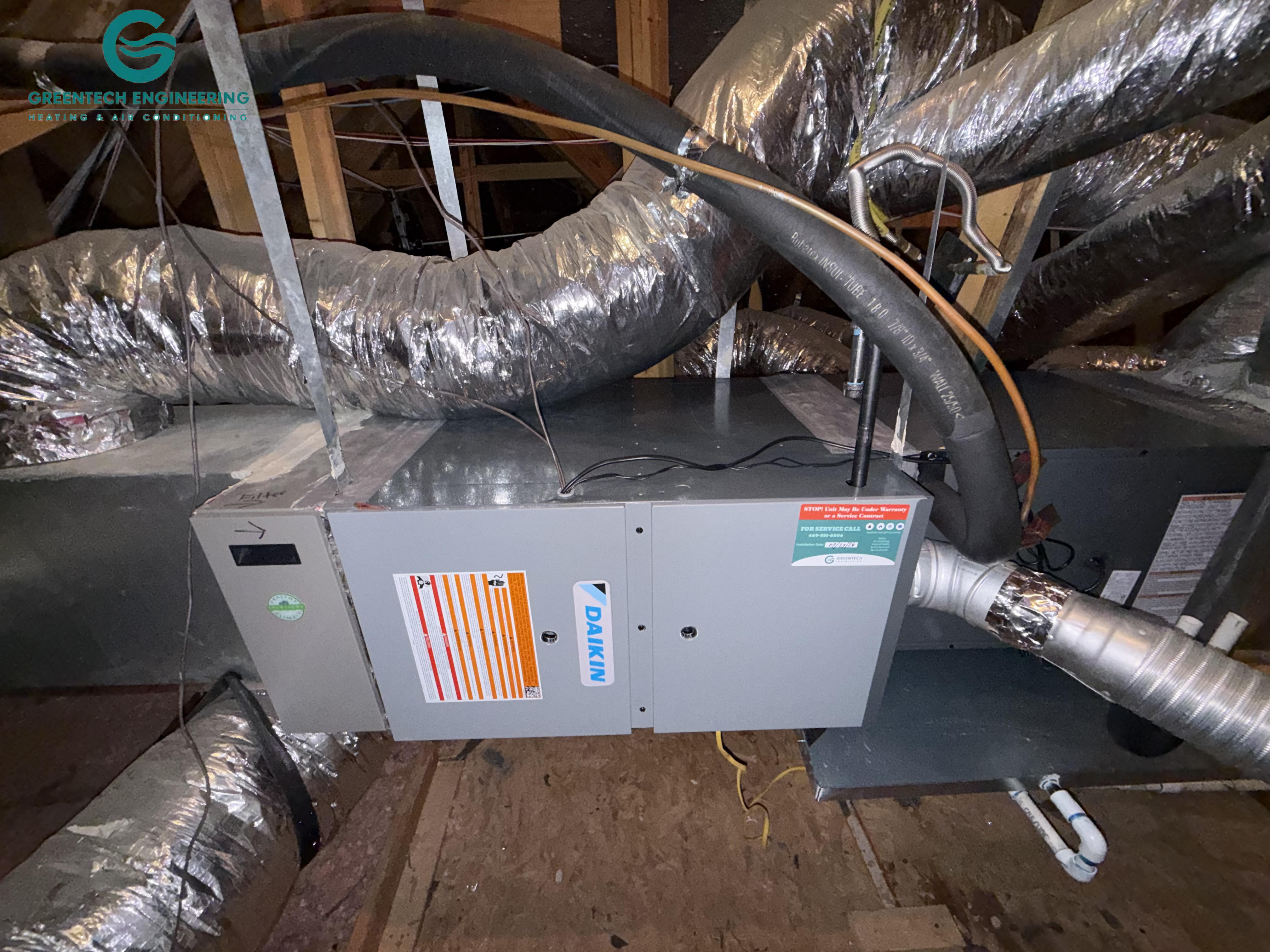
The replacement was a matched 3-ton Daikin R-32 split system:
- Outdoor unit: Daikin DC4SEA3610AA
- Horizontal evaporator coil: Daikin CHPTA3630B3AA
- Gas furnace: Daikin DR80SN0604BXAA
- Furnace efficiency: 80% AFUE
- Furnace input: 60,000 BTU/h
- Blower: Four-ton airflow class
- Thermostat: Ecobee Smart Thermostat Premium
- Refrigerant: R-32
Publishing the model numbers helps identify the installed matched system. Equipment serial numbers and the homeowner’s exact address are intentionally excluded.
What Does the AHRI Rating Confirm?
AHRI Certified Reference Number 214855794 identifies the certified equipment combination used for this project. The matched system is rated at:
- 15.2 SEER2
- 12.0 EER2
- 34,400 BTU/h certified cooling capacity
An AHRI certificate confirms the published performance of the specified equipment combination under standardized rating conditions. It does not, by itself, prove field airflow, duct performance, delivered capacity in the home or future utility-bill savings.The certification can be checked through the AHRI Directory of Certified Product Performance.
What Was Observed After Installation?
After installation, an approximately 16°F return-to-supply temperature difference was recorded. This is a useful operating observation, but it should not be treated as a complete commissioning report or as proof of total system capacity.
A temperature difference can be influenced by indoor conditions, humidity, airflow, measurement location and equipment operating state. Complete performance evaluation may require additional measurements that were not included in the verified case record used for this article.
What Warranty Applies to This Project?
Greentech provided a three-year/1,095-day labor warranty, subject to the complete written terms. The warranty is non-transferable and is void if ownership of the property changes.
Manufacturer warranty terms are not stated here because they were not independently verified for publication. Homeowners should review their equipment registration and the applicable manufacturer documents for complete coverage, exclusions and maintenance requirements.
What Should Little Elm Homeowners Do When the Upstairs AC Is Not Cooling?
Start with a diagnosis rather than assuming the system only needs refrigerant. A technician should evaluate the symptoms and determine whether the problem involves refrigerant loss, the evaporator coil, airflow, ducts, controls or another component.
If a leak is confirmed, ask:
- Where is the leak and how was it confirmed?
- Is adding refrigerant only a temporary measure?
- What are the repair and matched-system replacement options?
- How do system age, condition and component compatibility affect the decision?
- If replacement is proposed, is the selected combination AHRI certified?
- What startup observations and warranty terms will be documented?
Visit our Little Elm HVAC service page — for local service information, or schedule an AC diagnostic .
Frequently Asked Questions
Why is my upstairs AC running but not cooling?
Possible causes include low refrigerant from a leak, a failing evaporator coil, restricted airflow, duct leakage, control problems or other equipment faults. The symptom alone does not identify the cause; the system should be tested before repair recommendations are made.
Can an evaporator-coil leak be fixed by adding refrigerant?
No. Adding refrigerant replaces some of what escaped but does not repair the leak. It may be used temporarily in some situations, but the leak remains unless the failed component or leak itself is properly addressed.
Should I replace only the evaporator coil or the complete HVAC system?
The answer depends on the system’s age and condition, refrigerant type, component compatibility, repair cost and the available matched replacement options. A contractor should explain both technically valid repair and replacement paths using the facts of the specific system.
What is an AHRI-certified matched HVAC system?
It is a combination of indoor and outdoor equipment tested and rated together under standardized conditions. The AHRI reference helps confirm that the listed components form a certified combination and provides published efficiency and capacity ratings.
Is a 16°F return-to-supply temperature difference good?
It can be a useful operating observation, but it is not enough by itself to confirm total system performance. Indoor temperature, humidity, airflow, equipment state and measurement location all affect the reading.
Do you provide HVAC service in Little Elm, TX?
Greentech Engineering Heating & Air Conditioning — DFW HVAC provides HVAC diagnostic, repair and replacement services for homeowners in Little Elm and other parts of the Dallas–Fort Worth area.
Schedule an HVAC Evaluation in Little Elm
If your upstairs AC is running but not cooling, request a professional diagnosis before assuming that more refrigerant will solve the problem.
About the Author
Siwei (Lucas) Chen
Chief Technology Officer | Greentech Engineering Heating & Air Conditioning — DFW HVAC
Siwei (Lucas) Chen focuses on engineering-driven HVAC diagnostics, system performance and residential airflow. He holds a B.S. in Mechanical Engineering from Virginia Tech. His verified training and credentials include the ACCA Residential Design for Quality Installation Course, NCI Certified Duct System Optimization Specialist and NCI Certified Residential Air Balancer.

Flexible Financing Options
Explore our range of flexible financing options designed to suit your needs and budget.