






Dallas 75287 Upstairs HVAC Replacement: Lennox to Daikin R-32
Greentech Engineering Heating & Air Conditioning — DFW HVAC completed an upstairs-only HVAC replacement in a two-level Dallas 75287 home on September 19, 2026. The project replaced Lennox R-410A equipment with a matched nominal 4-ton Daikin R-32 cooling-only A/C, horizontal evaporator coil and 80% AFUE gas furnace. AHRI reference 214856292 rates the combination at 45,500 BTU/h, 14.5 SEER2 and 11.7 EER2. This case documents equipment and scope—not a diagnosis, load calculation or measured comfort result.
Considering an upstairs A/C and furnace replacement? Review A/C replacement options in Dallas or request an equipment and installation assessment.
Project at a glance
- Location: Dallas, Texas 75287; street address withheld.
- Home: Two-level single-family residence.
- System replaced: Upstairs HVAC system only.
- Completion date: September 19, 2026.
- Previous outdoor equipment: Lennox
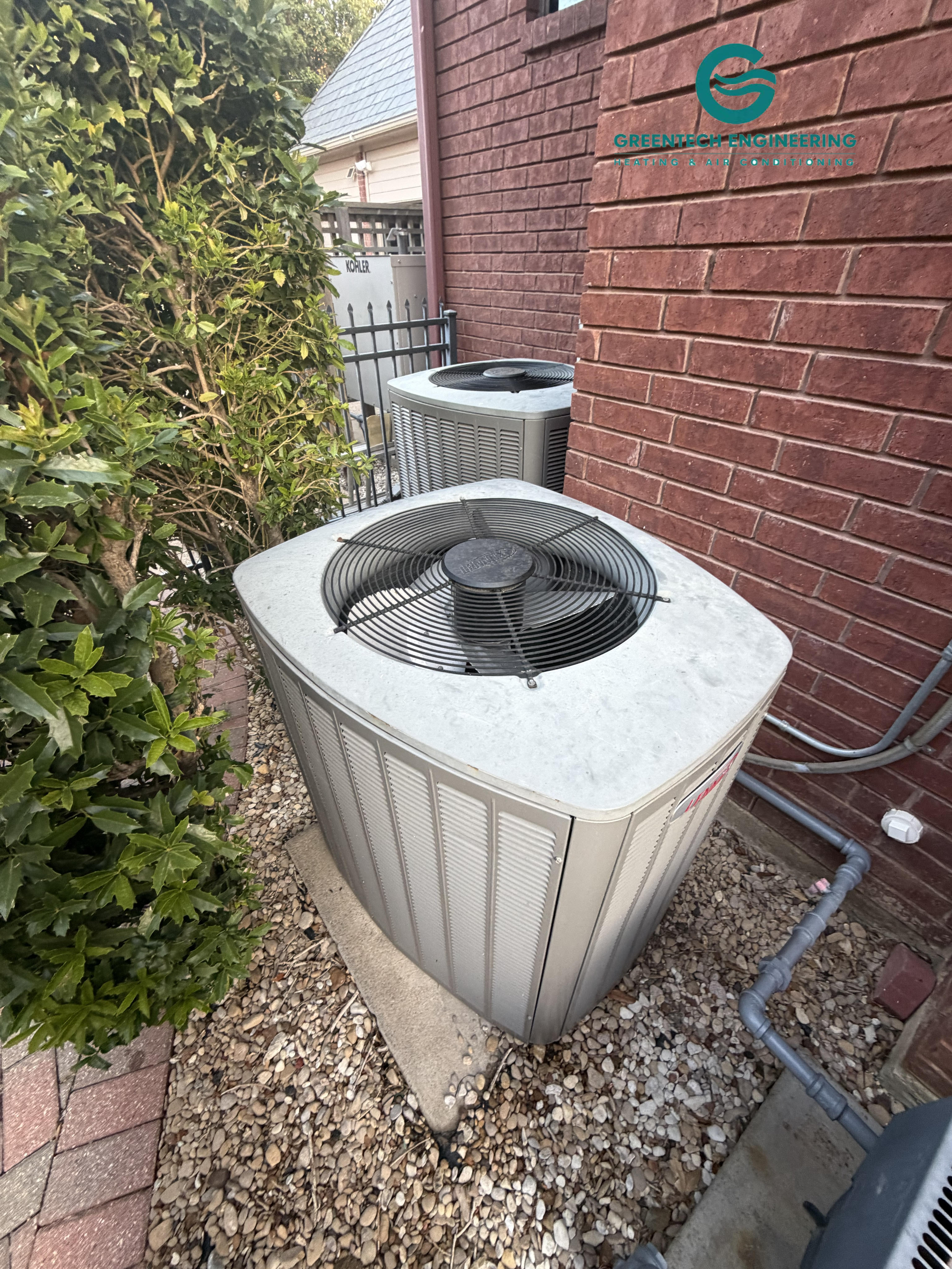
XC14-048-230-01, nominal 4-ton, R-410A condenser. - Previous indoor coil: Lennox
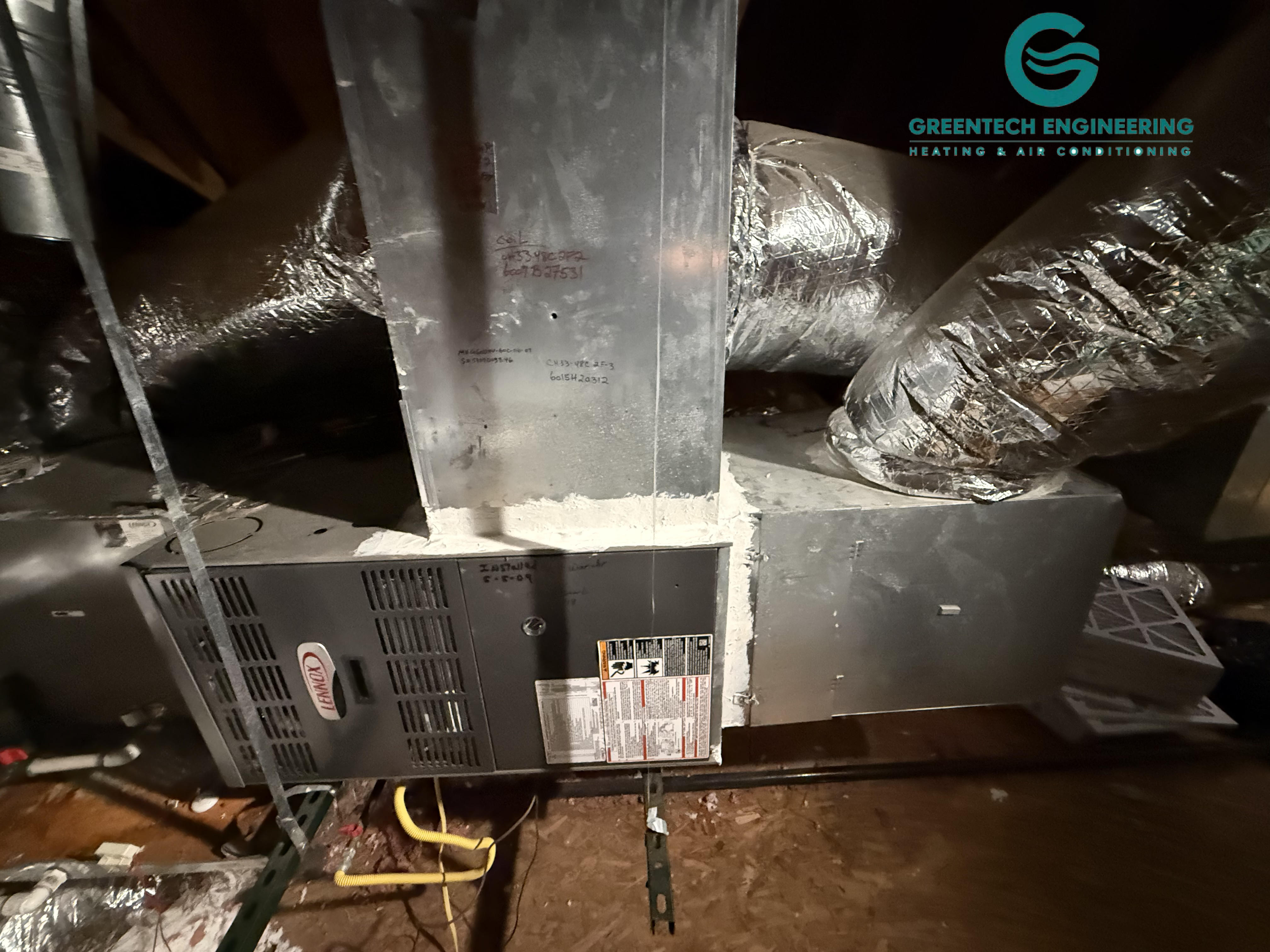
CH33-48C-2F-3. - New outdoor unit: Daikin
DC4SEA4810AA, nominal 4-ton, R-32 cooling-only A/C. - New evaporator coil: Daikin
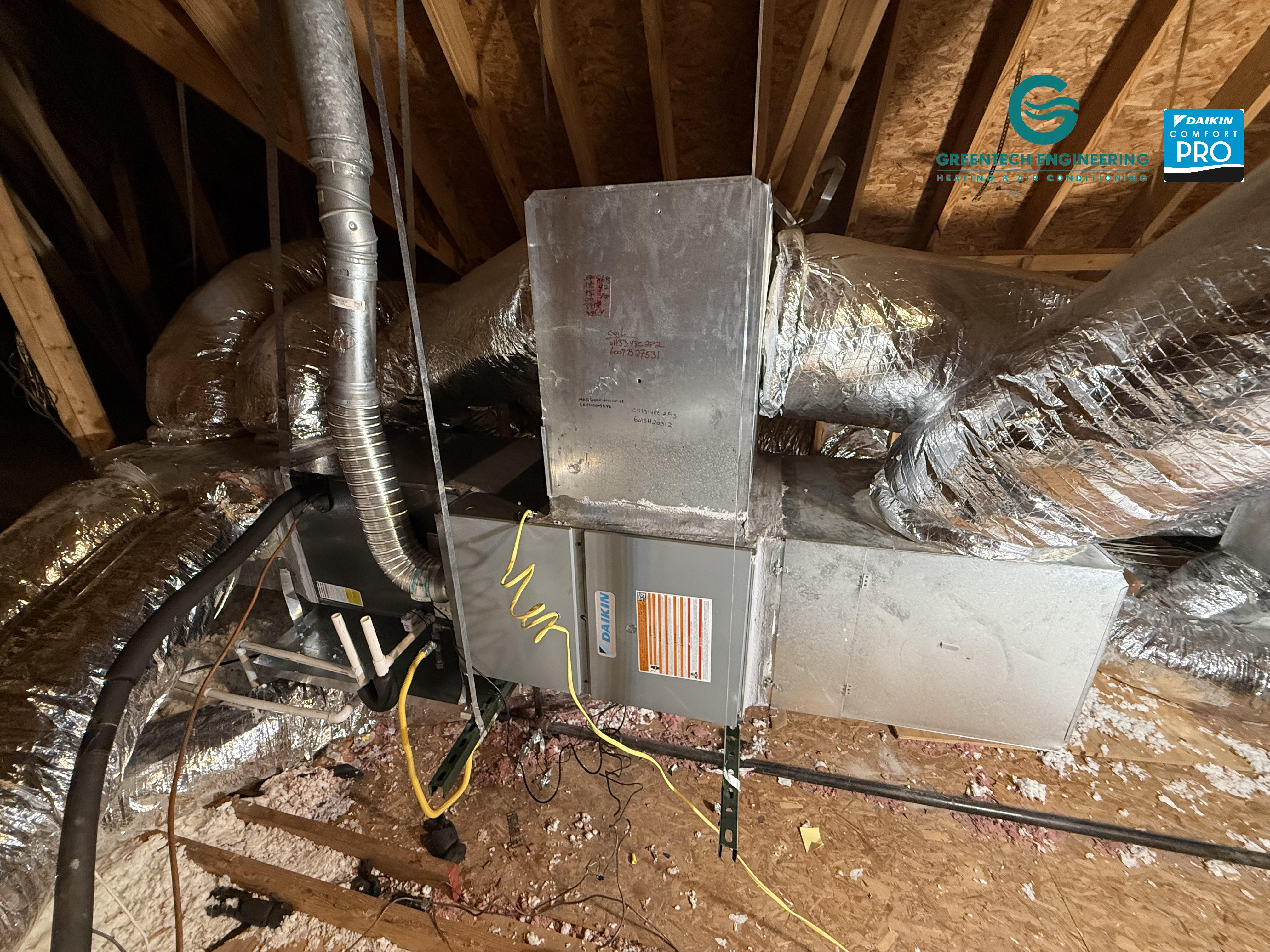
CHPTA4830C3AAhorizontal cased coil. - New gas furnace: Daikin
DR80SN0805CXAA, 80,000 BTU/h input, 64,000 BTU/h output and 80% AFUE. - Certified match: AHRI 214856292; 45,500 BTU/h; 14.5 SEER2; 11.7 EER2.
- Technical verification: Equipment records reviewed September 23, 2026.
An upstairs-only replacement—not a whole-home replacement
This case covers one HVAC system serving the upstairs of a two-level house. The records do not show that the home’s other HVAC system was replaced or modified as part of this project.
Before replacement, the upstairs cooling system used a nominal 4-ton Lennox XC14-series outdoor condenser labeled for R-410A refrigerant. The horizontal attic assembly included a Lennox evaporator coil. The labels and project photos confirm those equipment identities, but they do not establish the system’s installation year, service history or reason for replacement.
The matched Daikin R-32 system
The replacement combines three pieces of equipment in one AHRI-listed match:
- a Daikin
DC4SEA4810AAR-32 cooling-only outdoor A/C; - a Daikin
CHPTA4830C3AAhorizontal cased evaporator coil; and - a Daikin
DR80SN0805CXAAsingle-stage, 80% AFUE gas furnace.
The outdoor unit is an air conditioner, not a heat pump. It provides cooling, while the gas furnace provides heat. The indoor equipment is therefore a furnace-and-coil assembly, not an air handler.
The furnace label lists 80,000 BTU/h input and 64,000 BTU/h output. Calling it a “5-ton furnace” would be inaccurate: furnace heating is described by BTU/h and AFUE, while tonnage describes the nominal cooling-equipment class and related airflow application.
Daikin describes the DC4SE family as an R-32 split-system air conditioner available across nominal 1.5- to 5-ton classes. The exact ratings for this project come from its AHRI-listed equipment combination, not from a family maximum. See the official Daikin DC4SE product information.
What AHRI 214856292 verifies
AHRI reference 214856292 lists the project’s equipment combination at:
- 45,500 BTU/h certified cooling capacity;
- 14.5 SEER2; and
- 11.7 EER2.
“Four ton” is the nominal equipment class. One nominal ton corresponds to 12,000 BTU/h, so a 4-ton class broadly corresponds to 48,000 BTU/h. The certified output of this exact match is 45,500 BTU/h; the nominal label should not be substituted for that certified value.
AHRI certification reports standardized performance for the listed indoor/outdoor combination. It does not prove that the equipment is correctly sized for this house, verify field workmanship or establish a utility-bill or comfort outcome. The AHRI certificate used for technical verification is dated September 23, 2026, four days after installation; this article does not imply that the certificate image was generated before equipment selection or installation.
Readers can search certified combinations through the AHRI Directory of Certified Product Performance.
Documented installation scope
The project scope documents the following work:
- removal and disposal of the old upstairs equipment and recovery of refrigerant;
- placement of the new outdoor unit on a concrete equipment pad;
- installation of the horizontal evaporator coil and gas furnace in the attic;
- connection to the existing return and supply plenums, with accessible connections sealed using HVAC-rated materials;
- condensate-drain and drain-safety components;
- necessary gas-line and flue-pipe transitions;
- preparation of the existing copper line set using RX-11 and dry nitrogen;
- refrigerant connections brazed with 15% silver brazing alloy; and
- documented leak-test, evacuation, startup and operational-check procedures.
Signed closeout readings were not supplied for this article. Therefore, pressure, vacuum, airflow, static-pressure, refrigerant-charge and temperature values are not presented as measured final results.
What the photos show—and cannot prove
The before-and-after record supports the equipment transition from a Lennox R-410A outdoor condenser and older horizontal attic components to the listed Daikin R-32 A/C, coil and gas furnace.
Photos can document visible equipment and installation context. They cannot, by themselves, verify final airflow, static pressure, refrigerant charge, duct leakage, combustion safety, temperature split or household comfort.
One internal project image shows a 57.4°F infrared surface reading. Without a documented return-air temperature, measurement location, instrument method and test conditions, that image does not establish a final supply-air temperature or temperature split and should not be used as performance proof.
What changed from R-410A to R-32
The old Lennox outdoor label identifies R-410A. The installed Daikin outdoor label identifies R-32. That makes the refrigerant transition a verifiable project fact.
The refrigerant change does not, by itself, prove energy savings, lower operating cost or better comfort. Those outcomes depend on factors beyond refrigerant type, including the complete certified match, building load, duct system, installation, controls, maintenance, weather and occupant use.
What this case proves—and what it does not
This case documents:
- an upstairs-only HVAC replacement in Dallas 75287 completed September 19, 2026;
- the previous Lennox outdoor and indoor-coil models;
- the installed Daikin outdoor unit, horizontal coil and gas furnace;
- a transition from R-410A equipment to an R-32 air conditioner;
- AHRI reference 214856292 and its certified capacity and efficiency ratings; and
- the qualified installation scope described above.
The available records do not document:
- the homeowner’s original complaint or a failure diagnosis;
- the old system’s age or installation year;
- a project-specific Manual J load calculation or Manual S equipment-selection report;
- right-sizing, downsizing, duct design or air balancing;
- permit or inspection status;
- an Oncor application, approval, incentive or discount;
- labor-warranty duration;
- signed final commissioning measurements; or
- measured energy, comfort, humidity, sound or airflow improvement.
The distinction is important: equipment specifications and a certified match are not the same as field measurements or verified household outcomes.
Frequently asked questions
Was the whole home’s HVAC replaced?
No. This case covers only the HVAC system serving the upstairs of the two-level home. The records do not show replacement of the other system.
Is the new Daikin system a heat pump?
No. The Daikin outdoor unit is a cooling-only air conditioner. The paired gas furnace provides heat.
What does “4 ton” mean in this case?
It is the nominal cooling-equipment class. AHRI reference 214856292 lists the certified cooling capacity of this exact combination as 45,500 BTU/h.
What does AHRI reference 214856292 verify?
It identifies the listed outdoor unit, indoor coil and furnace/blower combination and reports standardized ratings of 45,500 BTU/h, 14.5 SEER2 and 11.7 EER2.
Does 14.5 SEER2 guarantee a specific bill reduction?
No. SEER2 is a standardized equipment rating. Actual energy use depends on weather, thermostat settings, building load, duct performance, installation, maintenance and operating conditions.
Does the 57.4°F infrared photo prove the final temperature split?
No. It shows one surface observation without the return-air temperature, measurement location, instrument method or test conditions needed to establish a temperature split.
Did this Dallas project receive an Oncor incentive?
No Oncor eligibility, application, approval or invoice discount was supplied for this project, so no incentive claim is made.
Request an upstairs HVAC replacement assessment in Dallas
If you are evaluating an upstairs A/C and furnace replacement, the existing equipment, building load, duct system, installation conditions and proposed certified match should be reviewed for your home rather than copied from another project.
Request an equipment and installation assessment or explore HVAC service in Dallas.
Manufacturer limited-warranty coverage depends on the exact model, eligible registration and the manufacturer’s controlling written terms. No project-specific labor-warranty duration is stated because none was supplied for this case.
About the author
Siwei (Lucas) Chen
Chief Technology Officer | Greentech Engineering Heating & Air Conditioning — DFW HVAC
Siwei (Lucas) Chen applies an engineering-based, data-first approach to residential HVAC system design, diagnostics, airflow measurement, equipment selection and duct-system optimization across Dallas–Fort Worth. He holds a B.S. in Mechanical Engineering from Virginia Tech.
Lucas completed ACCA’s Residential Design for Quality Installation Course, which covers residential design procedures associated with ACCA Manuals J, S, T and D. He is also an NCI Certified Residential Air Balancer and NCI Certified Duct System Optimization Specialist.

Flexible Financing Options
Explore our range of flexible financing options designed to suit your needs and budget.