






Dallas 75229 Commercial RTU Replacement: Daikin R-32 With a Custom Curb Adapter
On September 24, 2026, Greentech Engineering Heating & Air Conditioning — DFW HVAC completed a commercial rooftop-unit replacement in Dallas, Texas 75229. The project paired a nominal 5-ton Daikin R-32 straight-cool packaged unit with 20 kW electric heat, an economizer, programmable controls, a custom curb adapter and coordinated crane service. Daikin’s published table lists 57,500 BTU/h, 13.7 SEER2 and 11.8 EER2 for the installed base model. No project-specific AHRI reference was supplied, so those figures are manufacturer-published ratings—not an AHRI-certified match for this installation.
Planning a commercial rooftop-unit replacement in Dallas? Schedule an RTU and curb-compatibility assessment before equipment and crane logistics are finalized.
Dallas commercial RTU project details
- Location: Dallas, TX 75229
- Property: Commercial building; business use and tenant identity not disclosed
- Completion date: September 24, 2026
- Installed equipment: Daikin
DSC0601D000001SAA; public base modelDSC0601D000001S - System type: Packaged straight-cool rooftop A/C with electric heat
- Nominal class: 5 ton
- Daikin-published cooling capacity: 57,500 BTU/h
- Daikin-published efficiency: 13.7 SEER2 and 11.8 EER2
- Refrigerant: R-32
- Electrical: 208/230 V, single phase, 60 Hz
- Heating: 20 kW electric heat kit
- Ventilation and controls: Economizer and programmable thermostat
- Roof interface: Custom curb adapter
- Lifting: Coordinated professional crane service
- Warranty: One-year Greentech labor warranty and Daikin five-year limited parts warranty, subject to the applicable written terms, eligibility requirements and exclusions
Why did this replacement need a custom curb adapter?
A packaged rooftop unit sits on a roof curb that supports the equipment and connects it to the building’s supply and return air openings. A replacement RTU may not align with the existing curb when its footprint or opening arrangement differs from the previous equipment.
A custom curb adapter creates the transition between the existing roof interface and the replacement unit. Planning should account for:
- existing curb and roof-opening geometry;
- the new unit’s footprint and supply/return openings;
- equipment support and fastening requirements;
- airflow transitions to the building ducts;
- access to service panels and utilities; and
- roof-interface flashing and sealing details.
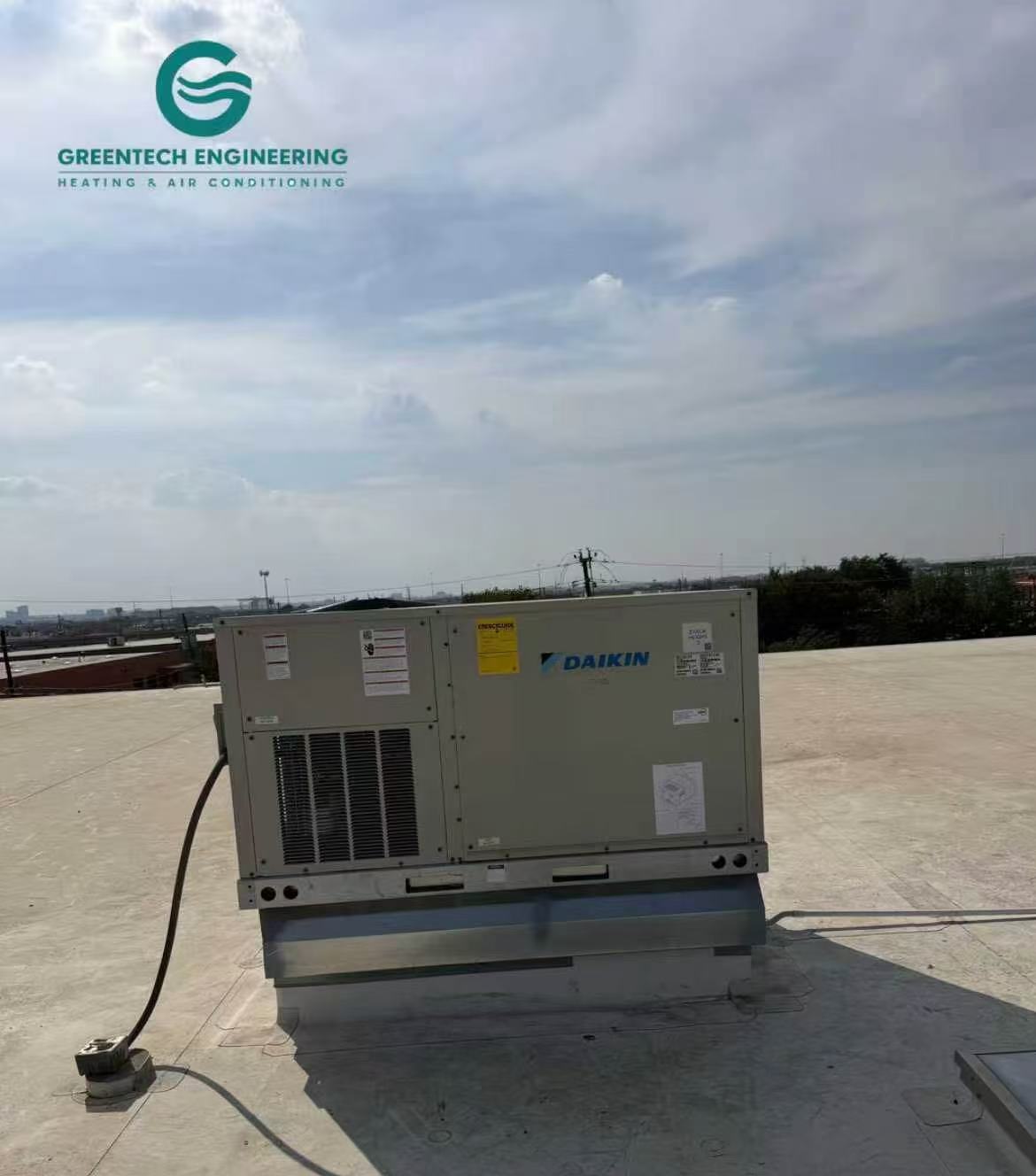
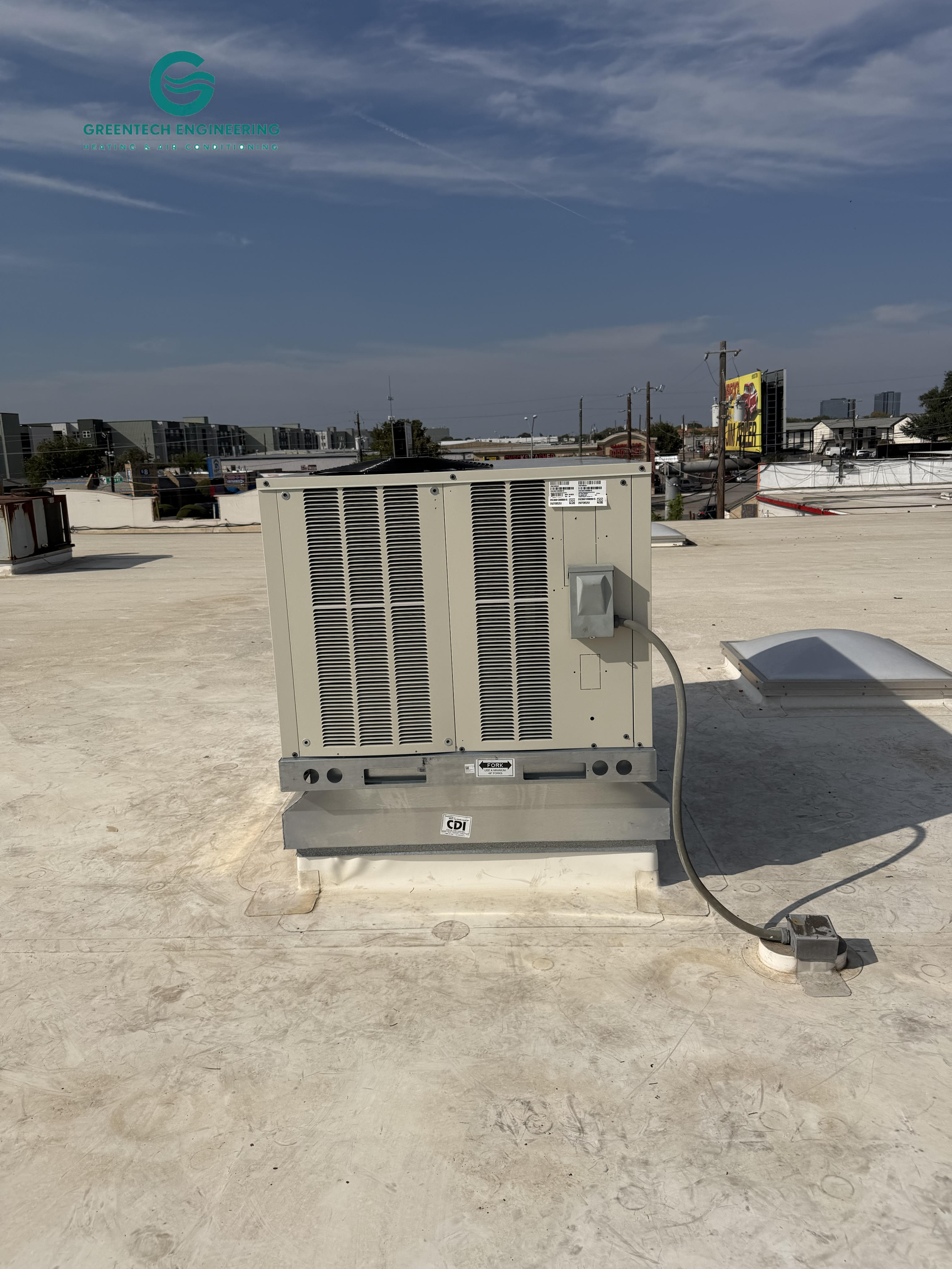
For this Dallas project, the custom adapter supported the replacement plan at the existing rooftop opening. The photograph documents the installed adapter beneath the RTU, but it does not prove exact dimensions, structural calculations, fastening details or weather resistance. Those items must be confirmed from the approved submittal and installation records.
The practical lesson for a commercial property owner is simple: verify curb compatibility before ordering equipment and scheduling the crane. Nominal tonnage alone does not establish that a replacement unit will match the existing roof opening.
<!--CMS BODY IMAGE INSERTION — DO NOT OMITPlacement: Insert immediately after the paragraph above and before “Which Daikin rooftop unit was installed?”Source file: New installed RTU 02(1).jpgPublic filename: dallas-75229-daikin-rtu-curb-adapter.jpgAlt text: Commercial Daikin rooftop unit mounted on a custom curb adapter in Dallas 75229Caption: Rear view of the installed Daikin RTU and custom curb adapter at the roof interface.Privacy edit: Crop the right-side billboard and distinctive background buildings. Confirm that people, faces, license plates, addresses, serial numbers, barcodes and QR codes are absent or unreadable. Strip EXIF/GPS/device metadata.Display: Responsive image with explicit width and height; use WebP/AVIF plus optimized JPEG fallback; lazy-load below the fold.-->
Which Daikin rooftop unit was installed?
The installed nameplate identifies model DSC0601D000001SAA, corresponding to public base model DSC0601D000001S. It is a nominal 5-ton Daikin DSC-series packaged straight-cool rooftop air conditioner using R-32 refrigerant.
Daikin’s published model table lists 57,500 BTU/h of cooling capacity, 13.7 SEER2 and 11.8 EER2 for the base model. The nominal 5-ton label identifies the equipment class; it is not a substitute for the published 57,500 BTU/h value. No project-specific AHRI certificate was supplied for the complete installed configuration.
The equipment nameplate contains a serial number and other codes, so the nameplate image remains internal. Product-family information can be checked against Daikin’s DSC Series commercial packaged A/C documentation.
Is this RTU a heat pump?
No. This rooftop unit is a straight-cool packaged air conditioner with a separate 20 kW electric heat kit. It is not a heat pump and not a gas/electric package.
The cooling section provides mechanical cooling, while the electric heat kit provides the documented heating stage. The available record does not identify the heat-kit accessory model or staging sequence, so no more-specific control or performance claim is made.
“Packaged RTU” describes the equipment format, not its heating method. Depending on the selected configuration, a packaged unit may use electric resistance heat, gas heat or heat-pump operation.
What do the economizer and programmable thermostat do?
The documented scope includes an economizer and a programmable thermostat.
When its sensors, controls, setpoints and outdoor conditions permit, an economizer can introduce outdoor air as part of the building’s ventilation or cooling sequence. The supplied record does not document the accessory model, control sequence, functional test or a savings result, so this case does not promise “free cooling” or a percentage reduction in energy use.
The programmable thermostat provides scheduled system control. Its exact model and schedule format were not supplied.
Why was crane coordination part of the work?
A commercial packaged unit must be lifted and positioned on the roof. Crane planning can involve equipment weight, reach, roof access, safe staging, site conditions and coordination between lifting, mechanical and electrical work.
The project record documents professional crane service. It does not include a crane-operation photograph or detailed lift log, so this page makes no claim about the lift sequence, old-unit removal, business downtime or uninterrupted operation. The rooftop photographs document the completed installation, not the crane lift.
What was verified at startup?
The installation was started and functionally checked before turnover. The supplied record does not include a commissioning sheet with measured airflow, static pressure, amperage, temperature split, economizer sequence or heat-kit staging, so this article does not report those values.
Several internal thermal images show surface readings, but they lack the target, emissivity, ambient conditions, air temperatures, operating mode and stabilization period needed for a defensible performance interpretation. They remain internal documentation and are not evidence of airflow, comfort, efficiency or commissioning results.
What does this Dallas 75229 case document?
This commercial case documents:
- a Dallas 75229 RTU replacement completed September 24, 2026;
- a nominal 5-ton Daikin DSC-series R-32 straight-cool packaged unit;
- Daikin-published ratings of 57,500 BTU/h, 13.7 SEER2 and 11.8 EER2 for the base model;
- 20 kW electric heat, an economizer and programmable controls in the project scope;
- a custom curb-adapter approach at the existing roof interface; and
- coordinated professional crane service.
The supplied record does not establish the old unit’s specifications or failure, a commercial load calculation, a project-specific AHRI certificate, permit or inspection completion, utility incentives, downtime, measured performance or savings. This distinction keeps the case useful without turning missing records into claims.
For different commercial applications, compare the Dallas 75236 10-ton gas/electric RTU case and the Arlington 76001 economizer-and-crane RTU case. Those projects have different equipment and should not be used as specifications for this installation.
Frequently asked questions
What is a commercial RTU curb adapter?
A curb adapter is a fabricated transition that connects a replacement rooftop unit to an existing roof curb when their footprints or supply and return openings differ.
Why was a crane used for this Dallas RTU replacement?
A packaged rooftop unit must be safely lifted and positioned on the roof. Crane planning coordinates equipment weight, reach, access, staging and placement.
Is this Daikin rooftop unit a heat pump?
No. It is a straight-cool packaged air conditioner with a separate 20 kW electric heat kit.
What is the rating of the installed unit?
Daikin’s published table for base model DSC0601D000001S lists 57,500 BTU/h of cooling capacity, 13.7 SEER2 and 11.8 EER2.
Is there a project-specific AHRI certificate?
No project-specific AHRI reference was supplied for the complete installed configuration. This article therefore attributes the ratings to Daikin’s published model table.
What does an economizer do?
When its controls and outdoor conditions permit, an economizer can introduce suitable outdoor air as part of the building’s ventilation or cooling sequence. Actual operation depends on the design, sensors, setpoints and commissioning.
Does a new RTU automatically fit an existing roof curb?
No. The curb, openings, footprint, support and utility connections should be checked before equipment is ordered and lifted.
Does the custom curb adapter prove the installation is weather-tight?
No. A curb adapter is part of the roof-interface solution, but weather resistance depends on the approved design, fastening, flashing or sealing details and completed installation. A photograph alone does not verify those items.
Planning a commercial RTU replacement in Dallas?
Greentech can evaluate existing rooftop equipment, curb compatibility, replacement configuration, controls and crane-access requirements before equipment is ordered.
Schedule a commercial RTU and curb-compatibility assessment or visit the Dallas HVAC service page.
This project includes a one-year Greentech labor warranty and Daikin’s five-year limited parts warranty, each subject to its applicable written terms, eligibility requirements and exclusions.
About the author
Siwei (Lucas) Chen
Chief Technology Officer | Greentech Engineering Heating & Air Conditioning — DFW HVAC
Siwei (Lucas) Chen applies an engineering-based, data-first approach to residential HVAC system design, diagnostics, airflow measurement, equipment selection and duct-system optimization across Dallas–Fort Worth. He holds a B.S. in Mechanical Engineering from Virginia Tech.
Lucas completed ACCA’s Residential Design for Quality Installation Course, which covers residential design procedures associated with ACCA Manuals J, S, T and D. He is also an NCI Certified Residential Air Balancer and NCI Certified Duct System Optimization Specialist.

Flexible Financing Options
Explore our range of flexible financing options designed to suit your needs and budget.