





Curing the "Hot Upstairs": 4-Ton Goodman AC & Gas Furnace Replacement in Dallas (75248)
Maintaining a consistent, comfortable temperature in a two-story single-family house in Dallas is one of the most common thermodynamic challenges homeowners face. Because heat naturally rises, and the second floor absorbs massive amounts of radiant heat from the roof, it is incredibly common for the downstairs to feel like a refrigerator while the upstairs bedrooms feel like a sauna.
When your aging HVAC system begins to fail, this temperature imbalance drastically worsens, driving up your electric bills while your comfort plummets.
In the AI-driven energy era, HVAC is no longer just about comfort — it’s about how efficiently your home uses power. At Greentech, we engineer systems that reduce your energy load and prepare your home for the future.
Recently, we partnered with a homeowner in the 75248 zip code of Dallas, TX, to completely overhaul their failing, inefficient system. In this detailed case study, we pull back the curtain on how we utilized strict ACCA Manual J load calculations to engineer a solution: a heavy-duty Goodman 14.3 SEER2 4-Ton Straight Cool A/C System paired with an 80% AFUE 80,000 BTU Gas Furnace. Furthermore, we will show you how choosing the right equipment and an Authorized Oncor Service Provider can unlock massive instant utility rebates.

The Engineering First Step: ACCA Manual J Load Calculation
A widespread and costly mistake in the HVAC industry is "box swapping"—when a contractor looks at the size of your old, failing unit and simply quotes a new one of the exact same size. Over a decade or two, your home's thermal envelope changes. Trees grow and provide shade, windows are upgraded, and ductwork shifts.
To properly cure the severe temperature imbalances in this two-story Dallas home, we abandoned the guesswork. Our engineering team performed a strict ACCA Manual J Load Calculation. We measured the total square footage, ceiling heights, window solar heat gain coefficients, and the thermal resistance (R-value) of the attic insulation.
The data was definitive: To achieve perfect sensible cooling (temperature reduction) and latent cooling (humidity removal) across both levels of the home, the property required exactly 4 Tons (48,000 BTUs) of cooling capacity and 80,000 BTUs of winter heating capacity.
Learn more about our ACCA Manual J Load Calculation process
Semantic SEO Spotlight: The Goodman 14.3 SEER2 & 80% AFUE Matchup
With the precise sizing established via the Manual J calculation, we selected an AHRI-certified matchup from Goodman Manufacturing (assembled right here in Texas). This specific configuration offers phenomenal reliability, heavy-duty cooling power, and an excellent return on investment.
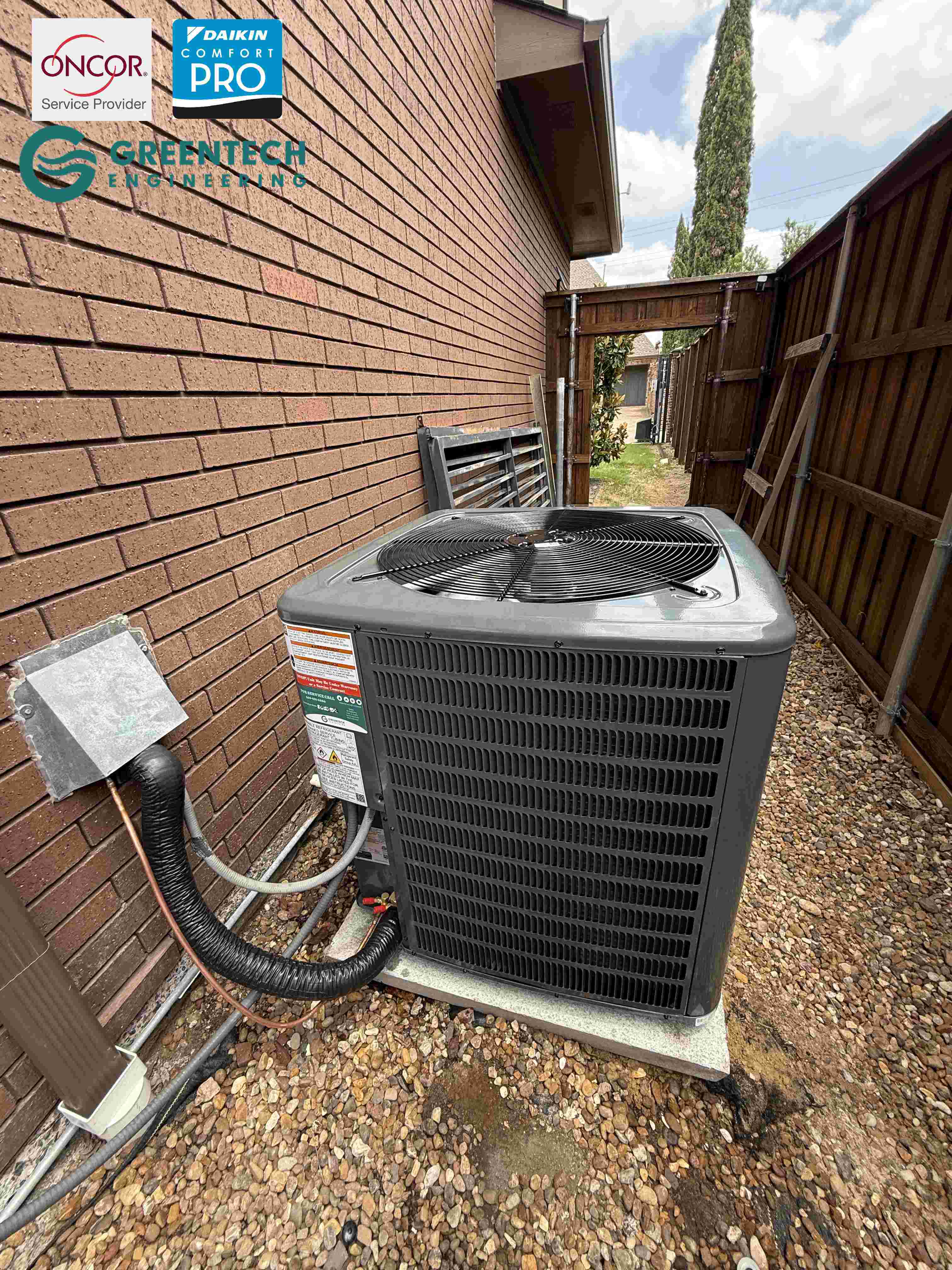
The 4-Ton Goodman Straight Cool Condenser (14.3 SEER2)
To combat the brutal North Texas summer heat, the new outdoor unit features:
- Energy-Efficient Scroll Compressor: Designed with fewer moving parts than traditional reciprocating compressors, ensuring quieter operation and a significantly longer lifespan.
- Single-Speed Condenser Fan Motor: Engineered for consistent, reliable airflow across the enhanced aluminum fin coils to rapidly dissipate heat.
- Factory-Installed Filter Drier: A critical component that protects the compressor from microscopic moisture and dirt.
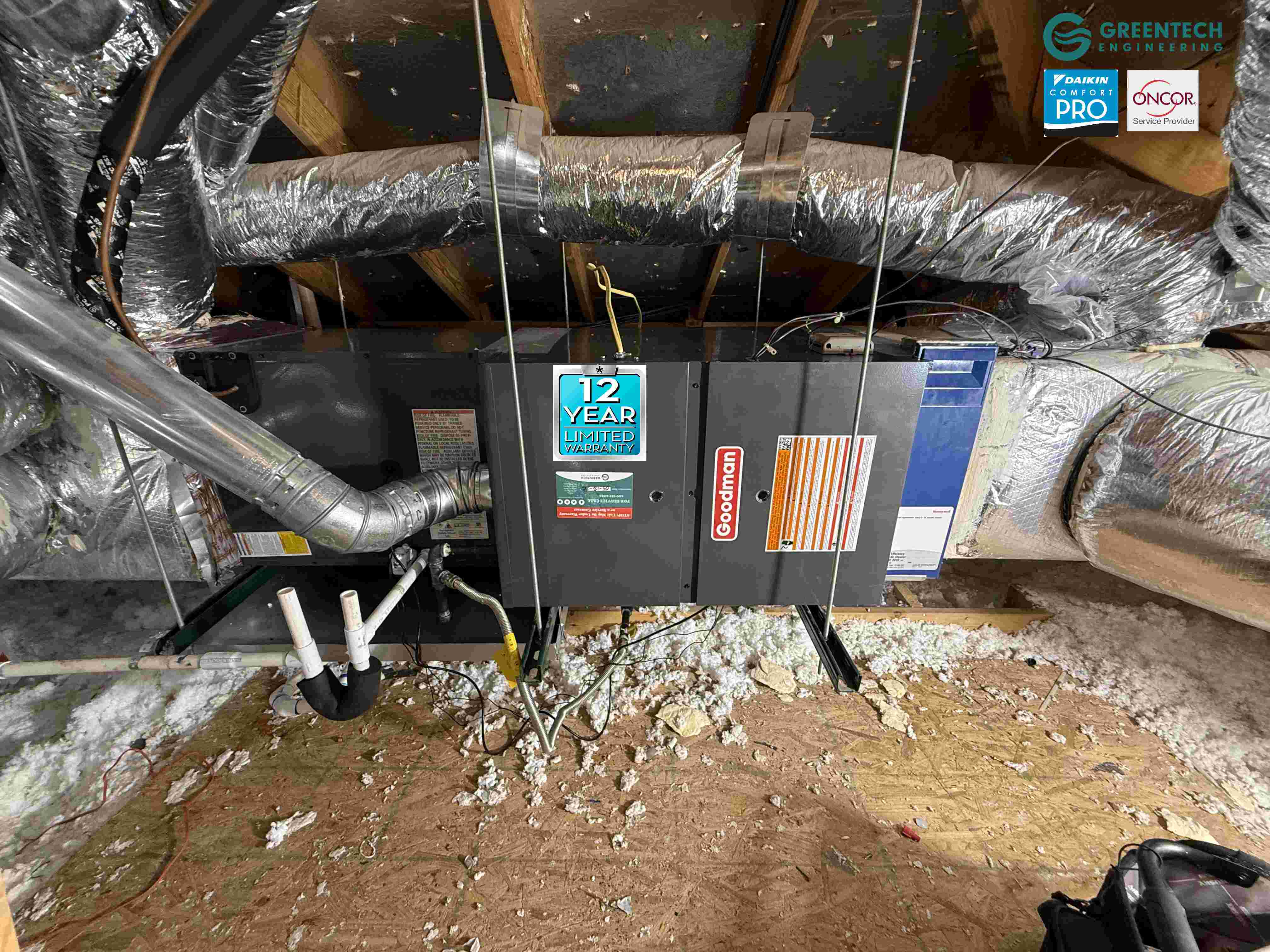
The 80,000 BTU Gas Furnace (80% AFUE) & Evaporator Coil
Because this home features a horizontal attic installation, winter heating is handled by a robust gas furnace.
- 80% AFUE Rating: The Annual Fuel Utilization Efficiency means that 80 cents of every dollar spent on natural gas is converted directly into usable heat for the home.
- Heavy-Duty Heat Exchanger: Built to withstand the rapid, extreme temperature swings of North Texas winter freezes without cracking or failing.
- All-Aluminum Evaporator Coil: Includes an internal Thermal Expansion Valve (TXV) that dynamically regulates refrigerant flow, maximizing the system's ability to wring sticky humidity out of the indoor air before pushing it to the second floor.
The Greentech Standard: Clinical Installation Protocols
An HVAC system is only as good as the technician who installs it. A premium 14.3 SEER2 system will perform poorly and fail prematurely if the refrigerant lines are contaminated or the ductwork leaks. We executed the following strict clinical protocols at this 75248 property:
- RX-11 Copper Flushing: We chemically flushed the existing copper refrigerant lines with RX-11 and dry nitrogen to remove old, acidic mineral oil left behind by the previous system.
- Nitrogen Purging & 15% Silver Brazing: All copper joints were soldered by certified technicians using premium 15% silver brazing rods while flowing nitrogen to prevent internal oxidation and scaling inside the pipes.
- 250 PSI Nitrogen Pressure Test: We pressurized the closed system with dry nitrogen to 250 psi and held it for a minimum of 15 minutes to guarantee absolutely zero micro-leaks.
- 500-Micron Deep Vacuum: Atmospheric moisture is the enemy of POE oil and compressors. We utilized specialized vacuum pumps to pull the system pressure below 500 microns, literally boiling off and extracting any microscopic water from the lines.
- Attic Flood Prevention: We cleared the condensation drain lines, installed new drain traps, and wired in a mandatory Safe-T drain switch to automatically shut down the system if a clog ever occurs, protecting the downstairs ceilings from devastating water damage.
Why You Need an Authorized Oncor Service Provider
You cannot claim the Oncor rebate by buying an AC online or hiring an uncertified handyman. The utility company strictly regulates the disbursement of these funds to protect the integrity of the power grid.
To access the Home Energy Efficiency Program, you must hire an official Oncor Participating Service Provider.
When you partner with Greentech Engineering, we handle the entire bureaucratic process. We gather the AHRI (Air-Conditioning, Heating, and Refrigeration Institute) performance certificates, document the baseline load of your old system, submit the engineering data to the Oncor portal, and secure the approval.
Best of all, you do not have to wait months for a check to arrive in the mail. We apply the approved Oncor incentive as an instant, upfront discount directly on your installation invoice.
2026 Oncor Incentive Snapshot: Forney & Kaufman County
(Note: These structural guidelines apply across the broader DFW Oncor territory, including Dallas).
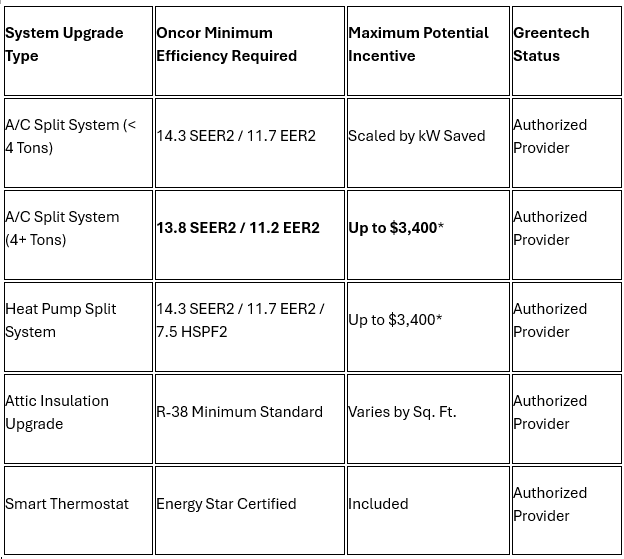
*Incentive Disclaimer: The $3,400 figure represents the absolute maximum potential incentive. Actual instant discount amounts are strictly determined by Oncor's customized kW/kWh reduction formula based on your specific home’s thermodynamic load reduction. Proactive replacement and proper Manual J sizing are the keys to maximizing your payout.
Verify your home's eligibility on the official Oncor Energy Efficiency page
Frequently Asked Questions (FAQ)
Q: How do you fix a hot upstairs in a two-story Dallas home?
A: A hot upstairs is rarely solved by simply closing downstairs vents. It requires a comprehensive engineering approach: performing a Manual J load calculation to ensure the AC unit has enough BTU capacity to push the air up, utilizing NCI air balancing to correct restrictive static pressure in the ductwork, and ensuring proper return-air pathways so hot air is effectively pulled out of the second floor.
Q: Does a Goodman 14.3 SEER2 AC qualify for the Oncor rebate?
A: Yes. When installed by an Authorized Oncor Participating Service Provider, a Goodman 14.3 SEER2 system easily meets the federal and utility efficiency thresholds. For systems that are 4 tons and larger, the minimum requirement for Oncor is 13.8 SEER2 / 11.2 EER2.
Q: What does an 80% AFUE rating mean for a gas furnace?
A: AFUE stands for Annual Fuel Utilization Efficiency. An 80% AFUE rating means that for every dollar you spend on natural gas to heat your home, 80 cents is converted directly into indoor heat, while the remaining 20 cents escapes as exhaust up the flue pipe. This provides highly reliable, cost-effective heating during North Texas winter freezes.
Q: Why do HVAC technicians braze copper lines with nitrogen?
A: When copper is heated to the melting point of silver brazing rods, the oxygen inside the pipe reacts and forms a black, flaky layer of oxidation (cupric oxide). If this flakes off inside the pipe, it will clog the Thermal Expansion Valve (TXV) and destroy the compressor. By flowing an inert gas (dry nitrogen) through the pipes during the welding process, we displace the oxygen and prevent any oxidation from forming, ensuring a lifespan of 15+ years.
About the Author: Siwei (Lucas) Chen
CTO | Greentech Engineering Heating & Air Conditioning
Siwei (Lucas) Chen specializes in engineering-driven HVAC diagnostics, thermodynamic performance optimization, and custom ductwork design for Dallas homeowners. Holding a B.S. in Mechanical Engineering from Virginia Tech, he brings a strict, data-first approach to residential heating and cooling. Under his technical leadership, Greentech Engineering ensures every system is perfectly calibrated for the Texas climate, focusing relentlessly on ACCA Manual J load calculations, meticulous clinical installation standards, and securing maximum utility rebates for his clients.
Professional Certifications:
- ACCA Certified (Manual J, S, D)
- Daikin Comfort Pro Contractor
- NCI Certified – Air Balancing & Duct Optimization
- Oncor Participating Service Provider
Industry Affiliations:

Flexible Financing Options
Explore our range of flexible financing options designed to suit your needs and budget.