






Why Your Online Efficiency Estimate Doesn't Match Reality
Nearly 80% of the projected energy savings you see online will vanish the moment temperatures cross the century mark, which makes a SEER Calculator Reality Check: What the Math Actually Means for Carrollton Summers absolutely necessary for local homeowners. If your air conditioning system is struggling and you are trying to decide whether to pay a premium for an ultra-high-efficiency unit, you have probably plugged some numbers into a generic online tool. These digital tools promise massive utility bill reductions, making that expensive upgrade look like a guaranteed win. The concrete problem our technicians see every day across Carrollton is that homeowners rely on these generic calculators without realizing they use mild laboratory conditions to generate those impressive savings numbers.
Understanding proper HVAC system design and using an accurate SEER calculator is the only way to find the right balance for your home.
Most homeowners do not realize that the fundamental statistical disconnect begins with the weather. When you compare the standard 82°F lab rating vs 100°F+ actual Carrollton temps, the standard math completely falls apart. National efficiency calculators assume you live in a mild climate where the air conditioner only works a few hours a day. They take the sticker rating of your current unit, compare it to a new high-efficiency model, and multiply the difference by a national average utility rate. It is simple math, but as our local engineering team knows, it is entirely the wrong equation for North Texas.
The decision point you face is whether to trust those generic numbers and overspend on a unit that will never deliver the promised return on investment, or to evaluate true efficiency based on local heat loads. When you are making a major investment in your home's comfort, you need math that reflects reality. Relying on flawed national averages leads to skewed expectations, longer payback periods, and frustration when your peak July utility bills arrive.
The 82-Degree Laboratory Illusion
The problem: You invest in a top-tier, high-efficiency air conditioner expecting your summer energy bills to drop by 40%, but the actual savings barely register on your monthly statement. We see this frustrating scenario constantly in the field, and the root cause goes back to how equipment is tested before it ever reaches the market.
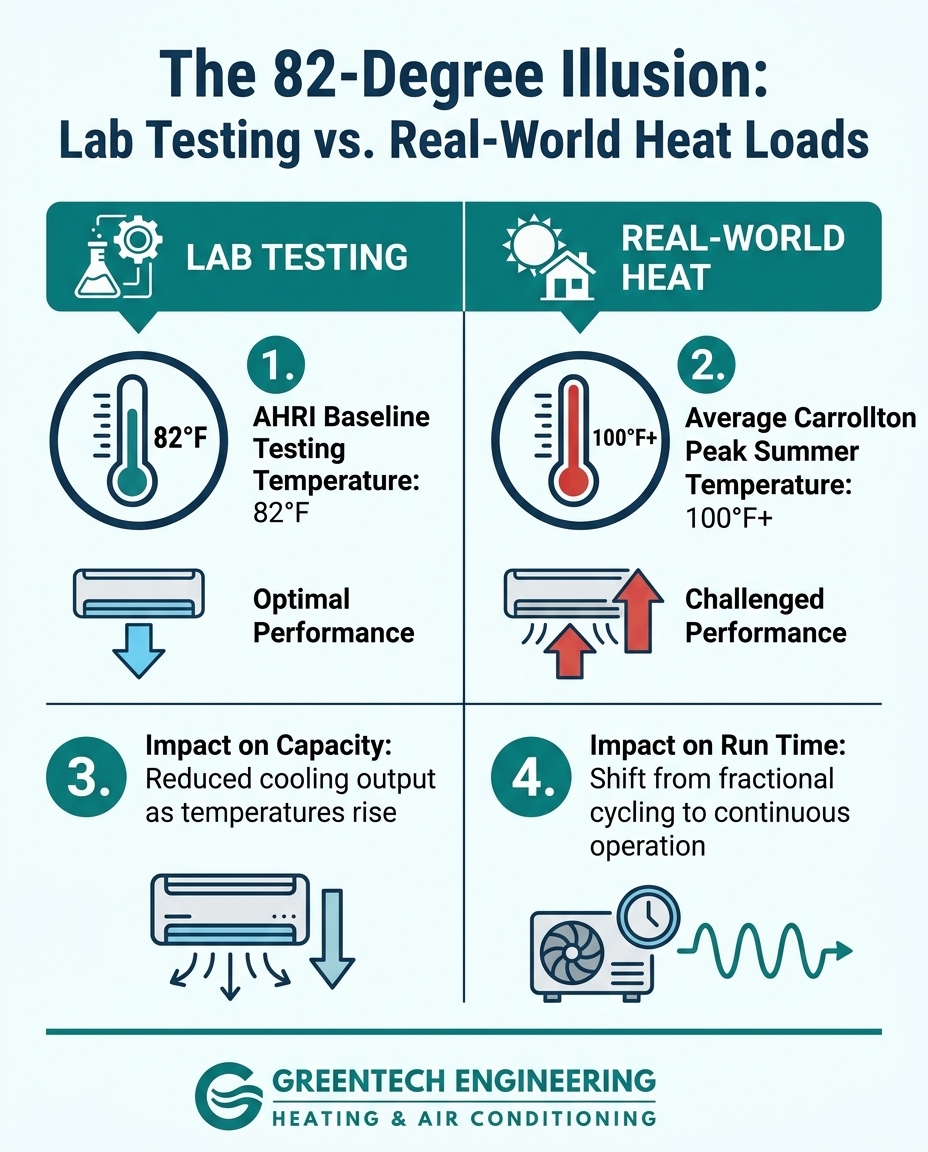
The cause: The Air-Conditioning, Heating, and Refrigeration Institute (AHRI) sets the testing standards for all HVAC equipment in the United States. To create a level playing field, they test units under specific baseline conditions. The AHRI 210/240 standard dictates that SEER (Seasonal Energy Efficiency Ratio) testing utilizes a baseline outdoor temperature of exactly 82 degrees Fahrenheit. The math behind most online tools assumes this mild temperature is your average summer day.
While 82 degrees might represent a perfectly pleasant national average, it drastically misrepresents the sustained, intense heat of a North Texas summer. The 82°F lab rating vs 100°F+ actual Carrollton temps creates a massive performance gap. An air conditioner running in a mild laboratory environment operates near peak theoretical efficiency. It faces minimal thermal resistance and draws relatively little electricity to cool the indoor air.
The solution: You must evaluate efficiency ratings through the lens of extreme regional climates. Relying on baseline laboratory numbers leads to mathematically impossible savings expectations in hotter regions. When the outdoor temperature spikes, the compressor has to work significantly harder, drawing more amperage and lowering the actual operating efficiency. To get a realistic estimate of your future energy bills, you have to discard the 82-degree illusion and look at how the equipment behaves when the environment turns hostile.
The Physics of Equipment Capacity Loss Under Load
To understand why online calculators fail, we have to look at the thermal dynamics and the physics of heat transfer. Air conditioning does not actually create cold air; it absorbs heat from inside your house and pumps it outside. This process relies on a basic law of physics: heat naturally flows from a warmer space to a cooler space.
During the peak Texas summer heat in July, this heat transfer process faces immense resistance. Here is how our team sees the physics break down under a heavy load:
1. The Heat Transfer Barrier: Inside your outdoor condenser, hot refrigerant gas tries to release its stored heat into the outside air. If the outside air is 82 degrees, the hotter refrigerant releases heat easily. If the outside air is 105 degrees, the temperature difference is much smaller, making it exponentially harder to reject that heat into an already hot environment.
2. Increased Compressor Strain: Because the heat will not transfer easily, the compressor has to work harder and run longer to force the refrigerant through the cycle. The compressor draws more electrical current (amperage) as the pressure inside the system builds up against the extreme outdoor temperatures.
3. Actual Capacity Degradation: As outdoor temperatures rise, an air conditioning unit experiences a measurable drop in its actual cooling capacity. A system rated for 36,000 BTUs of cooling at 82 degrees might only be able to produce 30,000 BTUs of cooling when the outdoor thermometer hits 105 degrees.
Extreme ambient temperatures force the equipment to operate completely outside of its optimal performance curve. This capacity loss directly impacts the energy consumption equation. When your system loses capacity, it has to run longer to remove the same amount of heat from your living room. Generic online calculators entirely ignore this physical reality, assuming the unit maintains 100% capacity regardless of the weather outside.
The Flaw in Fractional-Run-Time Mathematics
Beyond capacity loss, there is another massive mathematical oversight in generic efficiency tools: fractional-run-time math. This is the assumption that an air conditioner rests for a significant portion of every hour.
When engineers test equipment at 82 degrees, the system easily satisfies the thermostat. It might run for 20 minutes, turn off for 40 minutes, and repeat. The online calculator uses this fractional run time to estimate your monthly energy usage. It assumes your system only draws electricity for a fraction of the day.
Here is the reality we see on the ground: during peak July heat waves, units are designed to run almost continuously to keep up with the intense thermal load. A properly sized air conditioner on a 105-degree afternoon will not cycle off. It will run for 55 to 60 minutes out of every hour just to hold your indoor temperature at 75 degrees. This is not a malfunction; it is exactly how the system is supposed to operate to manage humidity and extreme heat.
Continuous operation completely rewrites the energy consumption variables used by standard calculators. If a calculator assumes your unit runs 8 hours a day, but the reality of a Carrollton summer forces it to run 16 hours a day, your estimated energy usage is instantly doubled. The fractional-run-time assumption causes the single biggest discrepancy between estimated savings and your actual utility bills. When a high-SEER unit runs continuously, it still uses less power than a low-SEER unit, but the gap in total kilowatt-hours consumed shrinks significantly.
How True Efficiency Shifts During a North Texas Summer
When our team evaluates an air conditioning replacement for your home, we provide a realistic look at how a high-efficiency unit actually performs when temperatures cross the century mark. While higher efficiency is always better for your utility bills, the actual payback period is often much longer than generic tools suggest due to diminishing returns under extreme stress.
Lab Conditions vs. Real-World Performance
Under mild conditions, a 20-SEER unit uses drastically less electricity than a 14-SEER unit. However, as the heat rises, the efficiency gap narrows. The ultra-high-efficiency unit relies on variable-speed technology to run at lower capacities and save power. But when it is 105 degrees outside, that variable-speed compressor has to ramp up to 100% capacity just to keep up. At maximum capacity, the energy draw of a 20-SEER unit starts to look a lot more like a standard unit.
Consider the 82°F lab rating vs 100°F+ actual Carrollton temps in this performance breakdown:
• 82°F (Lab Standard) — Assumed Run Time (per hour): 20 - 30 minutes — Cooling Capacity Output: 100% of rated capacity — Energy Efficiency Gap: Maximum difference between SEER ratings
• 95°F (Typical Summer) — Assumed Run Time (per hour): 40 - 45 minutes — Cooling Capacity Output: Slight capacity reduction — Energy Efficiency Gap: Moderate difference in energy draw
• 105°F (Extreme Heat) — Assumed Run Time (per hour): 55 - 60 minutes — Cooling Capacity Output: Significant capacity loss — Energy Efficiency Gap: Narrowed gap as all units run at 100% effort
This data does not mean high-efficiency units are a bad investment. They provide superior humidity control, quieter operation, and better overall comfort. However, we always caution homeowners not to base their financial decisions solely on a generic calculator's promise of a three-year payback period. The math must reflect the reality of sustained extreme heat.
Why an Engineering-First Approach Eliminates the Guesswork
To get accurate numbers, you have to move away from national averages and look at your specific home. This is where Manual J design temperatures become critical. A Manual J calculation is an engineering standard used to determine the exact heat load of a building. Instead of guessing, it uses localized historical weather data. For the Dallas-Fort Worth area, Manual J dictates calculating loads for extreme heat, vastly differing from the mild baseline used in standard SEER calculators.
Calculating true heat loads requires analyzing the home's specific thermal envelope. This means measuring the square footage, evaluating the insulation quality, counting the windows, and determining which direction the house faces. You cannot just plug a SEER number into a formula and expect an accurate result.
At Greentech Engineering Heating & Air Conditioning, our team leverages an engineering-first approach to calculate true HVAC performance and efficiency, removing the guesswork from AC sizing and SEER expectations. By accounting for capacity loss and continuous run times, our mathematical modeling projects how a system will actually behave during the peak July heat. This methodology ensures the equipment is sized correctly to handle the thermal load without short-cycling or running up unnecessary utility costs. Proper engineering is the only way to accurately project long-term return on investment.
Selecting the Optimal Efficiency Rating for Your Home
Making an informed decision requires looking beyond the bright yellow energy sticker on the side of the condenser. To choose a SEER rating that offers the best actual return on investment under local conditions, you need a practical framework based on actual data.
Based on the system upgrades our engineers design for Carrollton homeowners, here is what we recommend you evaluate when planning your next system upgrade:
• Match the rating to your timeline: If you plan to move in three years, a mid-range efficiency unit often makes more financial sense than a top-tier unit, as you will not live in the home long enough to see the payback.
• Focus on installation quality: A 16-SEER unit installed with perfect ductwork and precise airflow will outperform a 20-SEER unit attached to leaky, undersized ducts. The overall system design matters more than the equipment rating.
• Factor in local rebates: Utilizing energy rebate consulting can help offset the initial investment of higher efficiency units. Finding local money changes the math entirely.
• Check utility incentives: Available ONCOR HVAC incentives can significantly reduce the upfront cost of high-efficiency equipment, shortening your payback period and making higher SEER ratings much more attractive.
When you account for the 82°F lab rating vs 100°F+ actual Carrollton temps, you realize that the "best" SEER rating is not automatically the highest one available. It is the rating that aligns with your home's heat load, your budget, and the available financial incentives.
Frequently Asked Questions About HVAC Efficiency in Extreme Heat
What is the difference between lab SEER and actual SEER?
Lab SEER is a theoretical rating calculated under perfect, mild conditions at 82 degrees. Actual SEER is the real-world efficiency your system achieves when battling the specific weather outside your home. Because lab testing faces minimal thermal resistance, it almost always produces higher efficiency numbers than what you will experience during a harsh summer.
How does extreme heat affect SEER ratings?
Extreme heat forces your air conditioner to work harder to reject heat outdoors, which lowers its operating efficiency. As the temperature climbs past 95 degrees, the compressor draws more electricity and the system loses overall cooling capacity. This means a unit rated at 18 SEER might perform closer to a 14 SEER level during the hottest parts of the afternoon.
Why is my high SEER AC not saving as much energy as expected?
Your high SEER AC is likely running continuously during the peak July heat, rather than cycling on and off as generic calculators assume. When a variable-speed unit is forced to run at 100% capacity to keep up with intense heat loads, the energy gap between it and a standard unit shrinks. Additionally, leaky ductwork or poor insulation can waste the efficiency gains of a new unit.
How do you calculate true SEER savings in a hot climate?
You calculate true savings by using a Manual J load calculation that accounts for local design temperatures rather than national averages. This engineering calculation evaluates your home's specific thermal envelope, insulation, and window exposure. It factors in capacity loss and continuous run times to give you a realistic projection of your utility bills.
Is a higher SEER rating always better for North Texas homes?
A higher SEER rating provides better comfort, quieter operation, and improved humidity control, but it is not always the best financial investment for every home. The diminishing returns under extreme heat mean the payback period for ultra-high SEER units can take many years. The best choice depends on how long you plan to stay in the house and what local utility rebates are available.
What SEER rating provides the best ROI during a Carrollton summer?
In our experience consulting with local homeowners, the best return on investment usually falls in the mid-to-high efficiency range, typically between 16 and 18 SEER, especially when paired with local utility incentives. These units offer a significant upgrade over older systems without the massive upfront premium of ultra-high-efficiency models. An engineering analysis of your specific home is required to pinpoint the exact optimal rating.
Take the Guesswork Out of Your Next System Upgrade
Understanding the math is the first step to making a smart HVAC investment. Do not let the 82°F lab rating vs 100°F+ actual Carrollton temps skew your expectations. Look beyond generic calculators and seek out precise, engineered calculations based on your home's actual thermal load. Our team is here to ensure you get the right size and efficiency so your home stays comfortable without wasting your money.

Flexible Financing Options
Explore our range of flexible financing options designed to suit your needs and budget.