





Resolving Downstairs Heat & Humidity in Little Elm, TX (75068): A 4-Ton Goodman HVAC Case Study
Living near the shores of Lewisville Lake in Little Elm, Texas (75068) offers beautiful views and a fantastic community, but it also brings a unique microclimate. The elevated ambient humidity levels in Denton County, combined with the extreme Texas summer sun, create a grueling thermal environment for two-story detached homes.
From an engineering perspective, cooling a two-story home is a battle against thermodynamics. The upstairs system fights the radiant heat beating down on the roof, while the downstairs system must combat the humidity creeping in through doors, windows, and daily family activities. When the downstairs air conditioning unit begins to fail, the entire first floor can quickly transform into a sticky, uncomfortable environment, forcing the upstairs unit to overwork and driving your utility bills through the roof.
“In the AI-driven energy era, HVAC is no longer just about comfort — it’s about how efficiently your home uses power. At Greentech, we engineer systems that reduce your energy load and prepare your home for the future.”
Recently, a homeowner in Little Elm reached out to Greentech Engineering Heating and Air Conditioning to diagnose a failing downstairs cooling system. Their legacy equipment was drawing massive amounts of electrical current while failing to adequately dehumidify their expansive first-floor living spaces. In this deep-dive technical case study, we will abandon the typical industry "box swapping" mentality and explore the building science behind our engineered solution: upgrading their home with a Goodman 14.3 SEER2 4-Ton A/C System, a high-performance Daikin/Goodman TXV evaporator coil, and executing our uncompromising clinical installation standards.
The Diagnostics: Why Downstairs Systems Fail in Two-Story Homes
Before recommending any equipment, a proper HVAC replacement must begin with a thorough evaluation of the home's thermal boundaries.
In a two-story detached house, the first floor relies heavily on "latent cooling"—the process of removing moisture from the air. Because the first floor is physically shaded by the second story, it doesn't experience the same direct solar heat gain. However, it still handles the biological heat load of the family, the heat from cooking, and the moisture entering through exterior doors.
The homeowner's old system was suffering from degraded compressor windings and a failing fixed-orifice metering device indoors. It was running long, inefficient cycles, yet failing to pull the moisture out of the air. The result was a classic "cold but clammy" living room.
To resolve this, we engineered a specific equipment matchup designed to maximize latent moisture removal while adhering to the strict 2023 Department of Energy (DOE) Conservation Standards.
The Engineered Solution: Goodman 14.3 SEER2 Performance
To provide the Little Elm homeowner with robust reliability and a lower energy footprint, we selected a highly durable Goodman 4-Ton (48,000 BTU) Split Air Conditioner. Goodman has long been recognized for manufacturing heavy-duty, dependable equipment engineered to withstand the brutal Texas heat.
The Outdoor Condenser: 4-Ton Goodman Air Conditioner
The outdoor unit serves as the heart of the home's heat-rejection process. This specific model features an Energy-Efficient Compressor that drastically reduces the electrical amp draw compared to the homeowner's legacy unit.
- Advanced Heat Transfer: The condenser utilizes a 5mm diameter copper tube and enhanced aluminum fin coil. This micro-fin technology increases the surface area for heat transfer, allowing the unit to expel heat faster while using a smaller volume of refrigerant.
- Compressor Protection: We ensured the system came equipped with a factory-installed filter drier. This crucial component acts as a kidney for the air conditioner, filtering out microscopic contaminants and moisture from the refrigerant stream to protect the compressor from premature failure.
- Warranty Backing: For absolute peace of mind, this unit is backed by a robust 10-year factory limited parts warranty upon homeowner registration.
The Indoor Evaporator: Daikin/Goodman Cased Coil with TXV
The outdoor unit generates the cooling power, but the indoor evaporator coil is responsible for actually absorbing the heat and humidity from your indoor air. We installed a matching 48,000 - 60,000 BTU Horizontal Cased Coil.
- Thermal Expansion Valve (TXV): This is the secret to perfect downstairs humidity control. Unlike cheap "piston" systems that feed refrigerant at a fixed rate, a TXV is an active, mechanical valve that constantly adjusts the flow of liquid refrigerant based on the real-time heat load inside the living room. If the house is packed with guests and humidity is high, the TXV opens up to absorb more heat. This guarantees maximum system efficiency and superior dehumidification.
- All-Aluminum Construction: Older copper evaporator coils are notorious for developing "formicary corrosion"—microscopic holes caused by household VOCs (hairspray, cleaning chemicals, etc.). This new Daikin/Goodman coil is 100% rust-resistant aluminum, featuring rifled tubing and corrugated fins for maximum durability and a 10-year unit replacement plan.
The Greentech Standard: Clinical Installation Chemistry & Physics
The most expensive HVAC equipment in the world will fail in under five years if it is installed poorly. At Greentech Engineering, we approach residential HVAC installations with the precision of a laboratory. By adhering strictly to ACCA standards and our own internal clinical protocols, we ensured this system will last for decades.
Here is a look behind the scenes at the science of our Little Elm installation:
1. Refrigerant Recovery and Infrastructure Defense
The replacement began with the EPA-compliant recovery of the old, environmentally harmful refrigerant. Once the old equipment was removed, we laid a brand-new concrete condenser equipment pad outside to ensure perfect leveling. Indoors, we installed a new thermoplastic drain pan, completely insulated the drain lines, and installed a Safe-T drain switch. This switch is a critical failsafe that will instantly shut down the air conditioner if the drain line ever clogs, preventing thousands of dollars in water damage to the home's ceilings and floors.
2. Nitrogen Flushing and Drain Clearing
he condensation drain line was blasted with pressurized dry nitrogen to blow out years of biological algae and sludge. A new drain trap and vent were installed to ensure smooth, gravity-fed drainage.
3. Precision Airflow Sealing
The new horizontal evaporator coil was mated to the existing gas furnace and supply plenum using specialized hex washer head HVAC screws. To guarantee that 100% of the conditioned air makes it into the living space, every single connection seam was meticulously painted with mastic duct sealant and secured with engineered HVAC metal tape.
4. The RX-11 Chemical Flush
Because we were utilizing the home's existing copper line sets hidden in the walls, a chemical flush was mandatory. Old air conditioners run on mineral oil, while modern high-efficiency units run on synthetic POE oil. If these two oils mix, they create a thick sludge that destroys the new compressor. We injected RX-11 flush through the copper lines and chased it with dry nitrogen to chemically strip the pipes clean.
5. Nitrogen-Purged Silver Brazing
When copper is heated with a torch, the oxygen inside the pipe turns into black carbon soot (oxidation). If this soot flakes off, it will permanently clog the delicate TXV valve. To prevent this, our certified technicians continuously flowed dry nitrogen through the copper pipes while welding the joints with premium 15% silver brazing rods.
6. 250 PSI Pressure Testing & 500-Micron Deep Vacuum
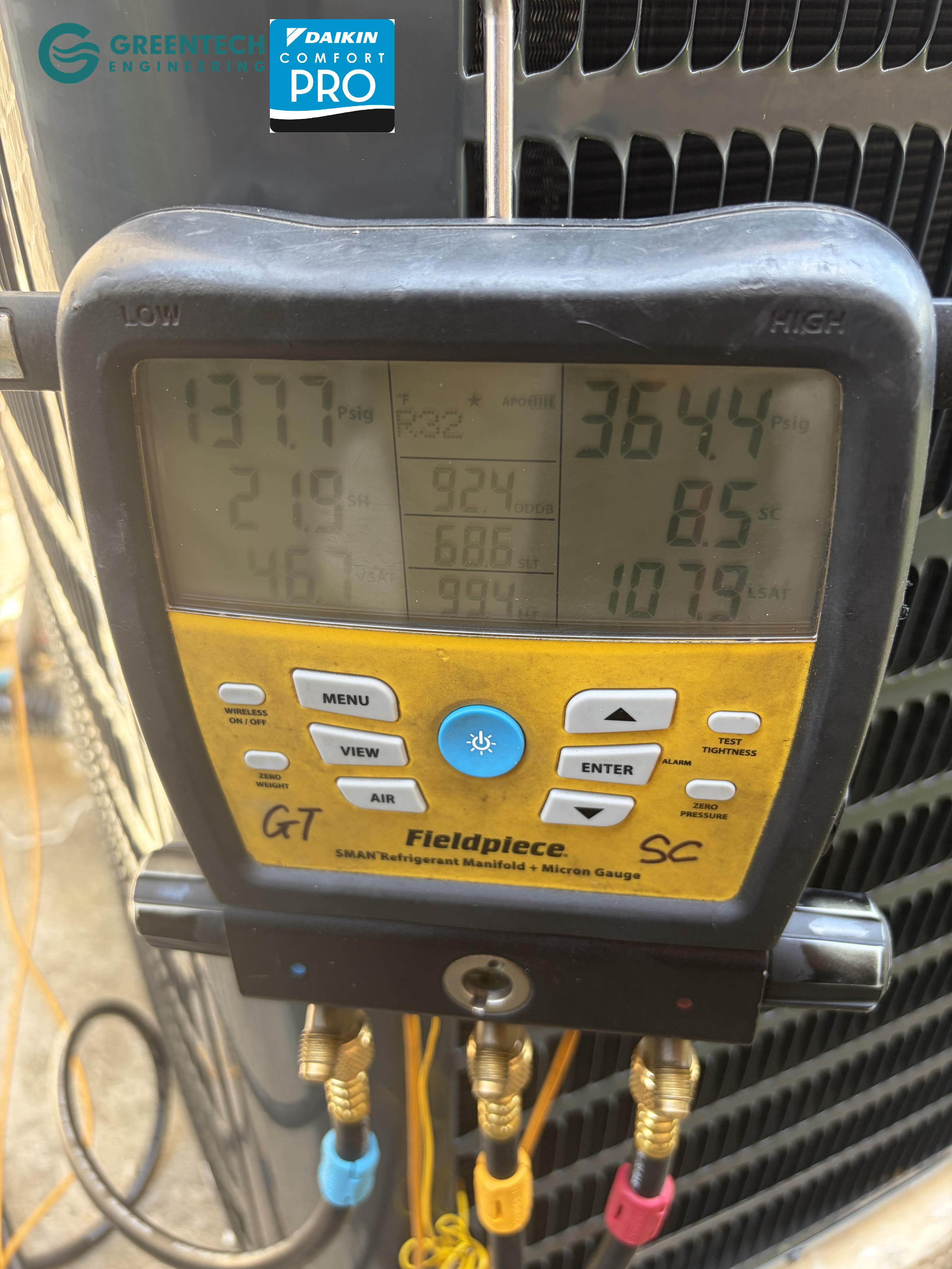
Before introducing the new refrigerant, the closed copper system was pressurized with dry nitrogen to 250 psi and held for 15 minutes to mathematically guarantee there were zero micro-leaks.
Following the pressure test, we utilized specialized digital vacuum pumps to pull the internal system pressure down below 500 microns. At this extreme vacuum level, the physical boiling point of water drops below room temperature. Any microscopic atmospheric moisture trapped inside the pipes instantly vaporizes and is sucked out of the system. This prevents the moisture from turning into hydrofluoric acid, protecting the compressor's internal windings.
7. Modernizing the Controls
To complete the project, we replaced the home's outdated, single-stage conventional thermostat with a modern digital control interface, ensuring crisp communication between the indoor and outdoor equipment.
Little Elm HVAC Frequently Asked Questions
To help our Denton County neighbors better understand their home's mechanical systems, our engineers have answered some of the most common HVAC questions we receive in the Little Elm area.
Q: Why does my downstairs feel humid even when the AC is running?
A: This is usually caused by an oversized air conditioner or a failing metering device. If your AC is too large, it cools the room's temperature rapidly and shuts off before the indoor coil has enough time to extract the humidity from the air. Upgrading to a properly sized system with a Thermal Expansion Valve (TXV) ensures the system runs long enough to wring the moisture out of your downstairs living areas.
Q: What is a Safe-T drain switch, and why is it required?
A: During a humid Texas summer, your air conditioner extracts gallons of water from the air every day. This water drains out through a white PVC pipe. If that pipe clogs with dust or algae, the water will back up and overflow the pan, causing massive water damage to your home. A Safe-T switch sits on the drain line and automatically shuts off your AC if it detects water backing up, saving your home from a flood.
Q: How often should I replace my air conditioner in Little Elm, TX?
A: In the harsh North Texas climate, a standard contractor-grade AC unit typically lasts 10 to 12 years. However, systems engineered and installed with clinical protocols (like deep vacuums and nitrogen brazing) by companies like Greentech Engineering routinely outlast industry averages due to the purity of the refrigerant lines.
Q: Do I need to replace my furnace when I replace my AC?
A: Not necessarily. In this specific Little Elm project, the homeowner's existing gas furnace was still in excellent condition. We were able to perfectly mate the new Goodman evaporator coil to the existing furnace, saving the homeowner thousands of dollars while still delivering a massive upgrade in cooling efficiency.
Ready to Engineer Your Home's Comfort?
If your two-story home is suffering from a hot, sticky downstairs living area, do not settle for standard box-swapping contractors. You need a data-driven, engineering approach to resolve the core thermodynamic issues of your property.
Trust the experts who utilize strict ACCA Manual J load calculations and uncompromising installation protocols. Reach out to Greentech Engineering today to schedule your comprehensive residential HVAC diagnostic in Little Elm, TX.
About the Author: Siwei (Lucas) Chen
CTO | Greentech Engineering Heating & Air Conditioning
Siwei (Lucas) Chen specializes in engineering-driven HVAC diagnostics, thermodynamic performance optimization, and custom ductwork design for Dallas homeowners. Holding a B.S. in Mechanical Engineering from Virginia Tech, he brings a strict, data-first approach to residential heating and cooling. Under his technical leadership, Greentech Engineering ensures every system is perfectly calibrated for the Texas climate, focusing relentlessly on ACCA Manual J load calculations, meticulous clinical installation standards, and securing maximum utility rebates for his clients.
Professional Certifications:
- ACCA Certified (Manual J, S, D)
- Daikin Comfort Pro Contractor
- NCI Certified – Air Balancing & Duct Optimization
- Oncor Participating Service Provider
Industry Affiliations:
- Supplier Partner Member – Apartment Association of Greater Dallas (AAGD)

Flexible Financing Options
Explore our range of flexible financing options designed to suit your needs and budget.