






The Cost of Waiting: Why a Summer AC Breakdown in Dallas Could Cost You a $3,400 Rebate
For homeowners in the 75248 zip code of North Dallas, the approach of summer brings a familiar dread. When the Texas heat index begins to shatter the 100-degree mark, aging HVAC systems are pushed beyond their operational limits.
Historically, many homeowners adopt a "run it until it dies" philosophy regarding their air conditioners. They hear a rattling compressor or notice their electric bills steadily climbing, but they delay calling a contractor, hoping to squeeze one last summer out of the equipment.
From an engineering and financial perspective, this strategy is a catastrophic mistake.
Waiting for your air conditioner to suffer a total mechanical breakdown in the middle of July does not just leave your family sweating in a 90-degree living room—it literally costs you thousands of dollars in lost utility incentives.
In this comprehensive guide, we are going to pull back the curtain on a strict technical rule within the Texas utility grid. We will explain why a dead AC unit disqualifies you from massive financial incentives, why proactive replacement is critical, and how upgrading to high-efficiency Daikin equipment through strict ACCA Manual J engineering secures maximum Oncor rebates.
The Hidden Trap: The "Operational Baseline" Requirement
The State of Texas and the ERCOT power grid (External Link) are highly motivated to reduce residential electricity consumption during peak summer hours. To achieve this, utility delivery companies like Oncor offer the Home Energy Efficiency Program (HEEP), which pays homeowners up to $3,400 when they upgrade to highly efficient HVAC systems.
However, there is a massive catch that retail "box-swapping" contractors rarely explain: The rebate is calculated based on verified kilowatt (kW) reduction.
To legally calculate how much electricity you are saving, an Authorized Oncor Service Provider must perform a Baseline Test on your existing equipment. We must attach digital manifold gauges and multimeters to your old system to document its exact amp draw and thermodynamic output while it is running.
What Happens if the System is Dead?
If you wait until August and your compressor completely seizes, or your blower motor burns out, your system can no longer be turned on.
- A dead air conditioner draws 0 amps.
- If your old system draws 0 amps, the mathematical formula shows a 0 kW reduction when the new system is installed.
- Result: You lose your entire Oncor rebate.
By waiting for an emergency breakdown, you forfeit the equity built into your aging system. To secure the Oncor Home Energy Efficiency Program incentives , you must proactively upgrade your system while it is still capable of being turned on and tested.
In the AI-driven energy era, HVAC is no longer just about comfort — it’s about how efficiently your home uses power. At Greentech, we engineer systems that reduce your energy load and prepare your home for the future.
Emergency Breakdowns Kill Precision Engineering
Beyond the loss of utility rebates, waiting for a total system failure forces homeowners into "panic buying."
When your Dallas home reaches 92 degrees inside, you do not have the time to interview multiple contractors, review AHRI certificates, or insist on proper building science. You simply hire the first company that promises to drop a new unit in your backyard by tomorrow morning.
This leads directly to the dreaded "Rule of Thumb" sizing. Rushed contractors will simply look at the old unit (e.g., 4 Tons) and blindly swap it with a new 4-Ton unit.
The ACCA Manual J Difference
At Greentech Engineering, we refuse to guess. Proactive replacement allows our team the time to perform a strict ACCA Manual J Load Calculation .
We mathematically map your home’s exact thermal envelope, including:
- Window Solar Heat Gain: How much radiant energy enters through your glass.
- Attic Thermal Resistance: The specific R-value of your insulation.
- Cubic Volume: The actual amount of air inside your home, factoring in vaulted ceilings.
We frequently discover that the home’s original system was massively oversized. By utilizing data-first engineering, we can precisely downsize your equipment. Properly sized systems run longer, gentler cycles that aggressively remove sticky summer humidity without short-cycling.
The Daikin Comfort Pro Solution
For Dallas 75248 homeowners who proactively upgrade, the technology of choice is Daikin. As the world's largest manufacturer of HVAC equipment, Daikin systems are engineered to withstand the extreme pressures of the Texas climate.
When you pair a strict Manual J calculation with a high-efficiency Daikin system, the results are transformative:
- Variable-Speed ECM Motors: Daikin indoor air handlers utilize Electronically Commutated Motors that slowly ramp up and down. This uses a fraction of the electricity of older motors and operates at a whisper-quiet hum.
- Copeland® Scroll Compressors: Designed with fewer moving parts for maximum longevity and unmatched SEER2 efficiency.
- Aggressive Latent Cooling: The factory-installed TXV (Thermal Expansion Valve) dynamically regulates refrigerant flow, wringing the humidity out of your indoor air and dropping the "feels like" temperature dramatically.
Why You Need an Authorized Oncor Service Provider
You cannot claim the Oncor rebate by buying an AC online or hiring an uncertified handyman. The utility company strictly regulates the disbursement of these funds to protect the integrity of the power grid.
To access the Home Energy Efficiency Program, you must hire an official Oncor Participating Service Provider.
When you partner with Greentech Engineering, we handle the entire bureaucratic process. We gather the AHRI (Air-Conditioning, Heating, and Refrigeration Institute) performance certificates, document the baseline load of your old system, submit the engineering data to the Oncor portal, and secure the approval.
Best of all, you do not have to wait months for a check to arrive in the mail. We apply the approved Oncor incentive as an instant, upfront discount directly on your installation invoice.
2026 Oncor Incentive Snapshot: Dallas-Fort Worth
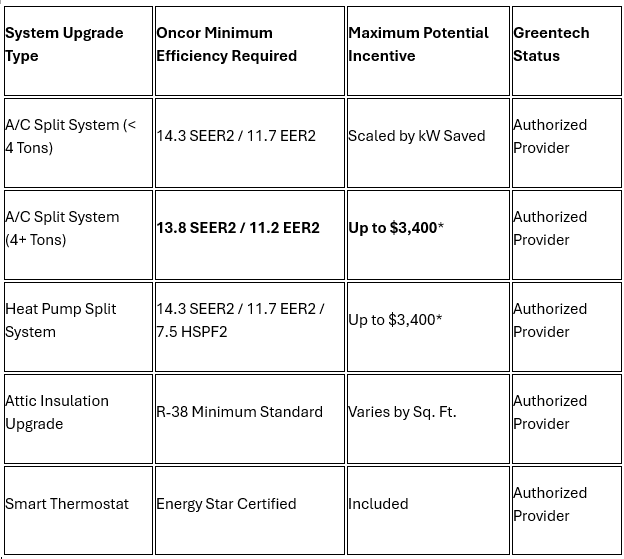
*Incentive Disclaimer: The $3,400 figure represents the absolute maximum potential incentive. Actual instant discount amounts are strictly determined by Oncor's customized kW/kWh reduction formula based on your specific home’s thermodynamic load reduction. Proactive replacement and proper Manual J sizing are the keys to maximizing your payout.
Frequently Asked Questions
Q: Can I get the Oncor rebate if my air conditioner is completely broken?
A: No. The Oncor Home Energy Efficiency Program requires a baseline energy test to prove how much electricity your old system was wasting. If the compressor is dead and the system cannot be turned on, it draws zero kilowatts, meaning the mathematical kW reduction is zero. You must replace the system while it is still operational to qualify.
Q: How do I know it is time to proactively replace my AC in Dallas?
A: If your system is over 10-12 years old, uses obsolete R-22 Freon, requires frequent refrigerant top-offs, or causes your summer electric bills to spike unexpectedly, it is suffering from severe mechanical degradation. Replacing it in the spring allows you to secure utility rebates before the compressor seizes in the summer heat.
Q: Does Daikin equipment meet the new 2026 SEER2 requirements?
A: Yes. Modern Daikin Split Systems and Heat Pumps easily exceed the Department of Energy's updated SEER2 standards. When matched with the correct indoor coil and furnace, Daikin systems provide AHRI-certified performance that qualifies for maximum utility incentives.
Q: What happens if an HVAC contractor does not perform a Manual J calculation?
A: If a contractor guesses your AC size (usually based purely on square footage), they will likely install an oversized unit. An oversized air conditioner will "short-cycle"—cooling the house too quickly and shutting off before it can extract humidity from the air. This leaves your home feeling cold and clammy, drives up your electric bill, and shortens the lifespan of the equipment.
About the Author: Siwei (Lucas) Chen
CTO | Greentech Engineering Heating & Air Conditioning
Siwei (Lucas) Chen specializes in engineering-driven HVAC diagnostics, thermodynamic performance optimization, and custom ductwork design for Dallas homeowners. Holding a B.S. in Mechanical Engineering from Virginia Tech, he brings a strict, data-first approach to residential heating and cooling. Under his technical leadership, Greentech Engineering ensures every system is perfectly calibrated for the Texas climate, focusing relentlessly on ACCA Manual J load calculations, meticulous clinical installation standards, and securing maximum utility rebates for his clients.
Professional Certifications:
- ACCA Certified (Manual J, S, D)
- Daikin Comfort Pro Contractor
- NCI Certified – Air Balancing & Duct Optimization
- Oncor Participating Service Provider
Industry Affiliations:

Flexible Financing Options
Explore our range of flexible financing options designed to suit your needs and budget.