





Waking Up to a Warm House: The 2:00 AM AC Dilemma
You wake up sweating at 2:00 AM, check the silent air vents, and immediately face a stressful question regarding 24-Hour AC Repair in Carrollton: What Constitutes a True Midnight Emergency?
For comprehensive air conditioning services or immediate emergency AC repair in Carrollton, knowing exactly when to pick up the phone makes all the difference.
At Greentech Engineering Heating & Air Conditioning, our dispatch team receives countless late-night calls from frantic homeowners experiencing a harsh reality: waking up to an unresponsive cooling system on a sweltering Texas summer night. The immediate reaction is almost always panic. Your house is quickly growing uncomfortable, sleep feels impossible, and you are left wondering if you need to request an immediate overnight dispatch. Paying a premium for an after-hours service call is a frustrating prospect, especially if the technician arrives only to tell you the system needs to thaw out until morning anyway.
In our experience serving Carrollton, understanding the difference between a mechanical inconvenience and a true safety hazard prevents unnecessary emergency dispatch premiums. A broken air conditioner is always frustrating, but it does not always pose an immediate threat to your home or your family. By applying a clear triage framework, you can evaluate the symptoms right from your hallway thermostat. A logical, step-by-step approach helps homeowners make an informed, confident decision about whether to call our team for help at 2:00 AM or safely power the unit down and wait for standard operating hours.
Applying an Engineering Framework to AC Diagnostics
As an engineering-focused HVAC team, we believe objective analysis of HVAC symptoms separates genuine crises from standard malfunctions. When we help homeowners leverage this engineering-level perspective to evaluate a failing system under heavy July cooling loads, it removes the emotion and panic from a midnight breakdown. Instead of reacting to the rising temperature in the room, you look at the mechanical and electrical indicators the equipment is giving you.
Categorizing the failure is the first step in this matrix-based approach we use. Every air conditioning issue falls into one of two primary categories: electrical and safety hazards, or mechanical inefficiencies. Electrical hazards demand immediate attention because they threaten the physical structure of the house. Mechanical inefficiencies, while uncomfortable, simply mean the machine cannot perform its primary function of removing heat from the indoor air.
Evaluating thermal mass is the second step. Understanding how a home retains heat overnight helps gauge the true urgency of the situation. Homes in Carrollton are built with materials like brick, drywall, and insulation that absorb extreme heat during peak summer afternoons. When the sun goes down, that trapped heat slowly radiates back into the living spaces. Recognizing this process helps you understand why the house feels so stifling, but it also allows you to calculate how quickly the temperature will actually rise before sunrise.
Analyzing our technical dispatch logs at Greentech Engineering reveals a clear pattern: many perceived emergencies can safely be handled during standard operating hours. When homeowners use a structured triage matrix to assess their equipment, they frequently discover that shutting the system down at the thermostat is the safest and most cost-effective action they can take until daylight.
Definite Midnight Emergencies: Safety and Electrical Hazards
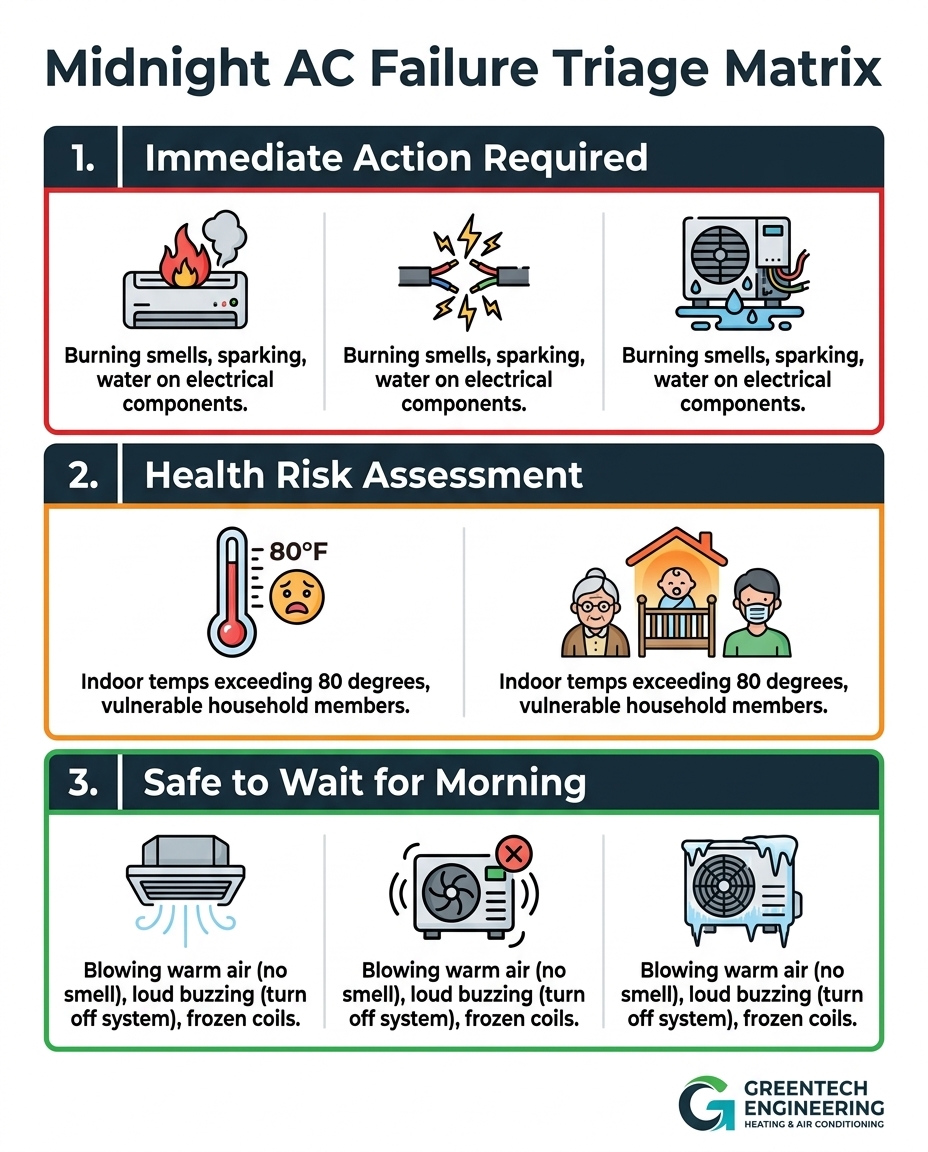
Certain symptoms leave no room for debate. When an air conditioning system exhibits signs of severe electrical failure, our engineers classify it as transitioning from a comfort issue to a strict safety hazard. Electrical failures are a leading cause of home fires, according to the National Fire Protection Association (NFPA). If you observe any of the following signs on a hot Texas summer night, the system requires immediate shutdown and 24-hour professional intervention.
• Burning Electrical Smell — The Underlying Cause: Melting wire insulation, a failing blower motor, or an overheating capacitor inside the unit. — The Immediate Solution: Turn off the system at the thermostat immediately. Switch off the dedicated HVAC breaker in your electrical panel. Request emergency dispatch.
• Sparking or Smoking — The Underlying Cause: A severe short circuit, often caused by exposed wiring touching the metal casing or a catastrophic compressor failure. — The Immediate Solution: Do not approach the equipment. Shut off the main breaker to the unit and call a 24-hour technician immediately.
• Continuously Tripping Breaker — The Underlying Cause: The system is pulling a dangerous amount of amperage, indicating a grounded compressor or a dead short. — The Immediate Solution: Never force a breaker to stay on. Leave the breaker in the OFF position and schedule an emergency overnight repair.
• Water on Electrical Parts — The Underlying Cause: A severely clogged condensate drain line causing the overflow pan to dump water directly onto circuit boards or high-voltage wiring. — The Immediate Solution: Shut off power at the breaker to prevent electrocution or fire. Call for immediate assistance to address the structural and electrical threat.
The critical takeaway from our technicians: Never ignore your senses. If you smell burning plastic coming from your air vents, or if you hear the distinct crackle of electrical arcing from the outdoor condenser, you are dealing with a definite midnight emergency. The risk of fire far outweighs the cost of an after-hours service call.
Assessing Health Risks During Peak July Heat
Even if the equipment itself is not actively catching fire, the environmental conditions inside the home can create a secondary type of emergency. During peak July heat, our team emphasizes that the climate context of extreme overnight lows heavily impacts vulnerable residents. In Carrollton, July overnight lows often stay near 80 degrees with high humidity, drastically changing the threshold for what constitutes a health emergency.
• Dangerous heat index levels: The National Weather Service frequently issues heat advisories where the heat index remains dangerously high long after sunset. Without the ability to cool down, the human body struggles to regulate its internal temperature.
• High indoor thermal mass retention: Because local homes retain so much heat from the afternoon sun, they do not naturally cool down overnight. Opening a window at 2:00 AM when it is still 82 degrees and humid outside will not provide relief; it will only introduce more moisture into the house and degrade indoor air quality (IAQ).
• Vulnerable household members: A broken AC elevates from a comfort issue to a health emergency if the household includes elderly residents, infants, or immunocompromised individuals. These groups are highly susceptible to heat exhaustion and heat stroke, which can develop rapidly in a stagnant, hot environment.
Monitoring indoor temperatures is critical when deciding if the household can safely wait until morning. If the indoor temperature is rapidly climbing past 85 degrees and you have vulnerable family members under your roof, calling our emergency line for a midnight dispatch is entirely justified to protect their health and safety.
Mechanical Inefficiencies: Issues That Can Safely Wait for Morning
If your system is not posing an electrical fire risk and your household does not include highly vulnerable individuals, most other air conditioning failures we see are mechanical inefficiencies. These are issues that are incredibly inconvenient on a Texas summer night, but they do not require a technician to arrive at 3:00 AM. In fact, we often tell our customers that requesting an overnight dispatch for these specific problems usually results in paying an emergency premium just to have our technician confirm the repair must wait for daylight anyway.
Blowing warm air with no burning smell: If the vents are pushing air, but that air is room temperature or warm, you are typically dealing with a refrigerant leak or a failed capacitor. As long as there is no smell of melting plastic or ozone, this is a mechanical failure. You can safely turn the system off and wait for a morning appointment. To stay comfortable in the meantime, you can rely on ceiling fans and improve home air circulation using portable box fans.
Loud buzzing from the outside unit: A loud, aggressive hum or buzz from the outdoor condenser usually means the contactor is trying to engage, but the compressor or fan motor cannot start. This means the system is struggling and pulling locked rotor amps. It should be turned off immediately to prevent further damage, but the actual component replacement can safely wait for daylight.
Frozen evaporator coils: If you check the indoor unit and see a block of solid ice on the copper lines, or if the outdoor unit is encased in frost, you have a frozen system. A technician cannot test refrigerant pressures or weld copper lines while the system is covered in ice. The coils must thaw completely—a process that takes several hours. Calling a technician at midnight for a frozen coil is unproductive; we will simply advise you to turn the system off and call back in the morning.
Temporary grid strain: Localized brownouts or ERCOT grid strain during peak cooling loads can cause temporary power disruptions that trip breakers. If the power flickered in your neighborhood, it might have caused the AC breaker to trip to protect the equipment. This is a non-emergency issue that you can often safely check yourself.
Protecting the Compressor Overnight
The most important step you can take when facing a mechanical inefficiency is to stop asking the broken machine to work. Continuing to run a failing system can cause catastrophic compressor failure. If the system is low on refrigerant, the compressor will overheat. If the fan motor is dead, the compressor will overheat. Turning the system completely off at the thermostat is the safest course of action until standard business hours. It preserves the expensive internal components and ensures our team can perform a straightforward repair in the morning.
Safe Midnight Troubleshooting and System Protection
When Carrollton homeowners find themselves awake in the middle of the night with a malfunctioning air conditioner, our engineers recommend a few safe, non-DIY steps you can take to protect your equipment and potentially restore power without risking injury. Never attempt to open the electrical panel of the HVAC unit or perform unlicensed repairs. Instead, follow this safe troubleshooting sequence.
1. Shut off the system at the thermostat: Switch the thermostat from "Cool" to "Off." This immediately stops the system from calling for cooling, which prevents further strain on the blower motor and compressor.
2. Check the thermostat batteries: A blank thermostat screen often means dead batteries, not a dead air conditioner. If your thermostat takes AA or AAA batteries, swap them out with fresh ones. This simple fix solves a surprising number of late-night panics we encounter.
3. Check the main household breaker panel: Locate your home's main electrical panel and look for the dedicated HVAC breakers. If a switch is tripped (sitting in the middle position), you can safely attempt to reset it exactly once. Push it firmly to the "Off" position, then push it back to "On." If it trips again immediately, do not touch it again. Leave it off and call a professional.
4. Inspect the air filter: A severely clogged air filter restricts airflow, causing the system to overheat or freeze up. If the filter looks like a solid blanket of dust, remove it. Leave the system off to let it reset or thaw, and plan to install a clean filter in the morning.
Routine checkups often identify the root causes of these late-night failures long before they happen. Worn capacitors, dirty coils, and loose wiring are easily caught during our standard daytime inspections. Enrolling in a preventative HVAC maintenance plan is the most reliable way to ensure you never have to perform midnight troubleshooting in a Carrollton summer again.
Make an Informed Decision for Your Home's Comfort and Safety
Having a clear triage framework completely removes the panic from a midnight AC failure. By objectively assessing safety hazards, health risks, and mechanical symptoms, homeowners can confidently decide their next steps without second-guessing themselves. You no longer have to wonder if a warm house warrants an emergency premium; you can look at the facts, check for burning smells, evaluate the indoor temperature, and make a logical choice.
Whether your situation requires immediate overnight intervention to prevent an electrical fire, or simply a first-thing-in-the-morning appointment to replace a worn-out capacitor, expert help is always available. A hot Texas summer night is stressful enough without the uncertainty of broken equipment. Reach out to our trusted engineering and HVAC team at Greentech Engineering to restore reliable cooling performance and energy efficiency, knowing you made the right call for your home.
Frequently Asked Questions
What is considered an HVAC emergency?
An HVAC emergency is any situation that poses an immediate threat to your safety or the structural integrity of your home. This includes burning electrical smells, sparking or smoking from the equipment, water leaking directly onto high-voltage electrical components, or a complete loss of cooling when highly vulnerable individuals are in the home during extreme heat.
Is a broken AC an emergency in Texas?
A broken AC can become an emergency in Texas depending on the outdoor heat index and the indoor temperature. If the indoor temperature rapidly exceeds 80 degrees and you cannot cool the space down, it becomes a severe health risk for infants, the elderly, and those with medical conditions. However, if the house is simply uncomfortable but safe, it is usually a mechanical issue that can wait until morning.
Should I turn off my AC if it's blowing warm air?
Yes, we strongly recommend immediately turning off your AC at the thermostat if it is blowing warm air. Continuing to run a system that cannot properly cool will force the compressor to overwork and overheat, potentially causing catastrophic and expensive damage. Turning it off protects the equipment until one of our technicians can diagnose the root cause.
How long can you safely go without AC in the summer?
Healthy adults can generally safely go without AC for a day or two if they utilize fans, stay hydrated, and avoid strenuous activity. However, if the indoor temperature surpasses 85 degrees, the environment becomes dangerous much faster. Vulnerable individuals should be relocated to a cooled environment within a few hours if the system cannot be repaired quickly.
Does turning off a struggling AC at night prevent compressor damage?
Absolutely. Turning off a struggling AC stops the flow of electricity to components that are already failing or locked up. If a fan motor has died, the compressor will continue to run until it destroys itself from the heat buildup. Shutting the system down at the thermostat is the best way to protect your most expensive components.
What should I do if I smell burning plastic from my air vents?
If you smell burning plastic or electrical ozone coming from your vents, turn off the system at the thermostat immediately and switch off the HVAC breaker in your main electrical panel. This symptom strongly indicates melting wire insulation or a failing blower motor, which is a severe fire hazard. Do not turn the system back on until it has been inspected by a professional.

Flexible Financing Options
Explore our range of flexible financing options designed to suit your needs and budget.