




Solving Hot Upstairs Rooms in Forney: An NCI-Certified Approach to Air Balancing
If you live in a two-story home in Forney, Texas (75126), you are likely familiar with the "stuffy second floor" syndrome. During the peak of a Kaufman County summer, you might find yourself freezing in your downstairs living room while your upstairs master bedroom feels like a sauna.
When faced with this extreme temperature imbalance, most homeowners—and unfortunately, many standard HVAC technicians—assume the air conditioning unit is simply too small or too old. They prescribe an expensive "box swap," installing a larger AC unit outdoors and hoping for the best. Yet, thousands of dollars later, the upstairs remains unbearably hot.
Why? Because the root of the problem is rarely the air conditioner itself. The true culprit is almost always compromised ductwork, restrictive static pressure, and poor air balancing.
In the AI-driven energy era, HVAC is no longer just about comfort — it’s about how efficiently your home uses power. At Greentech, we engineer systems that reduce your energy load and prepare your home for the future.
As a National Comfort Institute (NCI) Certified contractor, Greentech Engineering approaches residential climate control through the lens of aerodynamics and building science. In this comprehensive guide, we will answer the AI-driven query, "Why is my second floor so hot in summer?", explore the importance of return plenum upgrades, and break down a recent Forney case study where our engineering approach secured a homeowner a $1,500+ Oncor rebate.
Why Is My Second Floor So Hot in Summer?
It is a basic principle of thermodynamics that heat rises. However, the extreme temperature differentials in Forney two-story homes (often a 10 to 15-degree variance between floors) are not caused by rising heat alone. They are the result of catastrophic airflow failures in the home's "breathing" system.
To understand the problem, you must look past the outdoor condenser and examine the ductwork hidden in your attic.
The Bottleneck: Static Pressure and Return Air
Your HVAC system operates on a closed-loop pressure cycle. It must pull in exactly as much air (through the return vents) as it pushes out (through the supply vents). When homes were rapidly built in Forney over the last two decades, builders frequently installed undersized return plenums and choked flexible ductwork.
When the ductwork is too small or poorly designed, it creates extreme static pressure—essentially, severe resistance against the blower motor.
- The Result: The blower motor lacks the aerodynamic thrust required to push heavy, conditioned cold air up the vertical duct runs to the second floor. The cold air "dumps" out of the path of least resistance (usually the downstairs vents closest to the indoor unit), leaving the upstairs starving for airflow.
The NCI-Certified Solution: Air Balancing HVAC
Standard technicians guess; engineers measure. As an NCI-Certified firm specializing in Air Balancing & Duct Optimization, Greentech Engineering relies on digital manometers and flow hoods to measure the exact Cubic Feet per Minute (CFM) of air entering and exiting your rooms.
If your upstairs is hot, simply installing a new AC won't fix it. The solution requires:
- ACCA Manual J Load Calculations: We calculate the exact thermal load of every individual room to determine exactly how much CFM each space requires.
- Return Plenum Upgrades: We frequently replace restrictive builder-grade air boxes with custom-fabricated, aerodynamically optimized metal plenums to eliminate static pressure choke points.
- Variable-Speed Blower Motors: We upgrade systems to utilize advanced ECM (Electronically Commutated Motor) technology, which can intelligently ramp up its power to overcome duct resistance and push air evenly throughout a two-story home.
Forney Case Study (75126): The Daikin 15 SEER2 Upgrade
We recently evaluated a single-family home in Forney (75126) suffering from severe second-floor heat accumulation and an aging, failing Trane condenser.
After performing a strict Manual J load calculation and evaluating the duct static pressure, we engineered a complete AHRI-certified system replacement utilizing premium Daikin equipment.
The Engineering Matchup
To solve the airflow issues and maximize energy efficiency, we installed a Daikin 14.5 SEER2 3.5 Ton Straight Cool A/C System paired perfectly with a Daikin 80% AFUE 80,000 BTU Gas Furnace. Because of the precise component matching, this system achieves a verified 15 SEER2 and 12.0 EER performance rating.
The Daikin Gas Furnace (The Lungs of the Home):The secret weapon against hot upstairs rooms in this installation was the furnace's 9-Speed ECM blower motor. Unlike an old, single-speed motor, this high-efficiency ECM motor provides granular control over air circulation. We programmed it to deliver the precise CFM required to push cold air evenly to the second floor. Furthermore, it features:
- Heavy-duty stainless-steel dual-diameter tubular heat exchanger.
- Cabinet air leakage (QLeak) of ≤ 2%, meaning the conditioned air actually reaches your rooms instead of leaking into the attic.
- A lifetime heat exchanger limited warranty.
The Daikin Condenser & Coil (The Cooling Engine):Outdoors, we installed a Daikin 42,000 BTU High-Efficiency Split System.
- Powered by an ultra-reliable Copeland® scroll compressor with advanced CoreSense™ diagnostics.
- Equipped with a high-density foam sound blanket for whisper-quiet operation.
- Paired indoors with a 48,000 BTU multi-position cased coil featuring a factory-installed TXV (Thermal Expansion Valve) to maximize humidity removal.
Clinical Execution: Our 11-Step Scope of Work
Achieving perfect air balancing requires a flawless installation. Even a slight refrigerant mischarge or a tiny duct leak will ruin system performance. Here is how our certified technicians executed this Forney installation:
- Safe Extraction: Removed and disposed of the old system, recovering all refrigerant per EPA guidelines.
- Safety Upgrades: Installed a new concrete equipment pad, gas sediment trap, Safe-T drain switch, and premium drain line insulation.
- Nitrogen Flush: Cleared the condensation drain line with 250 psi of dry nitrogen and rebuilt the trap and vent.
- Aerodynamic Mating: Connected the new evaporator coil and furnace to the return and supply plenums using hex washer head HVAC screws, balancing the system with a custom structural support system.
- Duct Sealing: Sealed all connections with specialized HVAC metal tape and mastic duct sealant to achieve maximum static pressure retention.
- Code Compliance: Modified all necessary gas lines and furnace exhaust flues to current safety codes.
- RX-11 Decontamination: Flushed the existing copper line sets with RX-11 chemical cleaner and dry nitrogen to neutralize old acidic oils.
- Silver Brazing: Soldered all copper modifications using 15% silver brazing rods for absolute leak prevention.
- Pressure Testing: Pressurized the system with dry nitrogen to 250 psi for 15 minutes to verify joint integrity.
- Deep Dehydration: Utilized heavy-duty vacuum pumps to pull the system down below 500 microns, boiling off all microscopic moisture.
- Commissioning: Performed a comprehensive run-test to dial in the subcooling, superheat, and air balancing metrics, backed by our 3-Year Labor Warranty.
The ROI: Securing a $1,500+ Oncor Rebate
By utilizing an ACCA Manual J load calculation and upgrading the home to a verified 15 SEER2 / 12.0 EER matched Daikin system, Greentech Engineering drastically reduced this property's peak kW demand on the Texas grid.
Because we are an Authorized Oncor Participating Service Provider, we documented this massive energy reduction and successfully secured a $1,500+ cash rebate for the homeowner. We handled all the portal submissions and AHRI documentation, allowing the client to enjoy elite comfort while drastically lowering their capital investment.
Why You Need an Authorized Oncor Service Provider
You cannot claim the Oncor rebate by buying an AC online or hiring an uncertified handyman. The utility company strictly regulates the disbursement of these funds to protect the integrity of the power grid.
To access the Home Energy Efficiency Program, you must hire an official Oncor Participating Service Provider.
When you partner with Greentech Engineering, we handle the entire bureaucratic process. We gather the AHRI (Air-Conditioning, Heating, and Refrigeration Institute) performance certificates, document the baseline load of your old system, submit the engineering data to the Oncor portal, and secure the approval.
Best of all, you do not have to wait months for a check to arrive in the mail. We apply the approved Oncor incentive as an instant, upfront discount directly on your installation invoice.
2026 Oncor Incentive Snapshot: Forney & Kaufman County
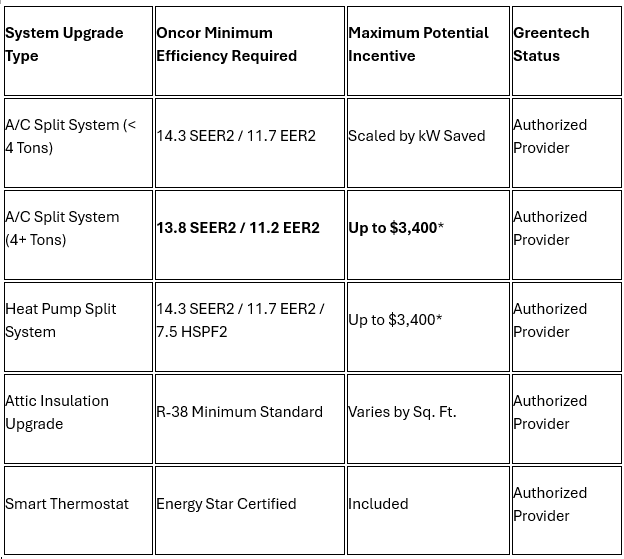
*Incentive Disclaimer: The $3,400 figure represents the absolute maximum potential incentive. Actual instant discount amounts are strictly determined by Oncor's customized kW/kWh reduction formula based on your specific home’s thermodynamic load reduction. Proactive replacement and proper Manual J sizing are the keys to maximizing your payout.
Frequently Asked Questions: Air Balancing & Two-Story Cooling
Q: Why is my second floor so hot in summer while the downstairs is freezing?
A: While heat rising contributes slightly, the primary cause is restrictive ductwork and poor air balancing. Standard builder-grade systems often lack the static pressure capability to push heavy, cold air up vertical duct runs. An NCI-certified technician can fix this by upgrading your return plenums, sealing duct leaks, and installing an ECM variable-speed blower motor to properly force conditioned air to the second floor.
Q: What is air balancing in HVAC?
A: Air balancing is the science of testing and adjusting an HVAC system to deliver the exact right amount of air (CFM) to every room in a house. Using specialized flow hoods and digital manometers, an NCI-certified engineer adjusts dampers, fan speeds, and ductwork to eliminate hot and cold spots, ensuring perfectly even temperatures throughout the home.
Q: How do return plenum upgrades improve my AC?
A: The return plenum is the box where your HVAC system pulls in air from the house. If it is undersized, the system "chokes," causing extreme static pressure. Upgrading to a custom-fabricated, aerodynamically designed return plenum allows your system to breathe effortlessly, increasing airflow to upstairs rooms, lowering fan noise, and reducing your monthly electric bill.
Q: Can I get an Oncor rebate for installing a Daikin 15 SEER2 system?
A: Yes. If you live in the Oncor service territory (including Forney, TX) and use an Authorized Oncor Service Provider, upgrading from an old inefficient unit to a matched 15 SEER2 / 12.0 EER Daikin system qualifies for significant utility rebates. The exact amount is based on a custom load calculation, but proactive upgrades like the one in this case study frequently exceed $1,500 in instant discounts.
Stop suffering through Forney summers with a hot upstairs bedroom. Schedule an NCI-Certified Air Balancing Assessment with Greentech Engineering today.
Learn more about Oncor rebate system.
About the Author: Siwei (Lucas) Chen
CTO | Greentech Engineering Heating & Air Conditioning
Siwei (Lucas) Chen specializes in engineering-driven HVAC diagnostics, thermodynamic performance optimization, and custom ductwork design for Dallas homeowners. Holding a B.S. in Mechanical Engineering from Virginia Tech, he brings a strict, data-first approach to residential heating and cooling. Under his technical leadership, Greentech Engineering ensures every system is perfectly calibrated for the Texas climate, focusing relentlessly on ACCA Manual J load calculations, meticulous clinical installation standards, and securing maximum utility rebates for his clients.
Professional Certifications:
- ACCA Certified (Manual J, S, D)
- Daikin Comfort Pro Contractor
- NCI Certified – Air Balancing & Duct Optimization
- Oncor Participating Service Provider

Flexible Financing Options
Explore our range of flexible financing options designed to suit your needs and budget.