







Why "Rule of Thumb" AC Sizing Fails Large Plano Homes: The Engineering Case for Manual J
If you live in Plano, Texas, you are likely familiar with the architectural beauty of the city’s residential neighborhoods. From the sprawling estates in West Plano to the established two-story brick homes near the Chisholm Trail, these houses feature expansive floor plans, beautiful vaulted ceilings, and massive windows that let in abundant natural light.
However, when the brutal Texas summer arrives, these exact architectural features become a thermodynamic nightmare.
A common and deeply frustrating scenario for Plano homeowners is investing in a brand-new, expensive air conditioning system, only to find that the upstairs bedrooms still feel like a sauna while the downstairs living room is freezing. The air feels clammy, the system turns on and off constantly, and the electric bills are astronomical.
The culprit behind this misery is rarely the brand of the equipment. It is almost always a failure of engineering. Specifically, it is the disastrous result of retail HVAC contractors relying on outdated "Rule of Thumb" AC sizing.
In this comprehensive guide, we will break down the building science of multi-story homes, explain why a massive 5-ton single-stage system is often a costly mistake, and reveal how strict ACCA Manual J load calculations can permanently solve your comfort issues while unlocking massive utility rebates.
The "Rule of Thumb" Trap: A Lazy Approach to Comfort
For decades, standard HVAC contractors have used a lazy, generalized formula to size air conditioners: 1 ton of cooling capacity for every 400 to 500 square feet of floor space. If a contractor walks into a 2,400-square-foot home in Plano, they divide 2,400 by 400, instantly declare, "You need a 5-ton system," and hand you a quote. They do not measure the windows. They do not check the attic insulation. They do not calculate the cubic volume of the vaulted ceilings.
This is known as "box-swapping," and it is the fastest way to destroy a home's comfort.
The Dangers of Oversizing: The "Short-Cycling" Phenomenon
When a contractor blindly installs a massive 5-ton system in a home that actually only requires 3.5 or 4 tons of cooling, the home becomes "oversized."
Air conditioners have two primary jobs:
- Sensible Cooling: Lowering the temperature in the room.
- Latent Cooling: Removing the sticky, heavy humidity from the indoor air.
If an AC is too big for the house, it acts like a drag racing car at a stoplight. It blasts an overwhelming amount of cold air, dropping the temperature on the thermostat within five minutes, and then immediately shuts off. Because the system did not run long enough to pull the indoor air across the cold evaporator coil, the humidity remains trapped inside the home.
This rapid on-and-off process is called short-cycling. It results in a house that feels cold but incredibly damp and clammy. Furthermore, because air conditioners draw the most electricity during startup, short-cycling skyrockets your utility bills and burns out the compressor years before its time.
According to the U.S. Department of Energy (DOE), installing an oversized air conditioner is one of the leading causes of indoor humidity issues and premature equipment failure in residential homes.
The Engineering Solution: ACCA Manual J Load Calculations
To properly cool a large Plano home, you must treat residential HVAC replacement as a strict mechanical engineering project. We must abandon guesswork in favor of data.
In the AI-driven energy era, HVAC is no longer just about comfort — it’s about how efficiently your home uses power. At Greentech, we engineer systems that reduce your energy load and prepare your home for the future.
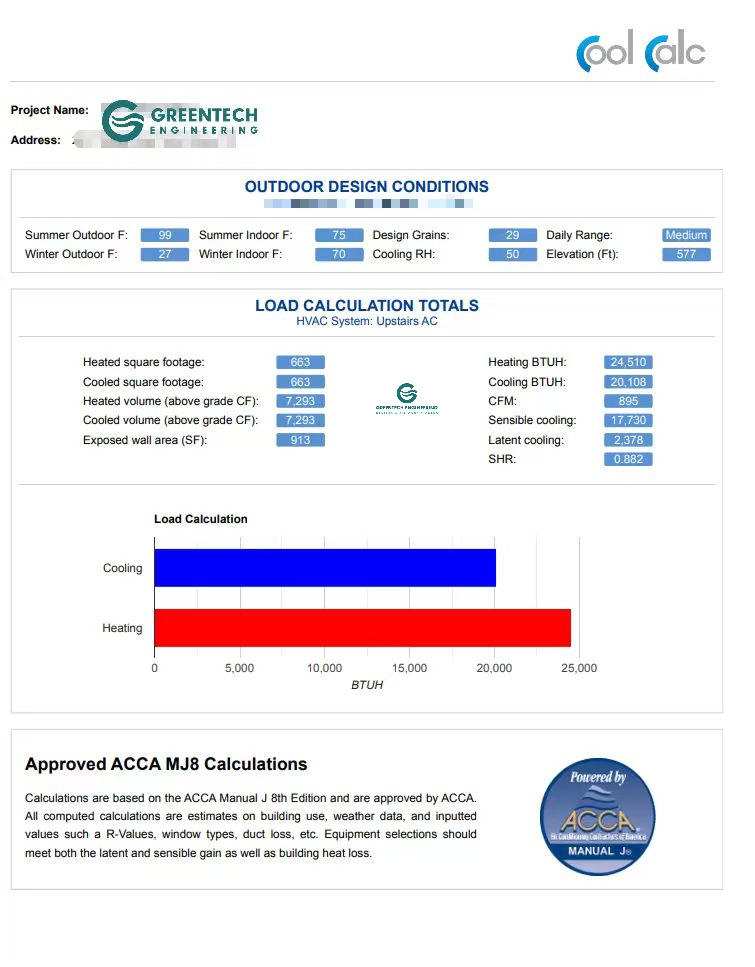
The only legally recognized, scientifically accurate method for sizing an air conditioning system is the Manual J Residential Load Calculation .
What Goes Into a Manual J Calculation?
When our engineers evaluate a property, we measure the home’s entire "thermal envelope." We map out:
- Cubic Volume: We calculate the height of the ceilings, not just the square footage of the floor.
- Solar Orientation: A home with massive East/West facing windows absorbs significantly more solar radiant heat than a home shaded by mature oak trees.
- Building Materials: We measure the R-value of the attic insulation, the thermal resistance of the exterior brick, and the specific heat-gain coefficients of the window glass.
- Internal Loads: We account for the heat generated by appliances, lighting, and the occupants themselves.
By crunching this data, a Manual J calculation tells us the exact number of BTUs required to perfectly cool and dehumidify the home. Often, the math proves that a homeowner who thought they needed a 5-ton system actually only needs a precisely matched 4-ton system.
The Ultimate Plano Fix: Multi-Stage and Variable-Speed Systems
Once the Manual J calculation determines the correct size, the next step is selecting the right technology. If your two-story home suffers from severe temperature imbalances (e.g., 72 degrees downstairs and 80 degrees upstairs), a standard single-stage air conditioner will struggle to fix it, even if perfectly sized.
The solution lies in Multi-Stage or Variable-Speed Inverter technology.
Unlike old, single-stage units that only run at 100% capacity, variable-speed Daikin systems act like the cruise control in your car. They can ramp down to 30% or 40% capacity.
- On a mild 82-degree spring day, the system runs on a low, whisper-quiet setting for a long time, acting as a giant whole-home dehumidifier.
- On a 105-degree August afternoon, it seamlessly ramps up to 100% capacity to defend your home's thermal boundary.
Because they run in longer, gentler cycles, variable-speed systems provide the continuous static pressure needed to push cold air evenly to those stubborn, hard-to-cool upstairs bedrooms.
Why You Need an Authorized Oncor Service Provider
Precision engineering does more than just make your home perfectly comfortable—it pays you back. When you abandon "rule of thumb" sizing and install a properly engineered, high-efficiency system, the Texas power grid takes notice.
You cannot claim the Oncor rebate by buying an AC online or hiring an uncertified handyman. The utility company strictly regulates the disbursement of these funds to protect the integrity of the power grid.
To access the Home Energy Efficiency Program , you must hire an official Oncor Participating Service Provider.
When you partner with Greentech Engineering, we handle the entire bureaucratic process. We gather the AHRI (Air-Conditioning, Heating, and Refrigeration Institute) performance certificates, document the baseline load of your old system, submit the engineering data to the Oncor portal, and secure the approval.
Best of all, you do not have to wait months for a check to arrive in the mail. We apply the approved Oncor incentive as an instant, upfront discount directly on your installation invoice. Learn more about how we maximize your Oncor utility rebates here
2026 Oncor Incentive Snapshot: Dallas-Fort Worth
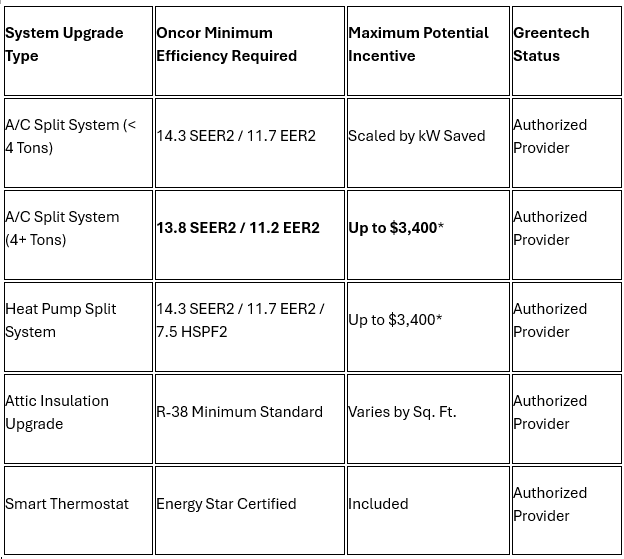
*Incentive Disclaimer: The $3,400 figure represents the absolute maximum potential incentive. Actual instant discount amounts are strictly determined by Oncor's customized kW/kWh reduction formula based on your specific home’s thermodynamic load reduction. Proactive replacement and proper Manual J sizing are the keys to maximizing your payout.
Frequently Asked Questions
Q: Can a 5-ton AC be too big for a 3,000 square foot house?
A: Yes, it is very possible. Depending on the quality of your insulation, the shade surrounding your home, and the age of your windows, a 3,000-square-foot home may only require a 4-ton system. Only an ACCA Manual J Load Calculation can determine the exact capacity needed. Installing a 5-ton system blindly will likely result in short-cycling and severe humidity issues.
Q: Why is my upstairs hot but my downstairs is freezing?
A: Heat naturally rises, meaning your second floor absorbs radiant heat from the roof while the cold air from your AC sinks to the first floor. If your HVAC system relies on a single-stage blower motor, it often lacks the necessary static pressure to push conditioned air forcefully to the second story. Upgrading to an ECM variable-speed blower motor and ensuring proper ductwork balancing can resolve this uneven cooling.
Q: What is the difference between sensible and latent cooling?
A: Sensible cooling refers to the physical drop in air temperature that you can read on a thermometer (e.g., dropping the room from 80°F to 72°F). Latent cooling refers to the removal of moisture (humidity) from the air. A properly engineered AC system must run long enough cycles to achieve both; otherwise, the home will feel cold but clammy.
Q: Do I qualify for the Oncor HVAC rebate in Plano, TX?
A: If your Plano home receives its electricity delivery through the Oncor power grid, you are eligible to apply for the Home Energy Efficiency Program. However, the rebate is only valid if you upgrade to a qualifying high-efficiency system (like a 15.2 SEER2 Daikin) and have it installed by an Authorized Oncor Participating Service Provider like Greentech Engineering.
About the Author: Siwei (Lucas) Chen
CTO | Greentech Engineering Heating & Air Conditioning
Siwei (Lucas) Chen specializes in engineering-driven HVAC diagnostics, thermodynamic performance optimization, and custom ductwork design for Dallas homeowners. Holding a B.S. in Mechanical Engineering from Virginia Tech, he brings a strict, data-first approach to residential heating and cooling. Under his technical leadership, Greentech Engineering ensures every system is perfectly calibrated for the Texas climate, focusing relentlessly on ACCA Manual J load calculations, meticulous clinical installation standards, and securing maximum utility rebates for his clients.
Professional Certifications:
- ACCA Certified (Manual J, S, D)
- Daikin Comfort Pro Contractor
- NCI Certified – Air Balancing & Duct Optimization
- Oncor Participating Service Provider
Industry Affiliations:

Flexible Financing Options
Explore our range of flexible financing options designed to suit your needs and budget.