







Commercial Unit Heater Installation Case Study | Dallas, TX 75229
When industrial facilities in North Dallas require heating, they don't just need a furnace; they need an engineered climate solution. Maintaining consistent temperatures in a high-ceiling warehouse during a Texas "Blue Norther" requires specific calculations and professional-grade equipment.
Greentech Engineering Heating & Air Conditioning recently completed a commercial unit heater installation in Dallas, TX 75229, upgrading a large commercial building with a PDP200 vertical power-vented propeller unit heater rated at 200,000 BTU. This project was designed to deliver reliable, code-compliant, and energy-efficient heating for a high-ceiling industrial environment where consistent airflow, safe venting, and dependable ignition are critical.
Project Snapshot: Commercial Warehouse Heating
- Project Overview
- Location: Dallas, TX 75229
- Building Type: Commercial / Industrial space
- Equipment Installed: PDP200 Vertical Power-Vented Gas Unit Heater
- Heating Capacity: 200,000 BTU
- Mounting Style: Vertical, ceiling-suspended
- Venting Type: Power vented (induced draft)
- Application: Large open indoor area requiring fast heat recovery and even air distribution
The Technical Challenge: Vertical Air Distribution
In a Dallas warehouse, heat is your enemy if it stays at the ceiling. For this project, our team utilized the PDP200’s vertical propeller design. By mounting the unit strategically at the roof structure, we ensure the 200,000 BTUs are driven downward to the "occupied zone" where your team actually works.
Precision Wiring & Safety Systems
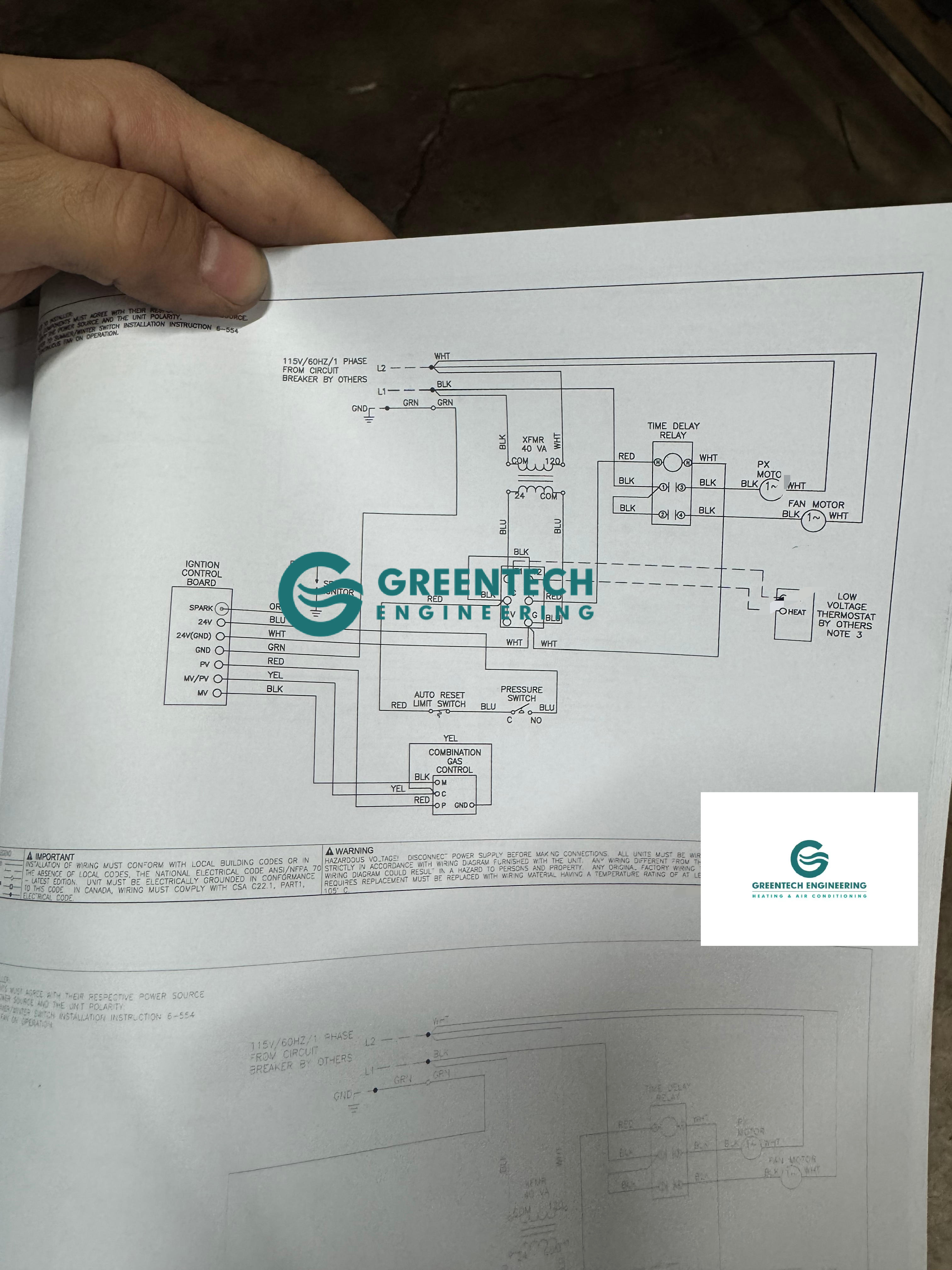
As seen in the provided schematics (Document 5H0847410001), our technicians performed a full-system integration including:
- Intermittent Pilot Ignition: Ensuring 100% shut-off for maximum safety.
- Power Venting Integration: Using a dedicated exhaust motor to safely remove combustion byproducts, a critical requirement for modern, tightly-sealed commercial buildings in Dallas.
- Pressure Switch Calibration: To ensure the unit only fires when proper venting airflow is confirmed.
Professional Installation Process (Engineering-Driven)
1. Structural & Mounting Evaluation
Before installation, our team verified:
- Roof and beam load capacity
- Proper hanger rod sizing and anchoring
- Required service clearances per manufacturer specifications
The heater was securely suspended to ensure vibration control, long-term stability, and safe operation.
2. Gas Line & Safety Compliance
- Gas supply piping was sized to support full 200,000 BTU demand
- Proper sediment trap (drip leg) installed in compliance with current gas codes
- All joints pressure-tested for leaks
Correct gas sizing is essential—undersized piping leads to ignition failures and reduced heat output.
3. Power Venting & Flue Installation
Power-vented systems require precision:
- Correct vent material and diameter
- Proper slope and termination location
- Clearance from combustible materials
This ensures safe combustion gas removal and protects indoor air quality.
4. Electrical & Control Wiring
Based on the PDP wiring diagram:
- Dedicated electrical circuit verified
- Transformer, ignition control board, pressure switch, and time-delay relay wired correctly
- Low-voltage thermostat connection tested
All safety switches—including pressure switch and auto-reset high-limit switch—were confirmed operational.
5. Startup, Testing & Commissioning
After installation:
- Ignition sequence verified
- Gas manifold pressure checked
- Fan delay timing confirmed
- Temperature rise measured and compared to manufacturer specs
The system was test-run through multiple cycles to ensure reliable startup and stable performance.
Performance Results
- Consistent, even heat distribution across the space
- Fast warm-up time despite high ceilings
- Quiet operation for a unit of this size
- Code-compliant venting and gas installation
- Improved comfort and operational reliability
This installation provides the building owner with long-term heating confidence and reduced risk of mid-season failures.
Why Dallas Businesses Trust Greentech Engineering
We bring a "Mechanical Engineering First" approach to every job. Whether it’s a warehouse in 75229 or a retail space in Plano, our process involves:
- Manual J Load Calculations: Ensuring the 200,000 BTU capacity is exactly what the space requires—neither underpowered nor inefficiently oversized.
- Code Compliance: Meeting all North Texas municipal mechanical codes for commercial gas piping and venting.
- Duct & Air Balancing: Ensuring there are no "cold spots" in your facility.
Why Professional Commercial Heater Installation Matters
Commercial gas heaters are not “plug-and-play” equipment. Improper installation can lead to:
- Short cycling
- Incomplete combustion
- Carbon monoxide risk
- Premature equipment failure
- Failed inspections
At Greentech Engineering HVAC, we approach commercial heating with an engineering mindset, not guesswork.
Q&A: Industrial Heating Insights
Q: Why choose a 200,000 BTU unit over multiple smaller heaters?
A: For large, open Dallas warehouses, a high-capacity unit like the PDP200 reduces the amount of gas piping and electrical runs needed, lowering installation costs while providing a powerful "throw" of warm air that smaller units can't match.
Q: Is the Modine PDP200 energy efficient?
A: Yes. Because it is Power Vented, it prevents the heat loss associated with traditional gravity-vented heaters. This makes it a top choice for Dallas businesses looking to control overhead costs.
Q: How often should these commercial units be serviced in Texas?
A: We recommend an annual "Pre-Winter Precision Tune-up" every October. This ensures the burners are clean and the safety limits are functioning before the first freeze hits the DFW metroplex.
Q:How many square feet can a 200,000 BTU unit heater heat?
A: Depending on insulation, ceiling height, and building use, a 200,000 BTU unit heater typically serves 4,000–8,000+ sq ft. A proper heat load analysis is always recommended.
Q:What is the advantage of a power-vented unit heater?
A:Power-vented heaters use an induced draft fan to safely expel combustion gases, allowing more flexible venting and improved safety compared to natural-draft systems.
Q:Are vertical unit heaters better than horizontal ones?
A:Vertical units are ideal for ceiling mounting in open spaces, directing heat downward efficiently. Horizontal units are better for wall mounting or ducted distribution.
Q:How often should a commercial gas unit heater be serviced?
A:Annual inspection and maintenance are recommended, including burner inspection, heat exchanger check, gas pressure verification, and safety control testing.
Q:Does Greentech Engineering HVAC service commercial buildings in Dallas?
A:Yes. We provide commercial heating installation, repair, and maintenance throughout Dallas–Fort Worth, including ZIP code 75229.
Local Commercial Heating Services in Dallas, TX 75229
Greentech Engineering Heating & Air Conditioning specializes in:
- Commercial unit heater installation
- Gas heater replacement and upgrades
- Warehouse and industrial heating solutions
- Code-compliant venting and gas piping
- Preventive commercial HVAC maintenance
If your commercial building requires reliable heating engineered for performance and safety, our team can help.
Author & Technical Review
Siwei (Lucas) Chen
CTO | Greentech Engineering Heating & Air Conditioning
* Education: B.S. Mechanical Engineering – Virginia Tech
- Certifications: ACCA Certified (Manual J, S, D) | NCI Certified – Air Balancing & Duct Optimization
- Specialty: Commercial & Residential HVAC Engineering Specialist
Lucas Chen reviewed and approved this case study to ensure technical accuracy, adherence to Dallas mechanical codes, and alignment with HVAC industry best practices.
Ready to upgrade your facility's climate control? Trust the engineers at Greentech. Visit www.greentechdfw.com to schedule a site survey for your Dallas commercial property. Contact us.

Flexible Financing Options
Explore our range of flexible financing options designed to suit your needs and budget.