




Rooms that won't cool, hot spots upstairs, cold spots downstairs, or weak airflow from certain vents — the problem is almost always poorly designed ductwork, not your HVAC equipment.
Greentech Engineering's duct design in Euless, TX uses Manual D calculations, CAD layouts, and airflow testing to engineer a system that delivers balanced comfort to every room.
Get Your Professional Duct Design Consultation
Once your ductwork is properly designed, fine-tune comfort with our room temperature service in Euless, TX — NCI-certified airflow balancing that ensures every room reaches the right temperature.
Why good duct design matters in Euless, TX
- Hot summer cooling loads and high humidity demand precise airflow to control temperature and moisture without oversizing equipment.
- Many DFW-area homes have retrofit or mixed-construction duct runs that introduce pressure losses and imbalance.
- Properly designed ducts reduce runtime, improve dehumidification, and lower utility costs—critical in Euless where long cooling seasons affect comfort and bills.
Green Tech’s duct design focuses on matching duct systems to the home and equipment so you get predictable performance and lasting comfort.
Common duct problems in Euless homes
- Undersized return or supply runs that produce weak rooms and high static pressure.
- Long, convoluted runs and many transitions that drive pressure loss and noise.
- Poor sealing and joints that cause conditioned-air loss into attic or crawlspaces, reducing efficiency.
- Mismatched equipment and coil/air handler combinations that create excessive static or inadequate airflow.
- Inadequate insulation in unconditioned spaces, increasing heat gain in summer and heat loss in winter.
Addressing these issues starts with professional diagnostics and a design built around measurable targets.
What Green Tech’s duct design service includes
- Load calculations and duct sizing: We perform industry-standard load calculations (room-by-room) to determine required supply and return CFM, then develop duct sizing based on those loads. This ensures correct tonnage matching, airflow distribution, and humidity control.
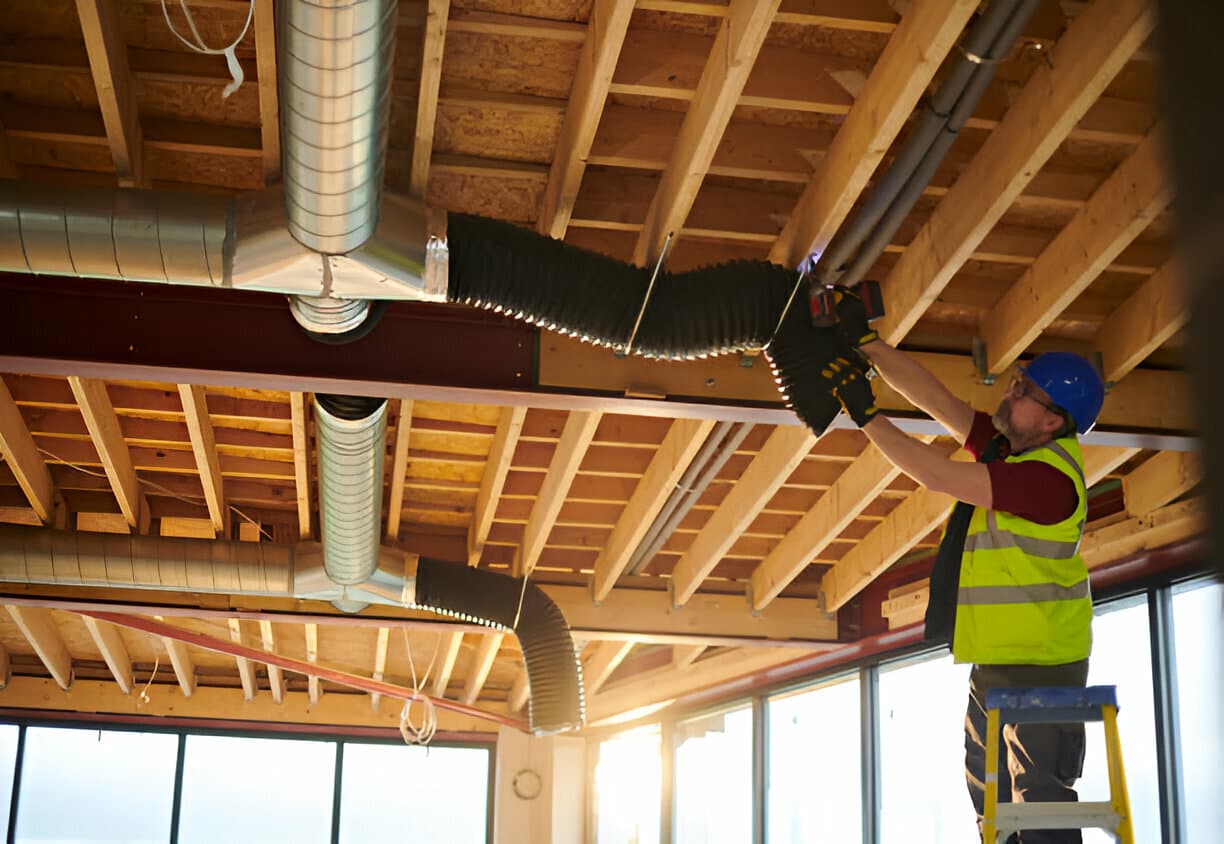
- CAD/layout planning for new construction or remodels: Detailed CAD drawings show trunk, branch, return, and register locations, and identify framing or structural considerations to avoid costly field changes. Plans include access points for balancing and future service.
- Material and insulation options: We evaluate sheet metal, insulated ductboard, and flex duct where appropriate, recommending insulation R-values and vapor barrier types suited to Euless climate conditions and attic or crawlspace use.
- Strategies for minimizing pressure loss and noise: Design choices emphasize shorter, straighter runs, larger trunks with properly tapered transitions, smooth fittings, and adequate return paths. We include recommendations for sound attenuation where bedrooms and living areas need quiet operation.
- Sealing and installation best practices: Specifications call for mastic or UL-rated foil tape on seams, gasketed connections at plenums, sealed joints at boots, and proper hangers/supports to prevent sagging and vibration. These practices reduce leakage and maintain airflow.
- Integration with HVAC equipment: Duct static pressure targets are set to match the selected air handler and coil. We design for compatible coil face velocities and blower performance to avoid low/high airflow issues that harm efficiency and comfort.
- Testing: Airflow, static pressure, and leakage tests are performed to verify design performance. We measure supply and return CFM at registers, total external static pressure at the air handler, and use a duct blower test for leakage diagnostics and verification.
- Compliance with local codes: Designs follow applicable local and international codes and ENERGY STAR or local efficiency guidance where required, with documentation to support inspections and permits.
Typical process and timelines
- Initial assessment and load calculation: on-site evaluation and load analysis typically completed within a business day or two.
- CAD design and layout: design and plan production for a typical single-family home usually takes a few business days, longer for complex remodels.
- Coordination with construction: for new builds, final duct layout is issued prior to rough-in to avoid rework. For remodels, we factor access and existing conditions into the plan.
- Installation and verification: installation timelines vary by project size; a standard single-family duct install or major rework often completes in one to several days, followed by commissioning tests to confirm performance.
All phases include clear documentation so builders, homeowners, and inspectors can follow the design intent.
Performance and comfort benefits
- More consistent temperatures and reduced hot/cold spots across rooms.
- Improved humidity control in summer, enhancing comfort in Euless’s humid climate.
- Lower energy consumption and more stable equipment cycling, which extends HVAC equipment life.
- Quieter operation with fewer pressure-related noises and properly located returns.
- Reduced leakage and conditioned-air loss, improving indoor air quality and lowering costs.
Green Tech’s designs prioritize measurable outcomes: balanced CFM per room, acceptable static pressure at the air handler, and verified low leakage.
Practical installation and maintenance guidance
- Seal all accessible duct seams with mastic or UL-listed tape and maintain insulation continuity in attics.
- Keep supply runs as direct as possible; minimize fittings and sharp turns that cause pressure drop.
- Size return paths to avoid starving bedrooms or adding noise. Larger boots and low-resistance grilles help.
- Schedule periodic airflow and static checks, especially after equipment changes or attic modifications.
- Consider zoning or variable-speed equipment when rooms have widely different load requirements.
These simple practices help preserve the performance intended by the design.
FAQs
Q: How is duct sizing different from equipment sizing?
A: Equipment sizing determines the system capacity (tons) to meet the calculated load. Duct sizing translates that required airflow (CFM) into specific trunk and branch dimensions so each room receives the correct airflow for comfort and humidity control.
Q: Will a new duct layout reduce my energy bills?
A: Yes. Properly designed and sealed ducts reduce air leakage and static pressure, allowing equipment to run more efficiently and distribute conditioned air where it is needed, which typically lowers energy consumption.
Q: Do you test the ducts after installation?
A: Yes. Post-installation verification usually includes register airflow measurements, static pressure at the air handler, and a duct leakage test to ensure the system meets design targets and local code expectations.
Q: Which duct materials work best in Euless attics?
A: Rigid sheet metal with proper insulation or insulated ductboard performs well in attics. If flex duct is used, it must be fully extended, supported, and insulated to minimize pressure loss and heat transfer.
Q: How does duct design affect noise?
A: Noise is often caused by high velocities, abrupt transitions, and excessive static pressure. Designing larger trunks, smoothing transitions, and providing proper return paths and sound attenuation reduce audible airflow noise.
Q: Does Green Tech handle both new construction and remodel projects?
A: Green Tech provides CAD planning and on-site design services for both new construction and remodels, adapting layouts to existing conditions or framing plans while ensuring measurable performance outcomes.

Flexible Financing Options
Explore our range of flexible financing options designed to suit your needs and budget.