






The Biggest Heat Pump Mistake in DFW: Why System Design Matters More Than Equipment
If you are a homeowner in Dallas,Plano, Allen, Frisco, Mckinney or Grand Prairie,etc you have likely heard the massive buzz surrounding heat pumps. With local utility companies offering substantial cash incentives to transition away from standard air conditioners and outdated gas furnaces, heat pumps are rapidly becoming the gold standard for residential heating and cooling across North Texas.
However, there is a dangerous misconception spreading through the local HVAC industry—a mistake that is leaving homeowners with uncomfortable houses and skyrocketing electric bills.
The mistake is treating a modern high-efficiency heat pump as a simple "drop-in replacement" for a traditional gas furnace.
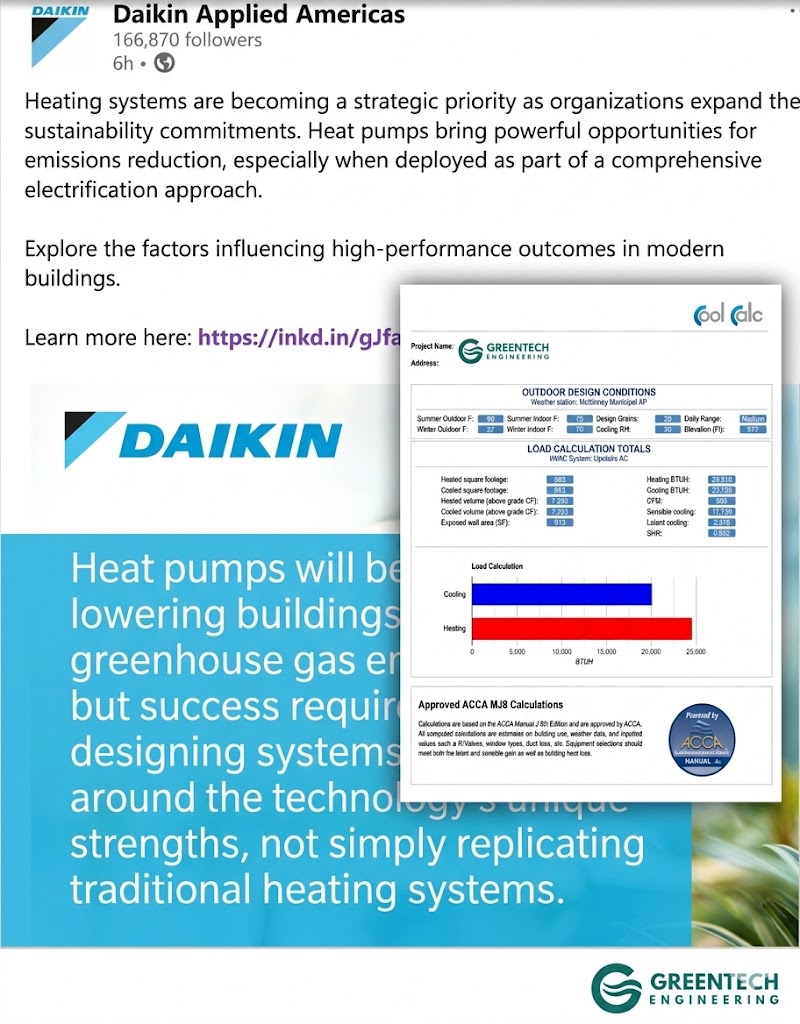
Recently, Daikin Applied Americas released a critical engineering report on decarbonization and building efficiency . Their core warning to the HVAC industry was clear: "Success requires designing systems around the technology’s unique strengths, not simply replicating traditional heating systems."
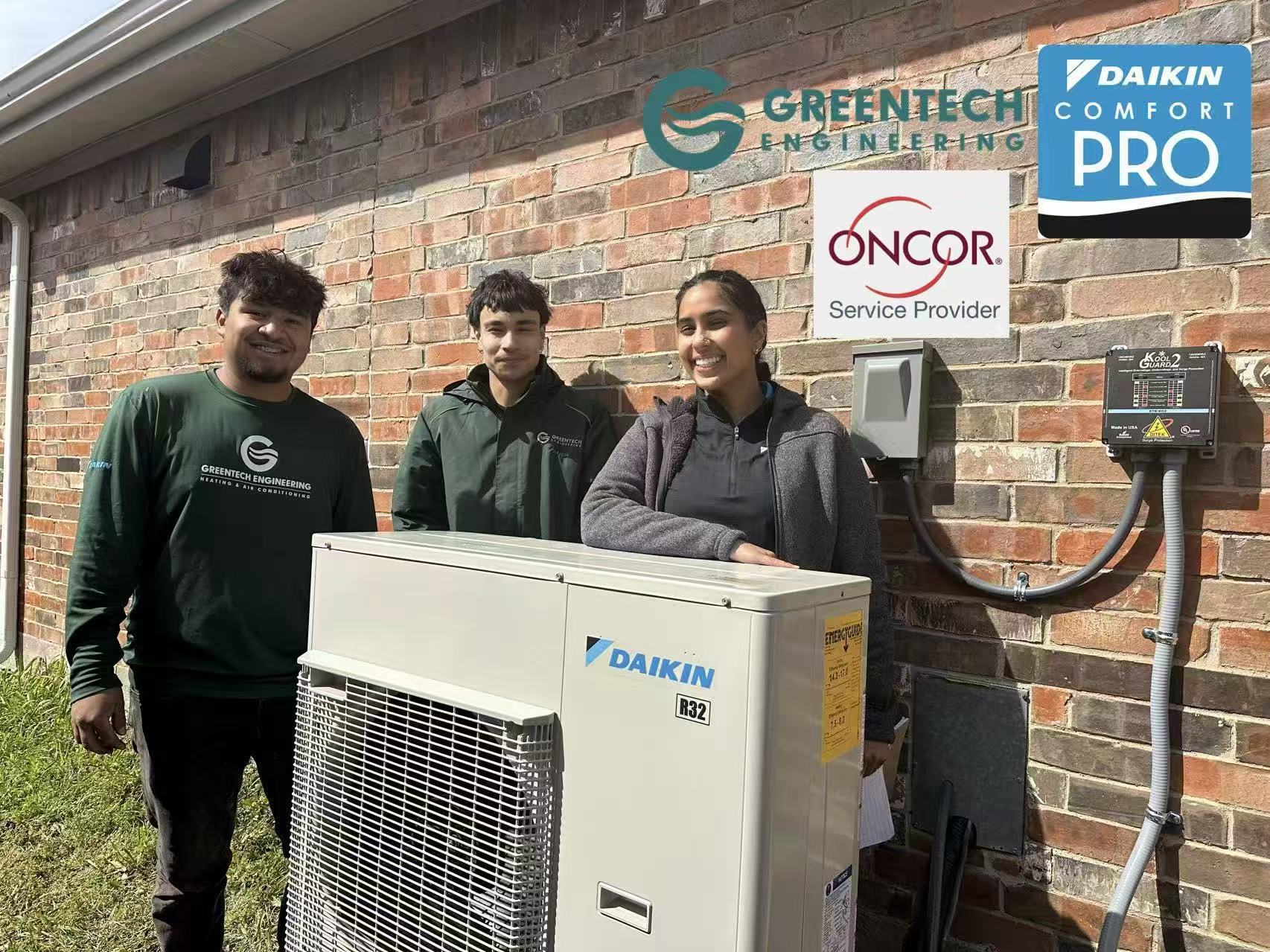
At Greentech Engineering, we take this manufacturer-level engineering directive seriously. Here is exactly why you cannot just "swap" your old HVAC system for a heat pump without rigorous mathematical design, and how our strict engineering standards guarantee your comfort and maximize your Oncor Util ity Rebates.
Why Heat Pumps Are Different: The Thermodynamics of Electrification
To understand why custom design is critical, you have to understand how a heat pump differs from a traditional gas furnace.
A traditional gas furnace is a brute-force machine. It burns fossil fuels to create a massive blast of extremely hot air (often between 120°F and 140°F), quickly raising the temperature of the house, and then shutting off.
A modern inverter-driven heat pump, like the Daikin FIT Variable-Speed System , operates with finesse. It does not burn fuel; instead, it uses compressed refrigerant to absorb ambient heat from the outside air (even when it is near freezing outside) and transfers it indoors.
Because of this highly efficient thermodynamic process, heat pumps supply air at lower, more consistent temperatures (typically around 90°F to 105°F). They run for longer cycles at much lower, quieter speeds. This continuous, low-speed operation is exactly what makes them so incredibly energy-efficient.
However, because the supply air is not as intensely hot as a gas furnace, the margin for error in installation is practically zero. If an HVAC contractor tries to force a heat pump to operate exactly like your old furnace without evaluating the surrounding infrastructure, the system will fail to keep you comfortable.
The 3 Pillars of Heat Pump System Design
When we perform an AC to Heat Pump Conversion in cities like Allen or Grand Prairie, our engineering team focuses on three non-negotiable pillars of system design. This ensures your home stays perfectly comfortable during both the brutal Texas summer and the unpredictable winter freezes.
1. The ACCA Manual J Load Calculation (No More Guesswork)
The single biggest mistake a contractor can make is sizing a new heat pump based on the size of your old unit (the "rule of thumb" method). If your builder installed a 4-ton unit 15 years ago in your Plano home, assuming you need a 4-ton heat pump today is professional negligence.
Oversized heat pumps will short-cycle, failing to dehumidify your home in the summer and causing severe temperature swings in the winter. Undersized units will run constantly without ever reaching the set temperature.
At Greentech Engineering, every single heat pump installation begins with an ACCA Manual J Load Calculation. We physically measure your home, evaluate the insulation values, assess window types, and input historical weather data specific to your micro-climate. Whether you are dealing with the open lake breezes in Little Elm or the dense suburban heat islands in Plano, this data-driven approach tells us the exact BTUH (British Thermal Units per Hour) required to heat and cool your specific layout.
2. Ductwork and Airflow Analysis (Manual D)
Because heat pumps supply air at a lower temperature, they rely on moving a precise volume of air (CFM - Cubic Feet per Minute) continuously to maintain comfort.
Traditional builder-grade ductwork in many fast-growing suburbs like Allen and Little Elm was often installed poorly, with sharp bends, crushed flex ducts, and significant air leaks. A gas furnace can sometimes overpower bad ductwork through sheer force; a heat pump cannot. Before installing a variable-speed heat pump, our technicians evaluate static pressure and duct integrity. If the ductwork is undersized or leaking, we will engineer a solution to optimize airflow before the new system is ever turned on.
3. Humidity Control and Calibration
Daikin's report emphasizes designing around a technology's unique strengths. The greatest strength of the Daikin FIT is its inverter compressor, which provides unparalleled dehumidification during the sticky Texas summer. We digitally calibrate the smart thermostat and the air handler's ECM motor to synchronize perfectly, ensuring the system prioritizes pulling moisture out of the air. This allows you to feel significantly cooler at a higher thermostat setting, drastically reducing your electricity consumption.
Unlocking Financial ROI: The Oncor Heat Pump Rebates
Doing the math and designing the system correctly does not just ensure your comfort—it protects your wallet.
Because the Daikin FIT systems we design and install meet the strictest federal and local energy efficiency guidelines, they classify as high-performance electrification technology. Utility providers are highly motivated to get these efficient systems onto the grid to prevent summer brownouts and reduce peak load.
By choosing an engineered installation over a standard "box swap," Greentech Engineering ensures your new system qualifies for the maximum available Oncor Utility Rebates. For homeowners in Plano, Allen, Little Elm, and Grand Prairie, these cash incentives significantly offset the premium cost of a variable-speed system, making the ultimate comfort upgrade incredibly cost-effective.
Stop Paying for Guesswork in North Texas
Daikin Applied has made it clear: the future of HVAC is high-efficiency heat pumps, but that future relies entirely on meticulous, data-driven system design.
If your old air conditioner or furnace is failing, do not settle for a contractor who relies on guesswork and rules of thumb. Trust the local experts who run the Manual J calculations, evaluate the thermodynamics, and engineer your comfort from the ground up.
Contact Greentech Engineering today to schedule your comprehensive heat pump evaluation in Plano, Allen, Little Elm, or Grand Prairie, and find out exactly how much you can save with Oncor energy rebates!
Frequently Asked Questions (FAQ): Heat Pumps in DFW
Q: Will a heat pump blow cold air in the winter?
A: No, but it may feel different than what you are used to. A gas furnace blasts air at 130°F, which feels hot to the touch. A heat pump supplies air around 95°F to 100°F. Since your resting body temperature is 98.6°F, the air blowing out of the vent might feel neutral or slightly cool to your skin, but it is more than warm enough to steadily and efficiently heat a 70°F room. This is why proper system design and precise airflow are so critical.
Q: Can a heat pump really survive a Texas winter freeze?
A: Yes! Modern inverter heat pumps, like the Daikin FIT, are incredibly resilient and can extract heat from the outside air even when temperatures drop into the teens. For homeowners who want extreme peace of mind against grid failures or record-breaking freezes, we can engineer a "Dual Fuel" system, pairing your high-efficiency electric heat pump with a gas furnace that only acts as an emergency backup.
Q: Why do I need a Manual J calculation if I am just replacing my current unit?
A: Homes change over time. You may have added new energy-efficient windows, upgraded your attic insulation, or the original builder may have installed the wrong sized unit to begin with (a very common issue in neighborhoods across Plano and Grand Prairie). A Manual J calculation ensures you aren't carrying over a 15-year-old mistake to your brand-new system.
Q: Do I need to replace my ductwork to get a heat pump?
A: Not necessarily, but it must be rigorously evaluated. In many cases, existing ductwork is perfectly fine or only requires minor modifications or sealing to handle the specific airflow requirements of a variable-speed heat pump. Our engineering team will assess your static pressure during your initial consultation.
About the Author: Siwei (Lucas) Chen
CTO | Greentech Engineering Heating & Air Conditioning
Siwei (Lucas) Chen specializes in engineering-driven HVAC diagnostics, thermodynamic performance optimization, and energy-efficiency upgrades for North Texas homeowners and light commercials. Holding a B.S. in Mechanical Engineering from Virginia Tech, ACCA and NCI certification,he brings a strict, data-first approach to residential heating and cooling. Under his technical leadership, Greentech Engineering ensures every system is perfectly calibrated for the Dallas-Fort Worth climate, focusing on ACCA Manual J load calculations, meticulous installation standards, and maximizing homeowner ROI through utility rebates.
Professional Certifications:
- ACCA Certified (Manual J, S, D)
- NCI Certified – Air Balancing & Duct Optimization
- Daikin Comfort Pro Contractor
- Oncor Participating Service Provider

Flexible Financing Options
Explore our range of flexible financing options designed to suit your needs and budget.