







The Ultimate HVAC Cheat Code: Why This Grand Prairie Homeowner Converted Their AC to a Daikin Heat Pump (And Cashed In On Rebates)
For most homeowners in Grand Prairie, TX (75050), the thought of replacing a broken central air conditioner is accompanied by a sense of dread. The Texas summer is unforgiving, and the immediate instinct is to simply swap the old, dead AC unit for a shiny new one of the exact same type.
But what if replacing your standard air conditioner with another standard air conditioner is actually a costly mistake?
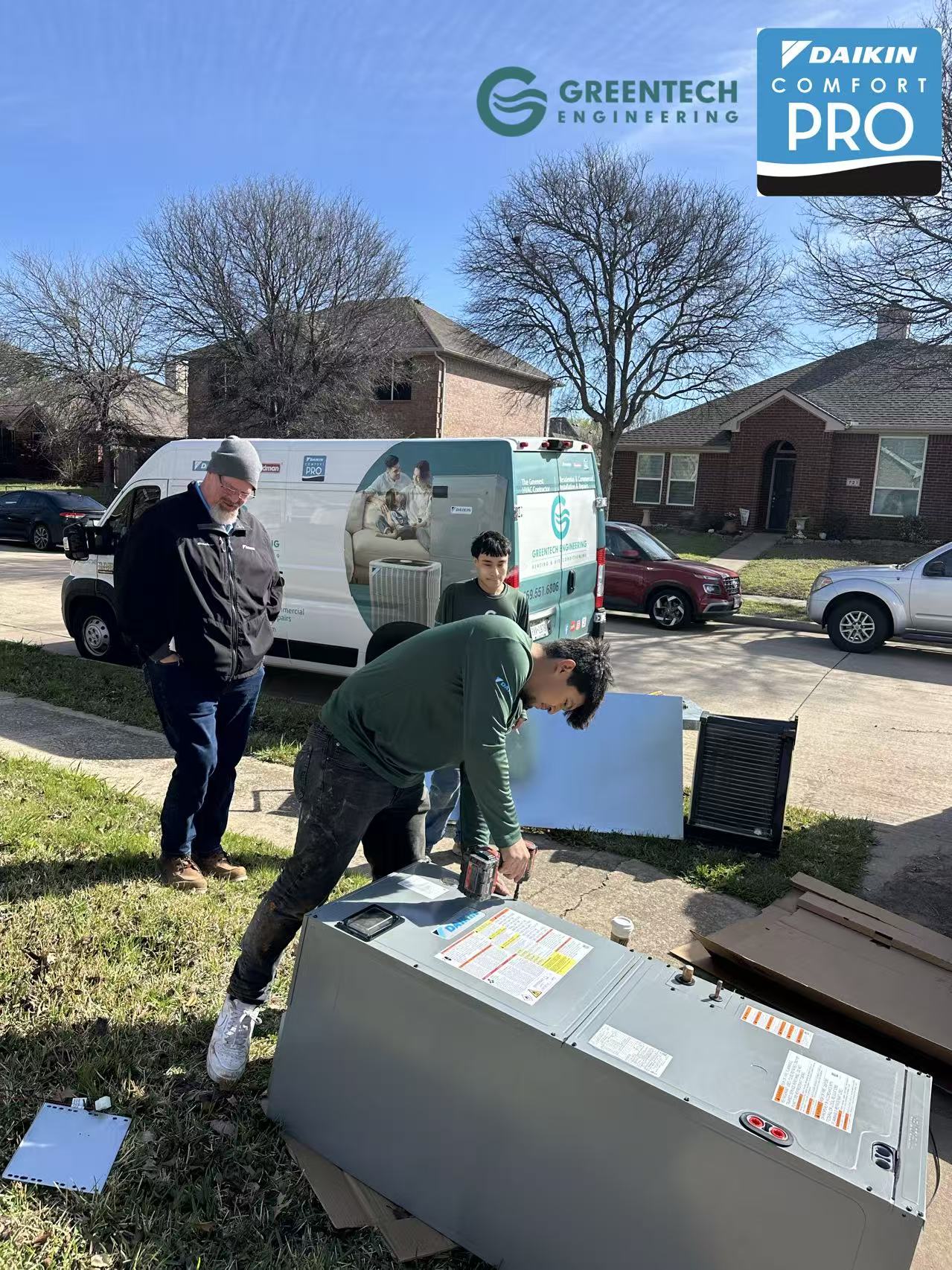
Recently, the engineering team at Greentech Engineering Heating & Air Conditioning showed a Grand Prairie family a smarter path forward. Instead of a traditional AC replacement, we performed a complete AC to Heat Pump Conversion using a state-of-the-art Daikin FIT Variable-Speed Heat Pump. Not only did this upgrade drastically improve their summer cooling and indoor air quality, but it also unlocked massive financial incentives through the local utility rebates.
Here is the complete case study on why converting from a traditional AC to a high-efficiency heat pump is the ultimate Texas HVAC hack, and how our strict engineering standards brought this project to life.
The Grand Prairie Challenge: The Noisy, Failing 14-SEER AC
The homeowner’s existing setup was a classic scenario we see throughout the Dallas-Fort Worth metroplex. They had a 15-year-old, builder-grade 14-SEER air conditioner paired with a standard gas furnace.
Over the last two summers, the system had begun to show severe signs of mechanical fatigue:
- Short-Cycling: The unit would blast cold air, shut off rapidly, and turn back on minutes later. This constant starting and stopping caused electricity bills to skyrocket.
- Poor Humidity Control: Because the system wasn't running long enough to properly extract moisture from the air, the home felt cold but "sticky" and clammy.
- Extreme Noise: The aging single-stage compressor sounded like a jet engine taking off right next to their backyard patio.
When the compressor finally locked up, the homeowner called us expecting a standard AC quote. However, after performing a strict thermodynamic load calculation (ACCA Manual J), we presented a solution that offered a far greater Return on Investment (ROI).
What is an AC to Heat Pump Conversion?
One of the most common questions we get from homeowners is: "Can I replace my air conditioner with a heat pump? And will it keep me cool in the summer?"
The answer is a resounding yes. In fact, a heat pump is an air conditioner. During the brutal Grand Prairie summer, a heat pump operates identically to a standard central AC. It uses refrigerant to absorb heat from inside your house and pumps it outside.
The "cheat code" comes in the winter. While a standard AC sits dormant in January, a heat pump has a reversing valve. It can reverse the flow of refrigerant to absorb ambient heat from the outside air and pump it into your home. This makes it an incredibly efficient, all-in-one electric heating and cooling system.
The Daikin FIT Variable-Speed Advantage
For this Grand Prairie conversion, we selected the Daikin FIT Heat Pump . Here is why this specific unit is a game-changer for Texas homes:
- Inverter Technology (Variable-Speed): Unlike the old unit that was either 100% ON or 100% OFF, the Daikin FIT uses an inverter-driven compressor. It acts like the cruise control on a sports car, ramping up and down seamlessly to match the exact cooling demand of the house.
- Ultimate Dehumidification: Because the variable-speed system runs continuously at lower capacities, it pulls significantly more sticky humidity out of the indoor air, making 74 degrees feel crisp and perfectly comfortable.
- Ultra-Quiet Side Discharge: The compact, suitcase-style design blows air sideways rather than upwards. Combined with high-density acoustic dampening, it runs as quietly as 45 decibels—you can comfortably have a conversation standing right next to it.
The Greentech Engineering Standard: Execution Matters
Premium equipment will still fail prematurely if it is installed poorly. At Greentech Engineering, we are not just box-swappers; we operate on strict, data-driven engineering protocols. Here is how we executed this Grand Prairie installation to guarantee a maximum lifespan for the new 3.5-Ton Daikin Heat Pump.
1. Pre-Moduling for Airtight Integrity
Attics in Texas are hot, cramped, and difficult to work in. To ensure absolute perfection, our technicians pre-assembled the major components of the Daikin air handler on the ground. By securing and sealing the primary connections in a controlled environment, we guarantee a cabinet air leakage rate (QLeak) of less than 2%. Every cubic foot of air you pay to cool makes it into your living room.
2. Deep Chemical Line Flush (RX-11)
Since we were transitioning from an old AC to a new Heat Pump, we had to ensure the existing copper refrigerant lines were pristine. We performed a deep flush using RX-11 solvent and dry nitrogen. This aggressively strips away acidic, burnt oil left behind by the old failing compressor, ensuring the new Daikin system operates in a chemically pure environment.
3. The 250 PSI Nitrogen Pressure Test
Before introducing a single drop of new R-32 refrigerant, we pressurized the entire brazed copper line set with dry nitrogen to 250 PSI. We held this pressure for a minimum of 15 minutes to guarantee there were zero micro-leaks in our silver-brazed joints.
4. The Sub-500 Micron Deep Vacuum
Moisture is the number one killer of variable-speed compressors. Utilizing advanced digital manifold gauges, we pulled a deep vacuum on the system, bringing it well below 500 microns. This highly technical process lowers the boiling point of water inside the pipes, literally boiling off any microscopic moisture at room temperature.
The Financial Masterstroke: Oncor Rebates
Here is why this Grand Prairie homeowner was thrilled with our engineering consultation.
If they had chosen a standard, builder-grade 14 SEER2 Air Conditioner, they would have paid full retail price for a system that costs more to run every month.
By upgrading to a high-efficiency Daikin FIT Heat Pump, they transformed their HVAC replacement into a strategic financial investment. Because heat pumps are classified as ultra-high-efficiency green technology, this system met the strict 2023 DOE Energy Conservation Standards.
This instantly qualified the homeowner for:
Oncor Energy Efficiency Rebates: As an Oncor Participating Service Provider, we helped the homeowner secure localized $2900 cash rebates specifically designed to reduce strain on the Texas electrical grid.
When you factor in these massive rebates, the Federal Tax Credit, and the drastic reduction in monthly summer utility bills, the premium Daikin FIT Variable-Speed Heat Pump effectively pays for itself over its lifespan. Plus, it is backed by an industry-leading 12-Year Unit Replacement Warranty and our 3-Year Labor Guarantee.
Stop Settling for Standard Cooling
If your air conditioner is over 10 years old, constantly running, or struggling to keep your second floor cool, do not wait for it to fail in the middle of a July heatwave.
Trust the data-driven local engineers to size, design, and install a system that actually pays you back. Contact Greentech Engineering Heating & Air Conditioning today to schedule your comprehensive system evaluation and find out if your home qualifies for the $2,900 Heat Pump Oncor rebate!
Frequently Asked Questions (FAQ): Heat Pump Conversions in Texas
Q: Does a heat pump work well in the Texas heat?
A: Absolutely. A heat pump acts exactly like a traditional air conditioner during the summer. High-efficiency models like the Daikin FIT are actually better at cooling than standard ACs because their variable-speed compressors provide superior humidity removal, making your home feel cooler at higher thermostat settings.
Q: Do I have to get rid of my gas furnace to install a heat pump?
A: No! This is called a "Dual Fuel" or "Hybrid" system. You can pair a high-efficiency electric heat pump with a gas furnace. The heat pump handles the cooling in the summer and the heating during mild winter days, while the gas furnace acts as a reliable backup during extreme freezes.
Q: How do I know if my HVAC upgrade qualifies for the Oncor rebate?
A: The system must meet specific Consortium for Oncor efficiency tier standards. Factors include SEER2, EER2, and HSPF2 ratings. Our engineers run AHRI-certified matchups to guarantee the equipment we quote qualifies for these incentives, and as Oncor Service Provider we provide all the documentation and application.
Q: Why is an RX-11 line flush necessary during a conversion?
A: Older AC systems often use outdated refrigerants (like R-22) and mineral oils. New heat pumps use modern refrigerants and synthetic POE oils. If these oils mix, they create a sludgy acid that will destroy your new compressor. The RX-11 flush ensures the copper lines are chemically pristine before the new system is connected.
About the Author: Siwei (Lucas) Chen
CTO | Greentech Engineering Heating & Air Conditioning
Siwei (Lucas) Chen specializes in engineering-driven HVAC diagnostics, thermodynamic performance optimization, and energy-efficiency upgrades for North Texas homeowners. Holding a B.S. in Mechanical Engineering from Virginia Tech, he brings a strict, data-first approach to residential heating and cooling. Under his technical leadership, Greentech Engineering ensures every system is perfectly calibrated for the Dallas-Fort Worth climate, focusing on ACCA Manual J load calculations, meticulous installation standards, and maximizing homeowner ROI through utility rebates and tax incentives.
Professional Certifications:
- ACCA Certified (Manual J, S, D)
- NCI Certified – Air Balancing & Duct Optimization
- Daikin Comfort Pro Contractor
- Oncor Participating Service Provider

Flexible Financing Options
Explore our range of flexible financing options designed to suit your needs and budget.