






Beyond the Yellow Truck: Why "Rule of Thumb" Sizing is Costing Dallas Homeowners
If you live in the Dallas-Fort Worth metroplex, you see them every day: massive fleets of brightly colored yellow, green, or blue HVAC trucks dominating the highways. When your air conditioner fails during a brutal Texas summer, it is tempting to call the company with the loudest radio jingle and the biggest marketing budget.
However, beneath the slick branding and promises of "same-day installation" lies a widespread, costly problem in the residential HVAC industry. High-volume companies often rely on aggressive sales tactics and skip the most critical step of HVAC replacement: The ACCA Manual J Load Calculation.
Instead of engineering a system for your specific home, salespeople often use a lazy "Rule of Thumb" to guess your air conditioning size based solely on square footage.
In the AI-driven energy era, HVAC is no longer just about comfort — it’s about how efficiently your home uses power. At Greentech, we engineer systems that reduce your energy load and prepare your home for the future.
In this guide, we will expose the dangers of oversized HVAC systems, explain why thermodynamic engineering matters, and show you how strict data analysis is the only way to unlock maximum Oncor utility rebates.
The "Rule of Thumb" Myth vs. Thermodynamic Reality
For decades, the HVAC industry relied on a simple, flawed mathematical shortcut: 1 ton of air conditioning capacity for every 500 square feet of living space.
If a sales representative from a big-box firm walks into your house, asks for your square footage, divides it by 500, and hands you a $15,000 quote, you are not getting an engineered solution—you are getting a guess.
Why is this rule of thumb disastrous for Dallas homeowners? Because a 2,000-square-foot home built in 1980 with single-pane windows and minimal attic insulation has a drastically different thermal load than a 2,000-square-foot home built in 2024 with spray foam insulation and Low-E argon gas windows.
Square footage is only a two-dimensional measurement. True HVAC engineering requires a three-dimensional thermodynamic analysis.
What is an ACCA Manual J Load Calculation?
To avoid guessing, the Air Conditioning Contractors of America (ACCA) developed the Manual J Load Calculation. This is the gold standard, scientifically proven method for determining exactly how much heating and cooling your home requires.
At Greentech Engineering, we do not guess. We input dozens of specific data points into advanced load-calculation software, including:
- Solar Orientation: Which direction does your house face? A home taking the brunt of the setting West Texas sun requires a vastly different cooling profile than a heavily shaded, East-facing home.
- Insulation R-Values: We evaluate the thermal resistance of your attic, walls, and floors.
- Window Specifications: We account for the size, glazing type, and shading coefficients of every window.
- Building Envelope Tightness: We assess how much outside air leaks into your home.
- Occupancy and Internal Loads: We calculate the heat generated by the people and appliances living inside the house.
Only after analyzing these precise thermodynamic variables can an engineer confidently recommend a specific tonnage for your condenser and evaporator coil.
Learn more about our NCI Air Balancing and Duct Optimization services
Is a 5-ton AC too big for a 2,000 sq. ft. house in Dallas?
The short answer is: In most modern or updated homes, a 5-ton AC is significantly oversized for a 2,000-square-foot house. If a contractor recommends a 5-ton unit for a 2,000 sq. ft. home without performing a Manual J load calculation, they are likely relying on an outdated "400 sq. ft. per ton" rule to protect themselves from complaints that the house isn't cooling down fast enough. However, this "bigger is better" mindset actually destroys your indoor comfort.
Here is the physics behind why an oversized 5-ton AC will ruin your comfort in a 2,000 sq. ft. home:
An air conditioner has two jobs: lowering the temperature (sensible cooling) and removing humidity (latent cooling). To remove humidity, the indoor evaporator coil must run long enough to get cold, extract moisture from the air, and drain it outside.
If a massive 5-ton unit is installed in a space that only requires 3.5 tons, it will blast the home with cold air and reach the thermostat set point in just 5 to 10 minutes. The system then shuts off before it has time to extract any humidity. This phenomenon is called short-cycling.
The result? Your home feels like a cold, damp cave. You will constantly feel clammy, your energy bills will skyrocket from the compressor constantly turning on and off, and the excess indoor moisture will create a breeding ground for mold and mildew.

Why You Need an Authorized Oncor Service Provider
Precise sizing isn't just about comfort—it is strictly tied to your wallet.
You cannot claim the Oncor rebate by buying an AC online or hiring an uncertified handyman. The utility company strictly regulates the disbursement of these funds to protect the integrity of the power grid.
To access the Home Energy Efficiency Program, you must hire an official Oncor Participating Service Provider.
When you partner with Greentech Engineering, we handle the entire bureaucratic process. We gather the AHRI (Air-Conditioning, Heating, and Refrigeration Institute) performance certificates, document the baseline load of your old system, submit the engineering data to the Oncor portal, and secure the approval.
Best of all, you do not have to wait months for a check to arrive in the mail. We apply the approved Oncor incentive as an instant, upfront discount directly on your installation invoice.
2026 Oncor Incentive Snapshot: Forney & Kaufman County
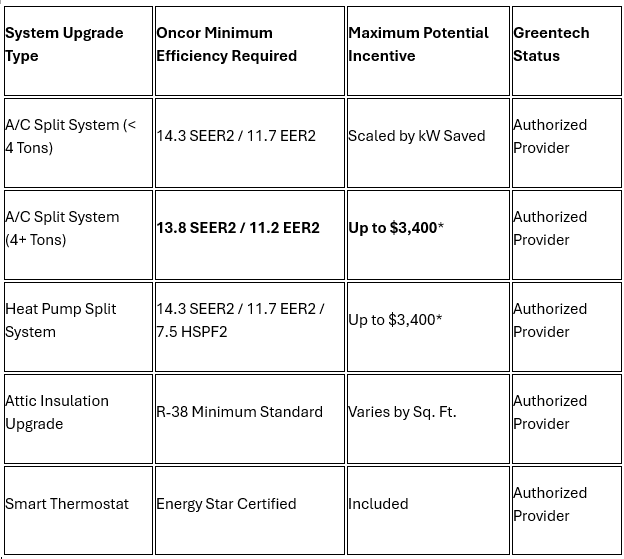
*Incentive Disclaimer: The $3,400 figure represents the absolute maximum potential incentive. Actual instant discount amounts are strictly determined by Oncor's customized kW/kWh reduction formula based on your specific home’s thermodynamic load reduction. Proactive replacement and proper Manual J sizing are the keys to maximizing your payout.
Stop Paying for Marketing Invest in Engineering.
When it comes to upgrading your home’s climate control, do not settle for a salesman quoting a price based on the square footage listed on Zillow. Proper HVAC design requires mathematics, physics, and a deep understanding of building science.
At Greentech Engineering, we don't guess your capacity. We engineer your comfort. By relying on strict ACCA Manual J data, we ensure your new system provides flawless dehumidification, maximum lifespan, and peak eligibility for Oncor utility incentives.
Verify Daikin's premium variable-speed technology
Frequently Asked Questions (FAQ)
Q: What happens if my AC unit is too big for my house?
A: If your HVAC unit is oversized, it will "short-cycle." This means the system turns on, blasts the home with cold air, and turns off very quickly. Because it doesn't run long enough, it fails to remove humidity from the air, leaving your home feeling clammy and damp. Furthermore, the constant starting and stopping puts massive strain on the compressor, leading to premature mechanical failure and higher electricity bills.
Q: How do I know what size AC my house needs?
A: The only mathematically accurate way to determine the correct size of your air conditioner is to have a licensed HVAC engineer perform an ACCA Manual J Load Calculation. This process measures your home's insulation, sun exposure, windows, and air leakage to determine the exact cooling capacity required. Never trust a contractor who sizes an AC based solely on square footage.
Q: Are big-name HVAC companies better for installation?
A: Not necessarily. While big brands have high visibility and large fleets, their business models often rely on high-volume, high-pressure sales. Salespeople at these companies frequently skip time-consuming engineering steps like the Manual J load calculation, instead relying on "Rule of Thumb" sizing to close the deal quickly. Look for an engineering-focused firm that prioritizes data over volume.
Q: Can any HVAC company give me the Oncor rebate in Dallas?
A: No. You cannot receive the Oncor rebate by hiring a standard contractor or buying equipment online. You must utilize an authorized Oncor Participating Service Provider. These vetted providers are the only ones authorized to submit your baseline load data, AHRI certificates, and engineering reports into the Oncor portal to secure your instant discount.
About the Author: Siwei (Lucas) Chen
CTO | Greentech Engineering Heating & Air Conditioning
Siwei (Lucas) Chen specializes in engineering-driven HVAC diagnostics, thermodynamic performance optimization, and custom ductwork design for Dallas homeowners. Holding a B.S. in Mechanical Engineering from Virginia Tech, he brings a strict, data-first approach to residential heating and cooling. Under his technical leadership, Greentech Engineering ensures every system is perfectly calibrated for the Texas climate, focusing relentlessly on ACCA Manual J load calculations, meticulous clinical installation standards, and securing maximum utility rebates for his clients.
Professional Certifications:
- ACCA Certified (Manual J, S, D)
- Daikin Comfort Pro Contractor
- NCI Certified – Air Balancing & Duct Optimization
- Oncor Participating Service Provider
Industry Affiliations:

Flexible Financing Options
Explore our range of flexible financing options designed to suit your needs and budget.