



Rooms that won't cool, hot spots upstairs, cold spots downstairs, or weak airflow from certain vents — the problem is almost always poorly designed ductwork, not your HVAC equipment.
Greentech Engineering's duct design in Wylie, TX uses Manual D calculations, CAD layouts, and airflow testing to engineer a system that delivers balanced comfort to every room.
Why professional duct design matters in Wylie, TX
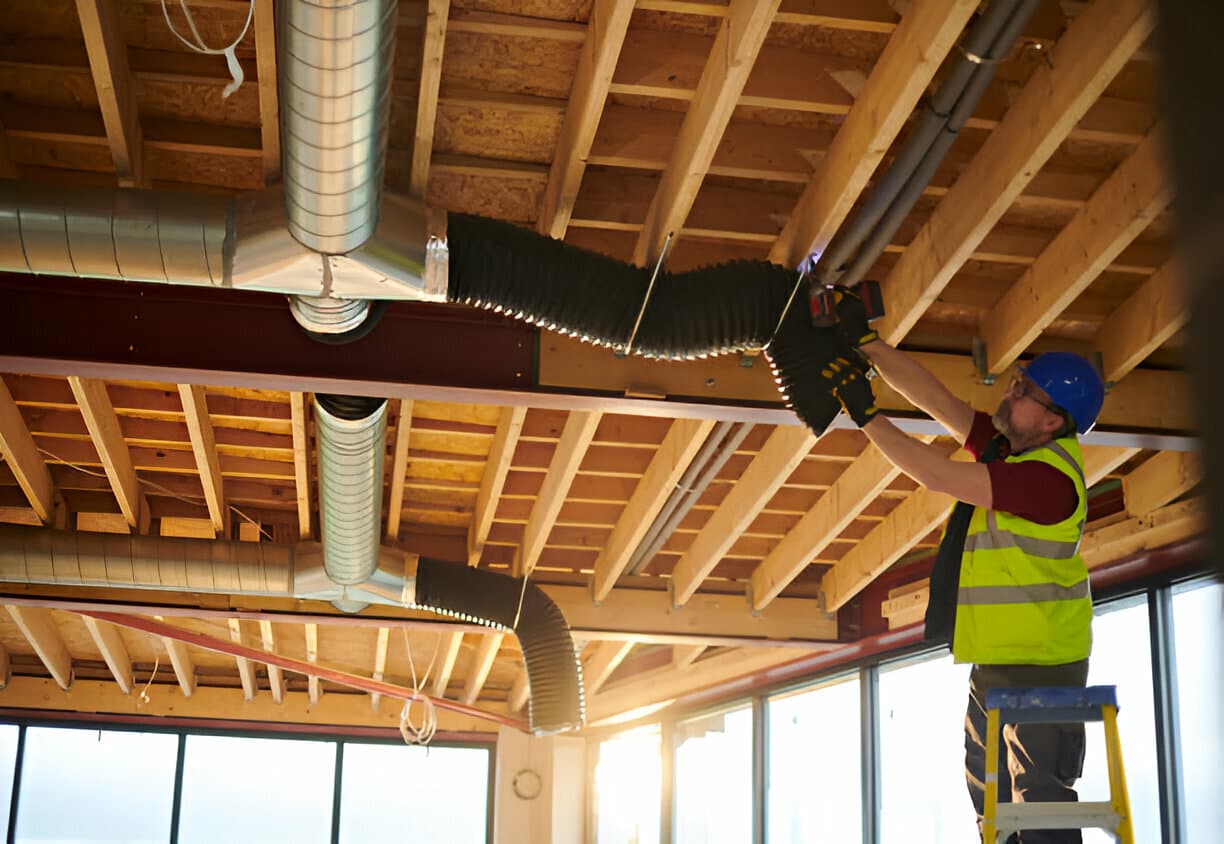
In Wylie and the surrounding Collin County area, attic temperatures routinely exceed outdoor air temperatures in summer. Poorly sized or leaky ducts in hot attics multiply cooling loads, increase run times, and reduce humidity control. Proper duct design corrects common problems that cause uneven rooms, high energy bills, noisy vents, and premature equipment wear. Green Tech’s engineered approach ensures the system installed matches actual heating and cooling loads and duct performance expected for local homes.
Once your ductwork is properly designed, fine-tune comfort with our room temperature service in Wylie, TX — NCI-certified airflow balancing that ensures every room reaches the right temperature.
Common duct problems we solve
- Improperly sized ducts causing low supply pressure, high static, or noisy registers
- Oversized or undersized equipment paired with inadequate ductwork
- Excessive leakage at boot, seams, and transitions that wastes conditioned air
- Long, convoluted duct runs and unnecessary fittings that increase pressure loss
- Lack of return pathways causing negative pressure and poor ventilation
- Poor insulation or ducts placed in extreme attic heat without protection
Our duct design process (what to expect)
- Load calculation (Manual J)
- We perform a room-by-room Manual J heat load to determine accurate heating and cooling requirements for your home, accounting for Wylie-specific factors like solar orientation, local construction materials, window types, and attic conditions.
- Duct sizing and layout (Manual D)
- Using Manual D, we create a detailed duct layout sized for the calculated loads to achieve design airflow (CFM) and acceptable static pressure. The layout minimizes long runs and reduces fittings to lower leakage and noise.
- Equipment pairing and recommendations
- We recommend equipment capacity and airflow requirements that align with the Manual J and D results. Proper pairing avoids oversizing or undersizing the condenser, air handler, and coils.
- Material and insulation selection
- We specify materials appropriate for the installation location: rigid sheet metal for high-velocity trunks, insulated flex for shorter runs where needed, insulated ductboard in conditioned spaces, and recommended R-values and vapor barriers for attic ducts in Wylie’s hot, humid climate.
- Noise and leakage control strategies
- We design for low air velocity at registers, specify turning vanes or long-radius elbows where needed, provide isolators for compressors and blowers, and detail sealing methods like mastic and foil tape to minimize leakage and noise transfer.
- CAD deliverables and documentation
- Final deliverables include CAD layouts, register schedules, equipment schedule, static pressure calculations, and a commissioning checklist ready for installers and builders.
- Coordination with construction or retrofit teams
- We provide staged drawings and site coordination notes for new construction framing, and retrofit plans that show cut-in points, access panels, and isolation requirements to ease installation.
- Testing and verification
- After installation we perform duct leakage testing (blower door or duct blaster CFM at 25 Pa), airflow verification (measuring supply CFM per register), and system balancing to confirm the design goals are met.
How we minimize leakage and noise
- Sealing seams with code-compliant mastic and high-quality foil tape
- Specifying welded or hemmed sheet metal joints for trunks and transitions
- Limiting flexible duct lengths and supporting them properly to avoid sagging
- Designing registers for low face velocity and correct throw patterns
- Isolating mechanical vibration with mounts and flexible connections
Deliverables you will receive
- Manual J load calculation report
- Manual D duct layout and sizing worksheets
- CAD drawings (plans and schematics) and register schedule
- Equipment pairing recommendations and static pressure summary
- Duct sealing and insulation specifications
- Duct testing reports: leakage and measured airflow with balancing notes
New construction vs retrofit considerations in Wylie
- New construction: We coordinate with framers, insulation crews, and HVAC installers so ducts can be routed through conditioned spaces where practical, which is the most energy-efficient approach in Wylie’s climate. Early design reduces change orders and ensures proper return placement and access for future service.
- Retrofit: We emphasize sealing existing ducts, improving insulation, and re-routing where possible to reduce attic exposure. In many Wylie homes, adding conditioned returns or creating an air-sealed attic-to-house barrier significantly improves performance without full duct replacement.
Expected efficiency and comfort benefits
- More consistent temperatures room-to-room and improved humidity control during humid Texas summers
- Lower run times and improved equipment efficiency resulting from reduced leakage and optimized airflow
- Quieter operation with reduced register noise and fan stress
- More accurate system sizing that prevents short cycling and extends equipment life
Timelines and pricing overview
- Typical timelines vary by project: design-only engagements for single-family homes often complete within a few business days once site data is collected. New construction coordination or detailed retrofit plans may require additional site visits and can extend the timeline. Testing and balancing are scheduled after installation and generally completed within a day or two depending on system size.
- Pricing is influenced by home size, complexity of the layout, number of design revisions, and whether on-site testing and commissioning are included. Costs are commonly structured as a flat fee for design deliverables, with add-ons for testing, CAD revisions, and on-site coordination during new construction. Pricing for full-service projects that include installation oversight or advanced testing will reflect scope and travel for local Wylie jobs.
Why Green Tech
Green Tech brings engineering-focused duct design backed by local experience in the DFW area. Our approach combines Manual J and Manual D discipline with practical construction coordination to deliver measurable improvements in comfort and efficiency for Wylie homeowners and builders. Deliverables are clear, documented, and test-verified so you can move forward with confidence.
FAQs
Q: How long does a Manual J and Manual D take for an average Wylie home?
A: Once measurements and photos are provided, the typical turnaround for a complete Manual J and Manual D package is a few business days. If a site visit is needed for complex retrofits or unique construction details, allow additional scheduling time.
Q: Will new duct design always require replacing existing ducts?
A: Not always. Some homes benefit from targeted repairs, sealing, and balancing. When existing duct geometry or insulation is inadequate for the calculated loads, partial or full replacement may be recommended for lasting results.
Q: What tests confirm a duct system meets the design?
A: We use duct leakage testing at 25 Pa (CFM25), measured supply airflow at registers, and whole-system static pressure readings. A balanced system report documents performance against the Manual D targets.
Q: Do you design ducts for attics in Wylie differently than ducts in conditioned space?
A: Yes. Attic ducts require higher insulation, rigorous sealing, and routing strategies to reduce exposure to extreme attic heat. When possible, moving ducts into conditioned space is preferred for long-term efficiency in Wylie’s climate.

Flexible Financing Options
Explore our range of flexible financing options designed to suit your needs and budget.