



Rooms that won't cool, hot spots upstairs, cold spots downstairs, or weak airflow from certain vents — the problem is almost always poorly designed ductwork, not your HVAC equipment.
Greentech Engineering's duct design in River Oaks, TX uses Manual D calculations, CAD layouts, and airflow testing to engineer a system that delivers balanced comfort to every room.
Get Your Professional Duct Design Consultation
Once your ductwork is properly designed, fine-tune comfort with our room temperature service in River Oaks, TX — NCI-certified airflow balancing that ensures every room reaches the right temperature.
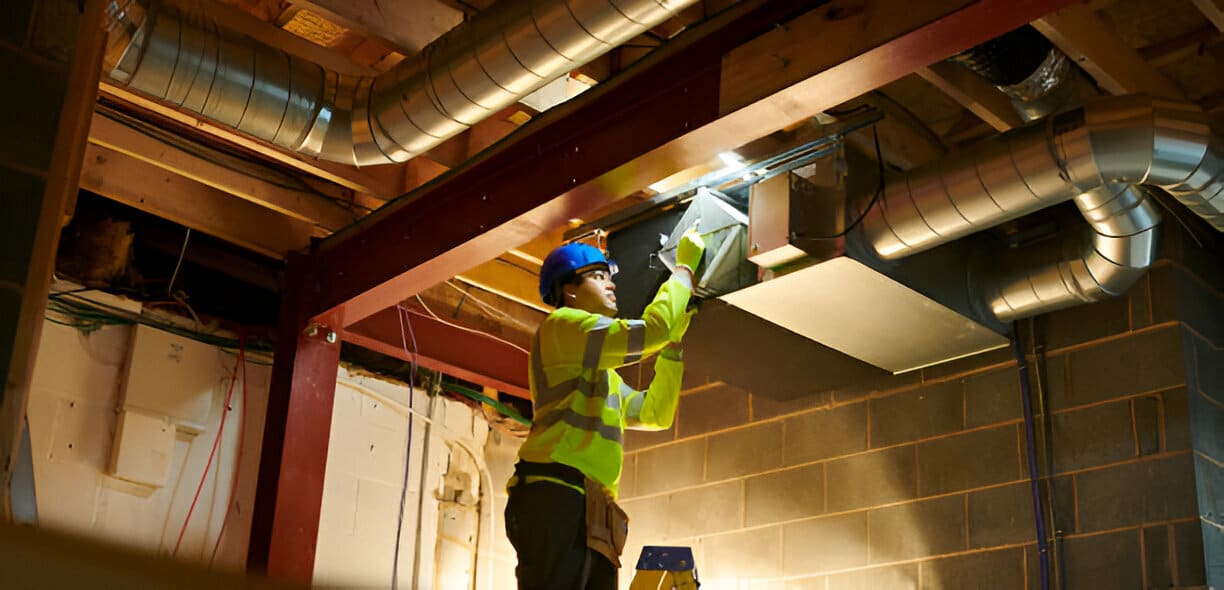
Why professional duct design matters in River Oaks
- Texas summers create high sensible and latent cooling loads; poorly sized or routed ducts lead to hot rooms, short cycling, and high energy use.
- Attic installations and long runs common in local home designs increase static pressure and leakage risk if ducts are not sized and insulated correctly.
- Oversized equipment paired with undersized ducts or poor airflow causes comfort complaints and premature equipment wear.
Green Tech addresses these local challenges with proven methodology and deliverables that make installations predictable and code compliant.
What our duct design service includes
- Load calculations (Manual J): Detailed room-by-room heat gain and loss analysis, factoring River Oaks-specific solar loads, window orientations, occupancy, and insulation levels to determine required cooling and heating capacity.
- Duct sizing (Manual D/M or D sizing methodology): Duct layouts sized to achieve target CFM, acceptable friction loss, and balanced static pressure while minimizing noise and velocity issues.
- Equipment coordination (Manual S considerations): Matching duct system performance to the recommended air handler/condenser/furnace characteristics and blower curves so the selected equipment actually delivers the target airflow.
- Duct layout and shop drawings: Scalable CAD drawings showing main trunks, branch runs, takeoffs, register and return locations, balancing damper locations, and required clearances for installers and permit reviewers.
- Airflow optimization and balancing techniques: Recommendations for register selection, adjustable dampers, return path strategies, transfer grills or dedicated returns, and static pressure targets to improve comfort and reduce noise.
- Sealing and insulation standards: Specifications for mastic and UL-approved tapes, recommended insulation levels for ducts in attics or unconditioned spaces, and methods to reduce condensation risk in humid months.
- Material and construction guidance: Pros and cons of spiral/rectangular sheet metal, insulated flexible duct, low-profile plenums, and acoustic liners for noise-sensitive applications.
- Retrofit solutions: Strategies to improve airflow in existing homes—repacking runs, redesigning returns, adding short ducts, implementing zoning dampers, and identifying when partial replacement or conversion to ductless zones is more practical.
- Deliverables: Load calculation reports, complete drawing sets (PDF/CAD), equipment schedules, register/return schedules, pressure loss worksheets, and written installation notes and specifications.
Typical process and timelines
- Initial review and information gathering: Green Tech reviews floor plans, building orientation, and relevant property details to scope the on-site assessment.
- On-site assessment (if requested): Inspection of attic, plenum spaces, existing ductwork, and equipment; optional duct leakage testing (Duct Blaster) when retrofit performance is unknown.
- Load calculation and preliminary layout: Delivered as a draft for review—typically within 5 to 10 business days after the field visit for standard single-family homes.
- Final design and specification package: After client or contractor feedback, Green Tech issues the final drawings and specifications—commonly within 7 to 14 days from preliminary acceptance depending on project complexity.
- New construction timelines are generally faster since full access to plans is available; retrofit projects may require extra time for investigative testing and iterative solutions.
Airflow optimization: what we target
- Achieve room-by-room CFM targets from Manual J outputs to prevent hot/cold rooms.
- Maintain system static pressure within the equipment manufacturer’s recommended range to protect blower performance.
- Reduce noise by controlling air velocities in trunks and using proper diffuser/duct transitions.
- Improve indoor air quality and humidity control by ensuring adequate return air and balanced supply/return pairs.
Materials, sealing, and insulation standards we recommend
- Use of rigid spiral or rectangular sheet metal for trunks where space and budget allow for lowest leakage and best performance.
- Insulated flexible ducts for short runs with careful attention to support and compression limits.
- Sealing primary joints with mastic and mesh or UL181-rated tapes; avoid relying on HVAC cloth tape alone.
- Insulation levels meeting local energy code and Green Tech best practices to prevent thermal loss and condensation in attics and unconditioned spaces.
Retrofit vs new construction: how approaches differ
- New construction: We design systems to take advantage of conditioned crawlspaces, centralized equipment locations, and staged zoning where beneficial. Early coordination with framing and mechanical teams reduces change orders and improves final performance.
- Retrofit: Work focuses on diagnosing existing airflows, locating leaks, and designing practical interventions that fit current architecture—often combining sealing, partial reruns, booster fans, or targeted register adjustments to meet comfort goals without a full rebuild.
Deliverables you can expect from Green Tech
- Complete Manual J load report and Manual D duct design documentation
- CAD-ready duct layout drawings and isometric details
- Equipment schedule and blower curve matching notes
- Register and return placement schedule and diffuser specifications
- Written installation specifications: sealing, insulation, and balancing instructions
- Optional testing scope: duct leakage results, post-installation airflow verification
Requesting a design consultation in River Oaks
To request a design consultation with Green Tech, assemble available floor plans or blueprints, note the age and model of existing HVAC equipment (if applicable), and document any persistent comfort issues or high-usage areas. Green Tech will schedule an on-site assessment as needed, perform load calculations, and deliver a written proposal and design package outlining the recommended scope for new construction or retrofit projects. This approach ensures the proposed duct system is tailored to River Oaks climate conditions and your home’s construction.
FAQs
Q: How does a Manual J and Manual D design reduce my energy bills?
A: A properly sized system matches capacity to the home load and moves air efficiently; that reduces short cycling, limits oversizing losses, and improves heat exchange, which lowers energy consumption.
Q: Can you redesign ducts without opening walls?
A: Many improvements—sealing, adding returns, adjusting registers, or re-routing flex runs—can be done with minimal invasive work. Full re-routing often requires access but Green Tech will design the least-disruptive solution that meets performance goals.
Q: Do you provide permit-ready drawings?
A: Yes. Green Tech delivers drawing sets and specifications that meet typical permit review requirements and local code expectations.
Q: Will this design consider my existing equipment?
A: Yes. We coordinate duct design with equipment selection (Manual S considerations) to ensure blower curves and static pressure targets align for efficient performance.
Q: How do you address high humidity common in River Oaks summers?
A: We size systems to control latent loads, recommend appropriate equipment options (variable speed blowers, properly matched coils), and design return/ventilation strategies to avoid short cycling that worsens humidity.
Q: What testing do you perform after installation?
A: Green Tech can include airflow verification and duct leakage testing as part of final acceptance to confirm the design targets were achieved.

Flexible Financing Options
Explore our range of flexible financing options designed to suit your needs and budget.