





Rooms that won't cool, hot spots upstairs, cold spots downstairs, or weak airflow from certain vents — the problem is almost always poorly designed ductwork, not your HVAC equipment.
Greentech Engineering's duct design in Princeton, TX uses Manual D calculations, CAD layouts, and airflow testing to engineer a system that delivers balanced comfort to every room.
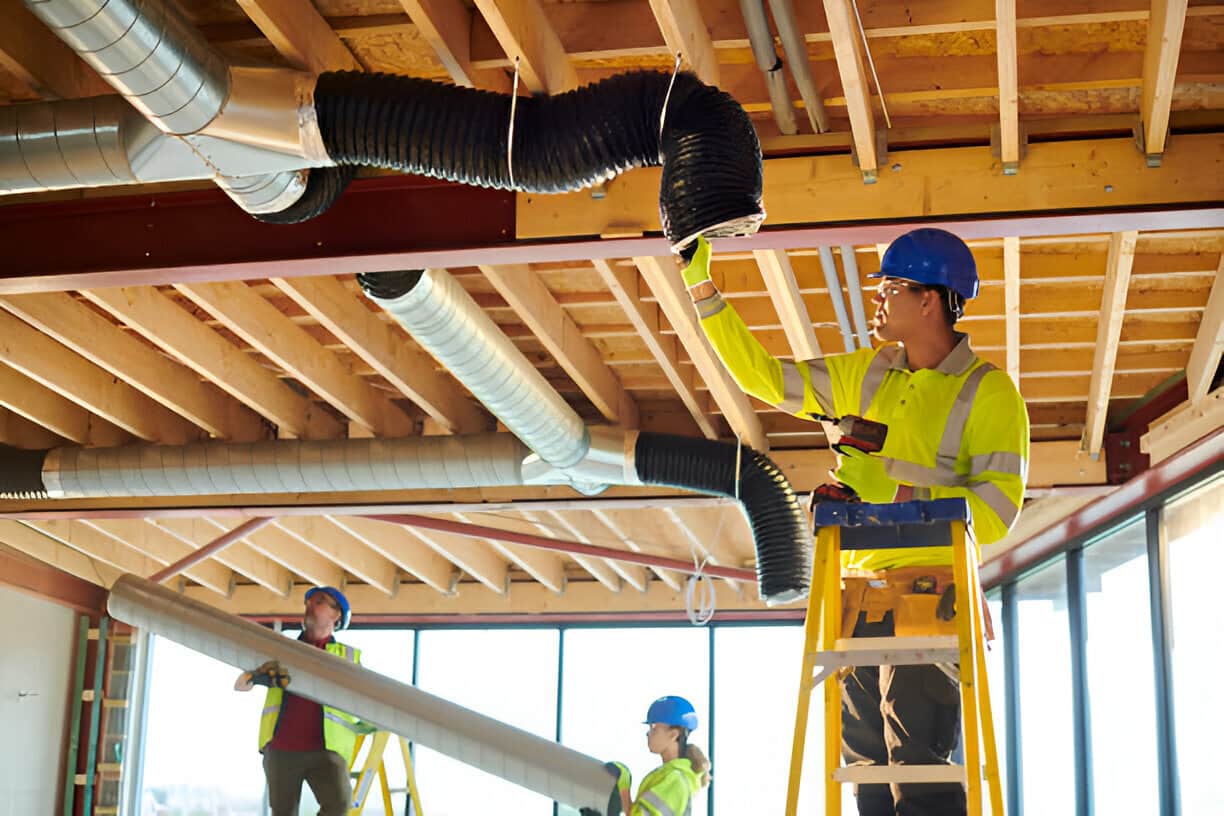
Why duct design matters in Princeton, TX
Princeton experiences hot, humid summers and variable shoulder seasons. High attic temperatures and high cooling loads make duct performance critical. Poorly sized or leaky ducts force HVAC equipment to run longer, increase energy use, and create uneven room temperatures. In both new construction and retrofit projects across Collin County, correct duct design is the difference between an HVAC system that meets expectations and one that struggles to keep up.
Once your ductwork is properly designed, fine-tune comfort with our room temperature service in Princeton, TX — NCI-certified airflow balancing that ensures every room reaches the right temperature.
Common duct problems we solve
- Undersized or oversized ducts that cause high static pressure or insufficient airflow
- Long or tortuous run layouts that increase friction loss and reduce CFM at registers
- Leaky connections and seams that lower delivered airflow and draw in attic air
- Poorly insulated ducts in unconditioned attics causing thermal losses and condensation risk
- Unbalanced supply and return designs that create hot/cold rooms and noisy registers
- Lack of zoning or inadequate balancing for multi-story homes or open floor plans
Duct design services and types
- Initial load calculations and system sizing using ACCA Manual J and Manual D principles to determine required tons and target airflow (typically around 350 to 450 CFM per ton depending on system and home specifics)
- Duct layout planning for new construction: optimized main trunk locations, short branch lengths, correct takeoff placement, and return air strategy to reduce friction and keep static pressure low
- Retrofit duct design: solutions for constrained cavities, soffits, and existing attic spaces including alternative routing, sealed flex with metal trunks, or ductless supplemental options where applicable
- Material and sizing recommendations: when to use metal ductwork, insulated flex, or rigid round duct, and guidance on transition sizing to minimize turbulence and pressure drops
- Sealing and insulation best practices: mastic and mechanical fastening over tapes, recommended R-values for ducts in unconditioned attics, and vapor control for high-humidity situations
- Zoning and balancing strategies: motorized dampers, multi-stage equipment coordination, and manual balancing for equalized comfort across floors and large open areas
- Code compliance: designs that meet applicable local codes and energy-efficiency standards, including required documentation and specifications for permit review when needed
Our design and diagnostic process
- Load and site assessment - detailed Manual J load calculation that factors in Princeton climate, orientation, glazing, and insulation levels.
- Equipment selection and target airflow - determine ideal capacity and airflow targets to avoid short cycling and high static pressure.
- Layout development - schematic and detailed duct plans showing trunk, branches, takeoffs, returns, and register placement optimized for airflow and serviceability.
- Material and connection specifications - specify duct types, fittings, insulation, sealing methods, and access points for balancing.
- Installation oversight or retrofit plan - guidance for installers or contractors to follow during installation to preserve design intent.
- Testing and verification - post-installation testing to confirm airflow, static pressure, and duct tightness.
Practical recommendations to optimize airflow and minimize static pressure
- Keep total external static pressure under recommended manufacturer limits; designs aim to minimize fittings and abrupt transitions that create turbulence.
- Use larger-radius elbows and smooth transitions. Shorter, straighter runs reduce friction and improve delivered CFM.
- Prefer round duct where space allows; round ducts have lower friction per equivalent area than rectangular duct at the same cross-sectional area.
- Avoid excessive use of undersized flex duct; if used, stretch and support it properly to reduce kinks and compression.
- Locate supply registers to promote natural airflow across living spaces and place returns to capture used air effectively.
Sealing, insulation, and humidity control for Princeton homes
- Seal all joints and penetrations with mastic or UL-rated aerosol sealants instead of conventional pressure-sensitive tapes. Proper sealing prevents attic air infiltration and dust entry.
- Insulate ducts in unconditioned spaces to at least recommended R-values to limit heat gain in summer and condensation in high-humidity months.
- Specify vapor-impermeable insulation where condensation risk is high, and design returns and transfers to avoid negative pressure that can pull humid attic air into the system.
Zoning and system balancing
- Zoning solutions (motorized dampers or multi-zone equipment) are valuable in Princeton homes with second stories or large open plans to reduce upstairs overheating and downstairs overcooling.
- Proper balancing ensures each room receives its design airflow. Balancing uses dampers, register adjustments, and measured CFM to achieve comfort without increasing runtime or energy use.
Testing and verification methods
- Airflow measurement: use flow hoods, anemometers, or pitot tube traverses at registers to verify CFM.
- Static pressure testing: measure external and internal static pressures to confirm the system is operating within safe limits.
- Duct leakage testing: duct blaster testing quantifies leakage to the outdoors and identifies problem zones for sealing.
- Temperature and delta-T checks: measure supply and return temperatures to confirm heat transfer and system charge.
Long-term benefits: comfort, efficiency, and equipment longevity
A professionally designed and verified duct system reduces runtime, improves temperature uniformity, reduces noise, and lowers monthly energy costs. Proper ductwork also reduces wear on compressors and fans, extending equipment life and reducing repair frequency. For Princeton homeowners, this translates to more reliable cooling during hot summer peaks and lower utility bills year-round.
Maintenance and what to expect moving forward
After installation, periodic verification of duct seal and insulation condition, seasonal airflow checks, and filter maintenance keep performance steady. If renovations or attic work occur, evaluate the duct layout again to avoid accidental damage. Green Tech integrates practical design choices that simplify future maintenance and retrofits.
Green Tech brings engineering-based duct design and hands-on HVAC experience to Princeton, TX projects. Our approach prioritizes measurable performance: accurate load math, efficient layouts, quality materials and seals, and testing that proves results.
FAQs
Q: How does accurate duct sizing improve my energy bills?
A: Correct sizing reduces static pressure and unnecessary runtime, allowing the system to move the required airflow efficiently so equipment cycles less and consumes less energy.
Q: What is involved in a duct leakage test?
A: A duct blaster pressurizes the duct system to quantify leakage and uses smoke or pressure mapping to locate major leaks for targeted sealing.
Q: Can I add zoning to an existing system in Princeton homes?
A: Yes. Many existing systems can be retrofitted with motorized dampers and controls; feasibility depends on current duct layout and available return air capacity.
Q: How does attic insulation affect duct performance in hot weather?
A: Higher attic temperatures increase heat gain through uninsulated ducts. Proper duct insulation and attic insulation reduce heat transfer and lower cooling load.
Q: What are common signs that my ducts are poorly designed?
A: Uneven room temperatures, noisy registers, long run times, and unexplained high energy bills are typical indicators of design or installation issues.

Flexible Financing Options
Explore our range of flexible financing options designed to suit your needs and budget.