






Rooms that won't cool, hot spots upstairs, cold spots downstairs, or weak airflow from certain vents — the problem is almost always poorly designed ductwork, not your HVAC equipment.
Greentech Engineering's duct design in Mckinney, TX uses Manual D calculations, CAD layouts, and airflow testing to engineer a system that delivers balanced comfort to every room.
Get Your Professional Duct Design Consultation
Once your ductwork is properly designed, fine-tune comfort with our room temperature service in Mckinney, TX — NCI-certified airflow balancing that ensures every room reaches the right temperature.
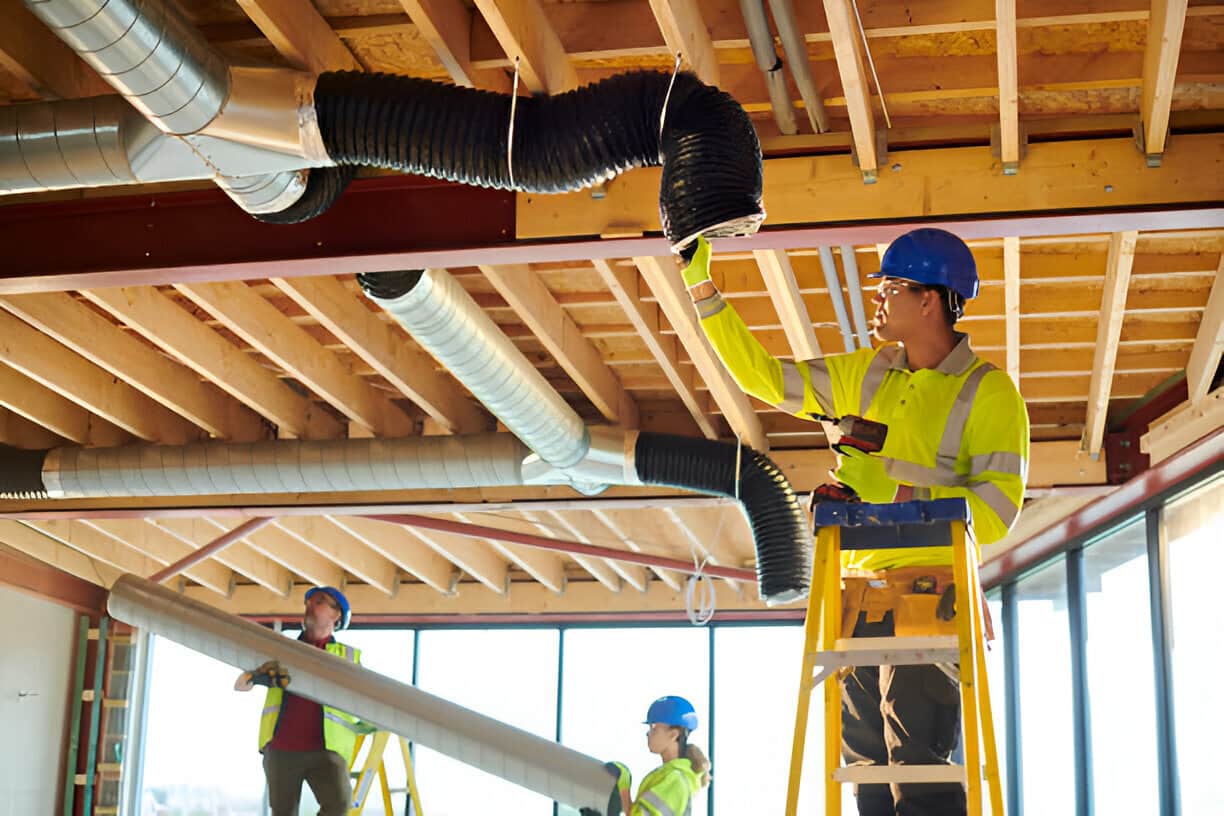
Why correct duct design matters in McKinney, TX
McKinney’s climate puts a premium on accurate cooling load calculations and airtight, insulated duct runs. Excess attic heat, high humidity, and increasing new-construction volumes in the area mean improperly sized or leaky ducts quickly lead to comfort complaints, higher energy bills, and premature equipment cycling. A duct system designed to match a properly sized system (Manual J, S, and D) reduces noise, improves humidity control, and extends equipment life.
Common duct design issues in McKinney homes
- Undersized or oversized ducts causing low supply pressure or short-cycling
- Leaky connections and unsealed plenums losing conditioned air into hot attics
- Poor layout with long, convoluted runs or unnecessary turns that reduce airflow
- Inadequate insulation on attic ducts leading to heat gain and higher cooling loads
- Imbalanced airflow between rooms, creating persistent hot spots
- Retrofit constraints in slab, crawlspace, or tight-framed new builds that limit access
Duct design services and deliverables
A comprehensive duct design in McKinney, TX includes:
- Load calculations (Manual J) to determine accurate heating and cooling requirements based on orientation, insulation, glazing, occupancy, and local climate data
- Equipment selection guidance (Manual S) to match equipment capacity to calculated loads
- Duct sizing and layout (Manual D) with friction-loss-based sizing and register placement for even distribution
- Airflow balancing specifications and recommended diffuser types for rooms with special needs
- Material and insulation recommendations tailored to local attic temperatures and humidity (e.g., insulated flex vs. sheet metal, R-value guidance for attic ducts)
- Duct sealing best-practices and specification for mastic/foam tape/UL-181 approved materials
- CAD drawings and plan sets suitable for builders, permitting, and contractor coordination
- Notes for installation, clearance, and access requirements to speed field work and avoid costly changes
The duct design process — what we document and why
- Site assessment and data collection: We review plans or perform on-site measurements, note orientation, attic conditions, insulation levels, and mechanical room locations. In McKinney this step highlights attic heat loads and common construction practices in local subdivisions.
- Manual J load calculations: Precise heating and cooling loads are calculated per room to avoid oversizing or undersizing equipment.
- Manual S equipment matching: We recommend equipment capacities and operating characteristics that pair with the duct system and local utility/environmental factors.
- Manual D duct layout and sizing: Duct routes, sizes, and register selections are calculated using friction and velocity limits to prevent noise and pressure loss.
- Sealing and insulation specification: Sealing strategies and insulation R-values are selected for attic, crawlspace, or conditioned-space runs to minimize loss in McKinney’s hot summers.
- CAD deliverables and notes: Scaled plan views, isometrics for complex runs, and installation notes are provided for trades and permitting.
- Commissioning and airflow balancing guidelines: Documentation for start-up, how to measure supply and return CFM, and how to make register adjustments is included.
Retrofit vs new-construction duct design
- New-construction: Early involvement with builders allows routing that minimizes length, reduces fittings, and places plenums and returns optimally. CAD drawings are coordinated with framing and MEP plans to avoid costly field changes.
- Retrofit: Solutions focus on maximizing existing opportunities — consolidating runs, adding short-branch trunks, creating return pathways, or moving registers. In McKinney homes with tight attics or slab foundations, we emphasize sealing and targeted insulation to recover lost capacity and improve comfort without major structural work.
Materials, insulation, and sealing choices for McKinney
- Metal duct vs. insulated flex: Sheet metal offers lower leakage and smoother flow for main trunks; insulated flex is useful for short branches where access or vibration isolation is needed.
- Insulation: Attic ducts should use higher effective R-values and consider reflective barriers where appropriate to fight radiant attic heat.
- Sealing: Mastic and UL-181 tapes are specified for long-term seals; aerosol-based duct sealing may be recommended for high-leak systems where access is limited.
- Vapor and condensation control: In high-humidity months, proper insulation and continuous return paths reduce the risk of condensation in the system.
Coordination with builders and contractors
Design deliverables are formatted for easy handoff: plan overlays, hanger and clearance notes, and a sequencing guide that aligns duct installation with framing, insulation, and mechanical rough-in. Early coordination reduces rework and improves energy code compliance during inspections, particularly in fast-growing McKinney subdivisions where timelines are tight.
Code compliance and energy-efficiency benefits
A professionally designed duct system supports compliance with local building codes and state energy requirements by documenting calculated loads, equipment sizing, and duct leakage/insulation specifications. Benefits include:
- Lower energy bills through reduced distribution losses
- Improved comfort and humidity control in summer months
- Increased equipment longevity and fewer service calls
- Potential qualification for efficiency incentives when paired with proper equipment
Timelines and what to expect
Typical design-only timelines vary with project scope:
- Basic plan-review and duct layout for standard homes: a few business days to one week
- Full site assessment, Manual J/S/D, and CAD deliverables for complex projects or renovations: one to three weeks
- Larger new-construction packages coordinated with builders may require extended review cycles. Designs include clear notes for field testing and a recommended commissioning sequence to verify performance after installation.
Practical tips for McKinney homeowners and builders
- Address attic insulation and ventilation together with duct work to lower cooling loads.
- Prioritize sealing joints and sealing the air handler cabinet to reduce total system leakage.
- Use supply and return layout that provides balanced airflow to all bedrooms and living spaces for better humidity control.
- Consider routing returns through interior pathways rather than soffits that expose them to attic heat.
FAQs
Q: What is included in a professional duct design package?
A: A duct design package typically includes Manual J load calculations, Manual S equipment matching, Manual D duct layout and sizing, CAD plan views and isometrics, sealing and insulation specifications, and commissioning/balancing guidelines.
Q: How does McKinney’s climate affect duct design?
A: McKinney’s hot, humid summers increase cooling loads and attic temperatures, making duct insulation, airtight sealing, and accurate sizing essential to prevent energy loss, condensation issues, and uneven cooling.
Q: Can duct design fix hot and cold rooms without replacing the HVAC unit?
A: Often yes. Correct sizing, re-routing, sealing, and balancing can resolve many comfort problems. A full load and airflow assessment determines whether equipment replacement is necessary.
Q: What documentation do builders need for permits?
A: Builders typically need Manual J load reports, equipment specs (Manual S), duct layout/drawings (Manual D), and notes on insulation and leakage—formatted for local building department review.
Q: How long after design will the ducts be ready to install?
A: Design timelines range from a few days for straightforward projects to several weeks for complex renovations or new-construction coordination. Installation time depends on site access, framing stage, and scope of work.

Flexible Financing Options
Explore our range of flexible financing options designed to suit your needs and budget.