





Rooms that won't cool, hot spots upstairs, cold spots downstairs, or weak airflow from certain vents — the problem is almost always poorly designed ductwork, not your HVAC equipment.
Greentech Engineering's duct design in Hurst, TX uses Manual D calculations, CAD layouts, and airflow testing to engineer a system that delivers balanced comfort to every room.
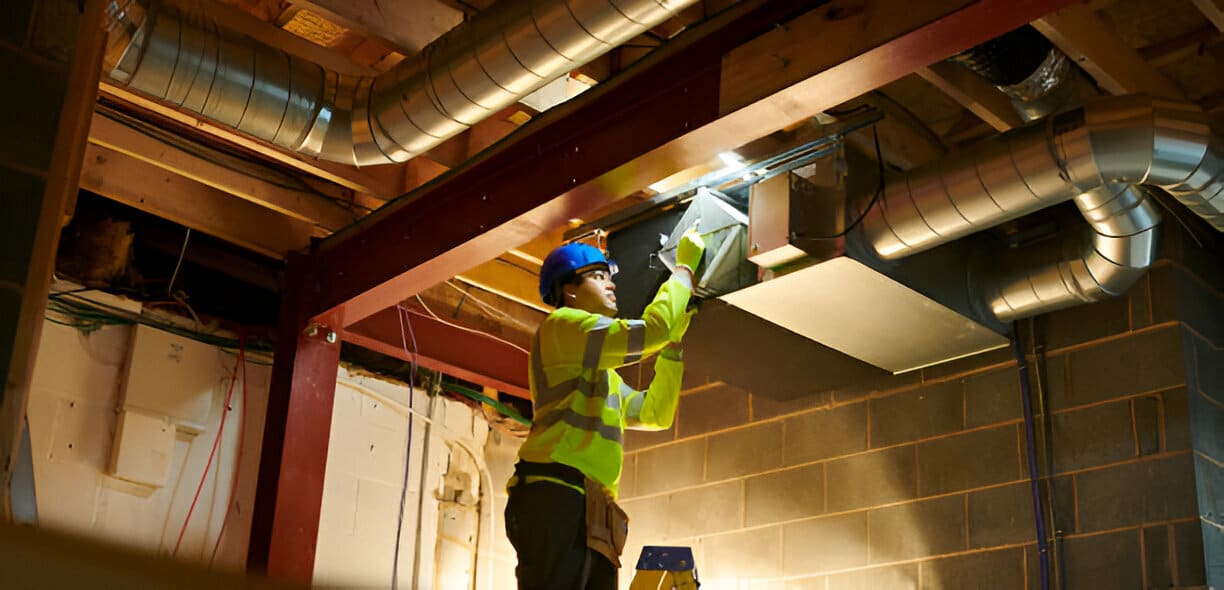
Why duct design matters in Hurst, TX
- Hurst homes face high cooling loads most of the year because attic temperatures can soar, increasing the heat that must be removed.
- Humidity control depends on consistent airflow and correct equipment sizing; undersized ducts reduce dehumidification and comfort.
- Older duct runs, typical in many local retrofit projects, often have leaks, inadequate insulation, or poor routing that reduces system capacity.
Green Tech designs ducts to address these local realities, improving comfort and reducing operating costs while coordinating with equipment selection and local code requirements.
What we include in a comprehensive duct design
- Accurate heat load calculations (Manual J) to determine sensible and latent loads for each conditioned space.
- Manual D duct sizing to provide recommended trunk, branch, and register sizes that meet target airflow without excessive static pressure.
- Layout planning for new construction and retrofits, with options for duct routing, register placement, and zoning considerations.
- Material and insulation recommendations that match Hurst climate needs, including R-value guidance for attic ducts and sealed, insulated returns.
- Attention to airflow balancing and static pressure to prevent noisy systems, short cycling, and uneven temperatures.
- Duct sealing and testing protocols, using industry-standard leakage testing and airflow verification to quantify improvements.
- Code compliance review and coordination with HVAC equipment selection and installation (sizing, coil matching, and system controls).
Typical duct design problems we solve
- Rooms that are consistently hotter or colder than others due to undersized or poorly routed ducts.
- Low airflow at registers even when the system runs, commonly caused by excessive static pressure or blocked runs.
- High energy bills tied to long run-times from improper duct sizing or leaky connections.
- Condensation or mold risk in ducts that lack proper insulation or suffer from pressure imbalances.
- Noisy supply or return registers due to high face velocities or abrupt transitions.
Our duct design and delivery process
- Site evaluation and data gathering
- We inspect attic spaces, existing ducts, return locations, insulation levels, and home orientation. We verify ceiling heights, window types, and occupancy patterns to refine load calculations.
- Heat load calculations
- Using Manual J principles, we calculate room-by-room sensible and latent loads to determine exact airflow requirements. This ensures heating and cooling capacity matches the home's needs.
- Manual D sizing and layout planning
- Manual D sizing produces a balanced plan for trunk and branch sizing, register locations, and static pressure targets. We provide drawings and materials lists tailored to either new construction or retrofit constraints.
- Coordination with equipment selection
- We coordinate duct recommendations with equipment sizing (Manual S guidance) so coils, air handlers, and condensers operate within manufacturer specifications.
- Installation oversight and quality checks
- For retrofit projects we review access, penetration details, and insulation. We specify sealing techniques (mastic or approved tapes) and insulation levels appropriate for Hurst’s climate.
- Testing and commissioning
- After installation: duct leakage testing, static pressure measurements, and airflow balancing at registers to confirm performance and make final adjustments.
Materials, insulation, and sealing recommendations
- Rigid or semi-rigid ducts for primary trunks where space allows; lined or insulated flex for short runs with careful support to avoid kinks.
- Attic ducts insulated to current recommended R-values to reduce heat gain during Hurst’s summer. Properly sealed boots and collars to prevent attic air infiltration.
- Sealing with mastic or UL-approved metal tape and mechanically fastened connections where possible.
- Specified access panels and serviceable balancing dampers to simplify future adjustments.
Testing protocols and quality assurance
- Duct leakage testing using duct blower testing to quantify CFM lost to leaks and verify post-seal improvement.
- Static pressure checks upstream and downstream of the air handler to ensure the system operates within safe manufacturer limits.
- Airflow balancing by measuring supply and return flows at registers and adjusting dampers or diffuser settings to match design CFM.
- Documentation of test results and as-built drawings for homeowner records and HVAC technicians.
Benefits of a properly designed duct system in Hurst
- More consistent room temperatures and improved humidity control during hot, humid months.
- Lower energy usage and reduced stress on HVAC equipment, extending equipment life.
- Quieter operation and fewer drafts or hot spots.
- Better indoor air quality through improved return placement and reduced infiltration of attic contaminants.
- Easier future maintenance and predictable performance when paired with proper equipment selection.
Retrofit considerations for Hurst homes
Retrofits often present space limitations and existing airflow problems. Green Tech’s experience with Hurst retrofits emphasizes minimal invasive routing, pressure-neutral return strategies, and sealing existing runs to achieve measurable performance gains without full system replacement. Even partial upgrades, like sealing and insulation combined with targeted resizing, can deliver significant comfort and efficiency improvements.
Company name: Green Tech integrates engineering rigor with practical installation knowledge so your duct system works reliably in local conditions. Our designs focus on measurable outcomes so homeowners in Hurst, TX experience the comfort and efficiency their homes were built to deliver.
FAQs
Q: What is a Manual D and why is it necessary?
A: Manual D is the industry method for designing duct systems. It sizes ducts to deliver required airflow to each room while controlling static pressure. It is necessary to prevent undersized or oversized ducts that cause poor comfort, high energy use, or noisy operation.
Once your ductwork is properly designed, fine-tune comfort with our room temperature service in Hurst, TX — NCI-certified airflow balancing that ensures every room reaches the right temperature.
Q: Will a new duct design reduce my energy bills?
A: Yes. Correct sizing, sealing, and insulation reduce air losses and static pressure, which lowers run times and improves equipment efficiency. Results depend on the existing system condition and scope of work.
Q: Do you perform testing after installation?
A: Yes. Typical testing includes duct leakage testing, static pressure measurements, and airflow balancing to confirm the system meets design targets.
Q: How does Hurst weather affect duct design choices?
A: Hurst’s hot, humid summers increase cooling loads and attic heat gain, making attic duct insulation, sealing, and correct sizing essential for consistent comfort and humidity control.
Q: Can duct improvements avoid replacing my entire HVAC system?
A: In many cases, targeted duct repairs, sealing, insulation, and resizing solve comfort issues and delay replacement. Coordination with equipment capacity is essential to ensure optimal results.

Flexible Financing Options
Explore our range of flexible financing options designed to suit your needs and budget.