





Rooms that won't cool, hot spots upstairs, cold spots downstairs, or weak airflow from certain vents — the problem is almost always poorly designed ductwork, not your HVAC equipment.
Greentech Engineering's duct design in Coppell, TX uses Manual D calculations, CAD layouts, and airflow testing to engineer a system that delivers balanced comfort to every room.
Get Your Professional Duct Design Consultation
Once your ductwork is properly designed, fine-tune comfort with our room temperature service in Coppell, TX — NCI-certified airflow balancing that ensures every room reaches the right temperature.
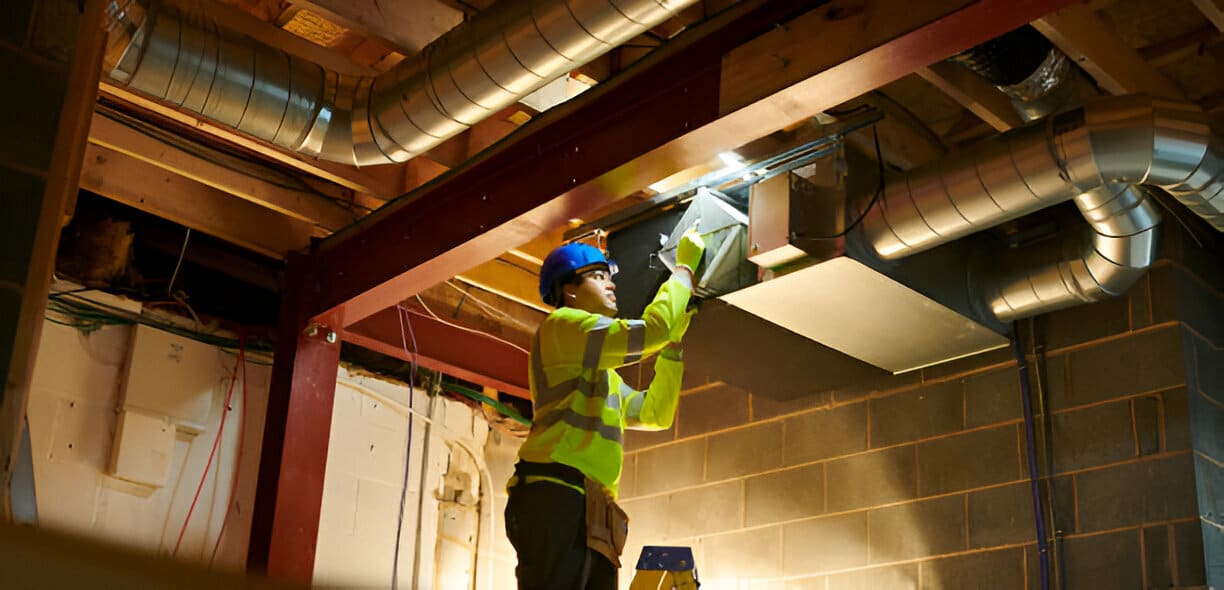
Why duct design matters in Coppell homes
- Hot, humid summers place heavy demand on cooling systems; undersized ducts or excessive leakage mean longer run times and higher humidity indoors.
- Many Coppell homes have attic or crawlspace duct runs exposed to extreme attic temperatures. Proper insulation, sealing, and layout reduce heat gain.
- New construction trends and retrofit constraints (tight plenum space, existing finishes, HOA limitations) require tailored duct solutions to match floorplans and aesthetics.
- Green Tech accounts for these local realities when producing ducts sized and placed to keep homes comfortable and efficient.
What we evaluate: common duct design issues in Coppell
- Undersized or oversized ducts causing poor airflow, short cycling, and high energy use
- Excess duct leakage (attic-to-outside losses) and poor sealing
- Long flexible duct runs with too many bends causing static pressure problems
- Improper return locations and under-provisioned returns that starve the system for air
- Noise from high velocity, sharp transitions, or vibrating sheet metal
- Moisture and condensation risk from uninsulated ducts in hot attics
Scope of our duct design services
- Manual J load calculations to determine accurate heating and cooling loads for each room
- Manual D duct layout and sizing to deliver required CFM to every register while controlling static pressure
- Manual C and equipment coordination where applicable to align cooling capacity and coil selection with duct results
- Material selection guidance (spiral/galvanized sheet metal, insulated board, UL181 flex) based on performance, space, and budget
- Plans and specifications (CAD-ready drawings, equipment schedules, airflow diagrams) suitable for builders, HVAC contractors, and permitting
- Coordination with builders, architects, or retrofit contractors to integrate ductwork with framing, insulation, and mechanical rooms
- Detailed commissioning: balancing, airflow testing, static pressure measurement, and final documentation
Diagnostic and design process
- Site assessment and data collection
- Floor plans, orientation, envelope details, attic access, and existing system inventory
- Insulation levels and local construction details common in Coppell (attic ducts, two-story splits)
- Manual J load calculation
- Room-by-room loads considering Coppell climate, window orientation, infiltration, and occupancy patterns
- Equipment selection and Manual C coordination
- Recommend equipment that matches load results and indoor humidity control needs
- Manual D duct layout and sizing
- Size trunks and branches to deliver target CFM at each register while keeping total external static pressure within equipment limits
- Material and installation specifications
- Specify duct types, insulation R-values (attic R-8 or higher where code requires), sealing methods (mastic or UL tapes), and supports
- Deliverables
- CAD drawings, schedule of diffusers and return grilles, duct routing, loss tables, Manual J/D worksheets, and a specification sheet for installers
Minimizing airflow loss and noise
- Design for low face velocities at registers: slightly larger runs and properly sized boots reduce noise
- Keep main trunks short and straight where possible; use long-radius elbows and turning vanes at transitions
- Use sheet metal for main trunks and reserve flex duct for short branch runs with minimal bends
- Seal all joints with mastic and UL-approved tapes; pressure-test ducts to identify leakage points
- Insulate ducts in attics and unconditioned spaces to prevent heat gain and condensation
- Consider lined duct or mufflers for runs near bedrooms or home offices to reduce transmitted noise
Balancing and airflow testing procedures
- Measure system external static pressure (TESP) at the air handler to confirm compatibility with manufacturer limits
- Use flow hood testing at each register to verify design CFM and adjust dampers for room-by-room balance
- Perform duct leakage testing with a duct blaster where accessible to quantify leakage and verify repairs
- Document pre- and post-balancing reports including register flows, static pressure readings, and any corrective actions
Code compliance and energy efficiency
- Designs follow local code requirements and IECC guidance for duct insulation, sealing, and pressure testing commonly enforced in the DFW region
- Energy-efficiency recommendations include proper sizing (avoid oversizing), high-efficiency equipment coordination, variable-speed blowers for lower noise and better dehumidification, and zoning where appropriate for multi-level Coppell homes
- Specifications include sealed plenums, return grille sizing and placement to avoid depressurizing living spaces, and recommendations for conditioned mechanical spaces when feasible
Deliverables, timelines, and project coordination
- Deliverables: Manual J/D worksheets, CAD layout plans, equipment schedules, installation specifications, and final air balance/commissioning report
- Typical timelines:
- Retrofit assessments and initial load report: 2 to 5 business days after site visit
- Complete design package (plans and specs) for new construction: 1 to 3 weeks depending on permit cycles and coordination needs
- Commissioning and balancing on-site: typically 1 to 3 days depending on system size
- Green Tech works with builders and contractors to fit schedules for framing, insulation, and system installation to avoid rework and ensure code-compliant handoffs
Examples of past deliverables
- Room-by-room Manual J spreadsheets with duct run loss tables and register CFM schedules
- CAD duct layout for a two-story Coppell plan showing attic trunk routing, sealed returns, and conditioned crawlspace options
- Commissioning reports including TESP, flow hood register charts, and photographic documentation of sealed connections
Green Tech applies engineering rigor and practical installation experience to deliver duct systems that perform in Coppell’s climate. Our emphasis on accurate load calculation, careful material choice, minimized leakage, and thorough commissioning helps homeowners and builders get efficient, quiet, and reliable HVAC performance.
FAQs
Q: What is Manual J and why is it important?
A: Manual J is the industry standard for calculating heating and cooling loads. It determines the correct equipment capacity and room-by-room airflow needs so ducts and equipment are neither undersized nor oversized.
Q: How does a Manual D duct design protect system efficiency?
A: Manual D calculates duct sizes and friction losses so the system achieves required CFM with acceptable static pressure, reducing energy waste, noise, and uneven temperatures.
Q: Will you test for duct leakage?
A: Yes. We use duct blaster testing and pressure measurements to quantify leakage and verify sealing, especially for attic duct systems common in Coppell.
Q: Can you design ducts for retrofit projects with limited attic access?
A: Yes. We provide tailored layouts and material recommendations (including short-run flex and insulated trunks) and coordinate installation approaches to minimize invasive work.
Q: What deliverables will I receive?
A: Deliverables typically include Manual J/D worksheets, CAD plans, equipment schedules, installation specifications, and a final air balance and commissioning report.

Flexible Financing Options
Explore our range of flexible financing options designed to suit your needs and budget.