





Rooms that won't cool, hot spots upstairs, cold spots downstairs, or weak airflow from certain vents — the problem is almost always poorly designed ductwork, not your HVAC equipment.
Greentech Engineering's duct design in Aubrey, TX uses Manual D calculations, CAD layouts, and airflow testing to engineer a system that delivers balanced comfort to every room.
Get Your Professional Duct Design Consultation
Once your ductwork is properly designed, fine-tune comfort with our room temperature service in Aubrey, TX — NCI-certified airflow balancing that ensures every room reaches the right temperature.
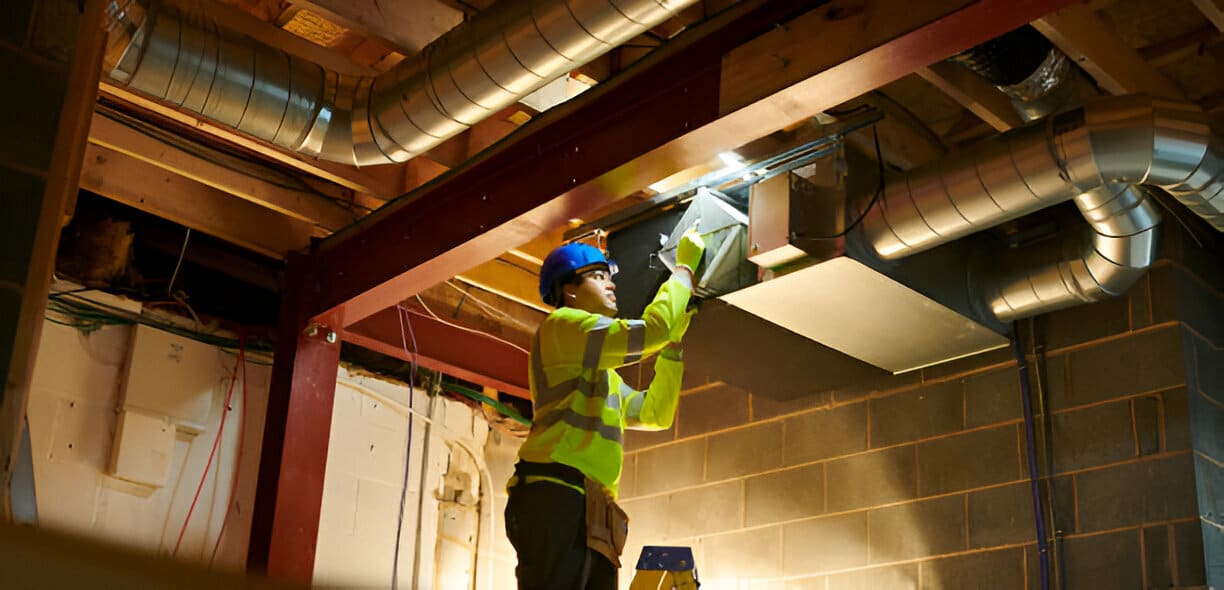
Why custom duct design matters in Aubrey homes
- Properly sized and routed ducts reduce hot/cold spots common in homes with attic runs or long branch ducts.
- In Aubrey’s summer heat and humidity, well-insulated and sealed ducts prevent thermal gains that undermine cooling efficiency.
- New construction growth and retrofits in older neighborhoods require different strategies; custom design ensures equipment and ductwork work together for longevity and comfort.
Common duct problems we solve
- Oversized or undersized ducts causing high static pressure, noisy registers, and uneven airflow
- Poorly routed layouts that increase friction loss and reduce system efficiency
- Leaky connections and joints that draw attic air into the system or lose conditioned air to unconditioned spaces
- Inadequate insulation on trunk lines exposed to Texas attic heat
- Systems with mismatched equipment and duct capacity resulting in short cycling or inadequate dehumidification
Our duct design services and deliverables
Green Tech’s duct design for Aubrey, TX includes a full suite of engineering and field services tailored to new construction and retrofits:
- Load calculation and system sizing using Manual J, Manual D and Manual H considerations to determine accurate heating/cooling loads, duct sizing, and hydronic needs where applicable
- Duct layout and routing options (attic, crawlspace, conditioned plenum, or interior chases) with tradeoffs for efficiency, accessibility, and installation cost
- Material and insulation specifications: sheet metal, insulated flex, R-value recommendations for attic runs to minimize heat gain in summer
- Airflow balancing strategy with terminal device selection and damper placement to reduce noise and improve comfort
- Static pressure analysis and fan performance matching to ensure the selected air handler or furnace operates within manufacturer limits
- Sealing and testing plan: expected leakage targets, pressure testing methodology, and airflow verification procedures
- Coordination with HVAC equipment selection to match coil and fan curves for highest system efficiency and performance
- Final deliverables: plan set (CAD or detailed sketches), register schedule, static pressure report, testing/verification results, and a scope for installation or retrofit work
How we approach load calculation and system sizing
We start every design with a room-by-room Manual J load calculation to establish precise heating and cooling requirements for your Aubrey home. That informs Manual D duct sizing and routing so each room receives the correct CFM without excessive velocity or pressure drop. For homes with unique water heating or hydronic needs, Manual H elements are included to size piping and heat sources appropriately. This engineering-first approach prevents the common mismatch of oversized equipment on undersized ducts.
Materials, insulation, and routing choices for Aubrey
- Sheet metal: durable, low-friction option for long runs and commercial-like performance
- Insulated flex duct: flexible and cost-effective for tight spaces; specification of inner diameter and support spacing is critical
- Insulation: attic ducts in Aubrey should use insulation rated for high attic temperatures (we commonly recommend R-values that limit heat transfer and condensation risk)
- Routing considerations: conditioned-space ducts reduce thermal losses; when attic installation is necessary, we prioritize short, straight runs and reflective barriers to minimize heat gain
Airflow balancing and static pressure
A design is only effective when the installed system performs as predicted. Green Tech models friction loss and total external static pressure and selects air handler and coil assemblies that maintain adequate fan performance. We plan for balancing dampers, zone dampers, and register sizing to control airflow and minimize audible issues. Proper static pressure control protects equipment lifespan and ensures efficient dehumidification during Aubrey summers.
Sealing, testing, and verification
Sealing and verification are essential to capture the energy savings and comfort benefits of a good design:
- Duct leakage testing (duct blaster) to quantify leakage; targets are set based on whether ducts are in conditioned space and local codes, with lower leakage goals for conditioned systems
- Static pressure measurements at the air handler to verify design operating point
- Room-by-room airflow verification with a flow hood or calibrated anemometer to confirm CFM distribution
- Temperature split and delta-T checks to validate system heat exchange and sensible capacity
Design for new construction and retrofits
New construction allows placement of ducts in conditioned space and simpler routing, which we leverage to maximize efficiency. Retrofits often require creative routing, dedicated returns, or reconfiguration of existing trunkwork. In both situations Green Tech documents existing conditions, presents routing options with performance tradeoffs, and delivers plans suitable for permitting and installation.
Deliverables and documentation
Each project receives a clear package of deliverables:
- CAD drawings or annotated field sketches showing trunk and branch layout, takeoff sizes, register/grille locations
- Load calculation and duct sizing worksheets (Manual J and D outputs)
- Material and insulation specifications and installation notes
- Static pressure and airflow verification report after installation
- Recommendations for equipment match and control strategies (zoning, variable speed motors, ECM blowers)
Pricing and consultation process
Our pricing approach is transparent and based on scope: square footage, number of stories, attic complexity, and whether the project is new construction or retrofit. The consultation process generally includes:
- Site review and data collection to confirm building geometry and existing system conditions
- Load calculations and preliminary layout options
- Review meeting to choose routing, materials, and equipment coordination
- Final design deliverables with a written scope for installation and testing
- Fees and estimates are provided after the initial assessment and are tailored to the project complexity.
FAQs
Q: How long does a custom duct design take for a typical single-family home in Aubrey?
A: Most designs are completed within several business days to two weeks, depending on project complexity, availability of field measurements, and whether coordination with builders or other trades is required.
Q: Do you include testing after installation?
A: Yes. Our standard deliverables include post-installation leakage testing, static pressure verification, and room-by-room airflow measurements to confirm the system performs to the design.
Q: What insulation R-value do you recommend for ducts in Aubrey attics?
A: We commonly specify insulation values appropriate for hot, humid climates to reduce thermal gain; the final R-value is chosen based on exposure, routing, and code requirements during design.
Q: Will the duct design work with my chosen HVAC brand or equipment?
A: Green Tech coordinates duct design with equipment selection, matching fan curves and coil characteristics to ensure the system operates within manufacturer specifications for efficiency and comfort.

Flexible Financing Options
Explore our range of flexible financing options designed to suit your needs and budget.