






Rooms that won't cool, hot spots upstairs, cold spots downstairs, or weak airflow from certain vents — the problem is almost always poorly designed ductwork, not your HVAC equipment.
Greentech Engineering's duct design in Arlington, TX uses Manual D calculations, CAD layouts, and airflow testing to engineer a system that delivers balanced comfort to every room.
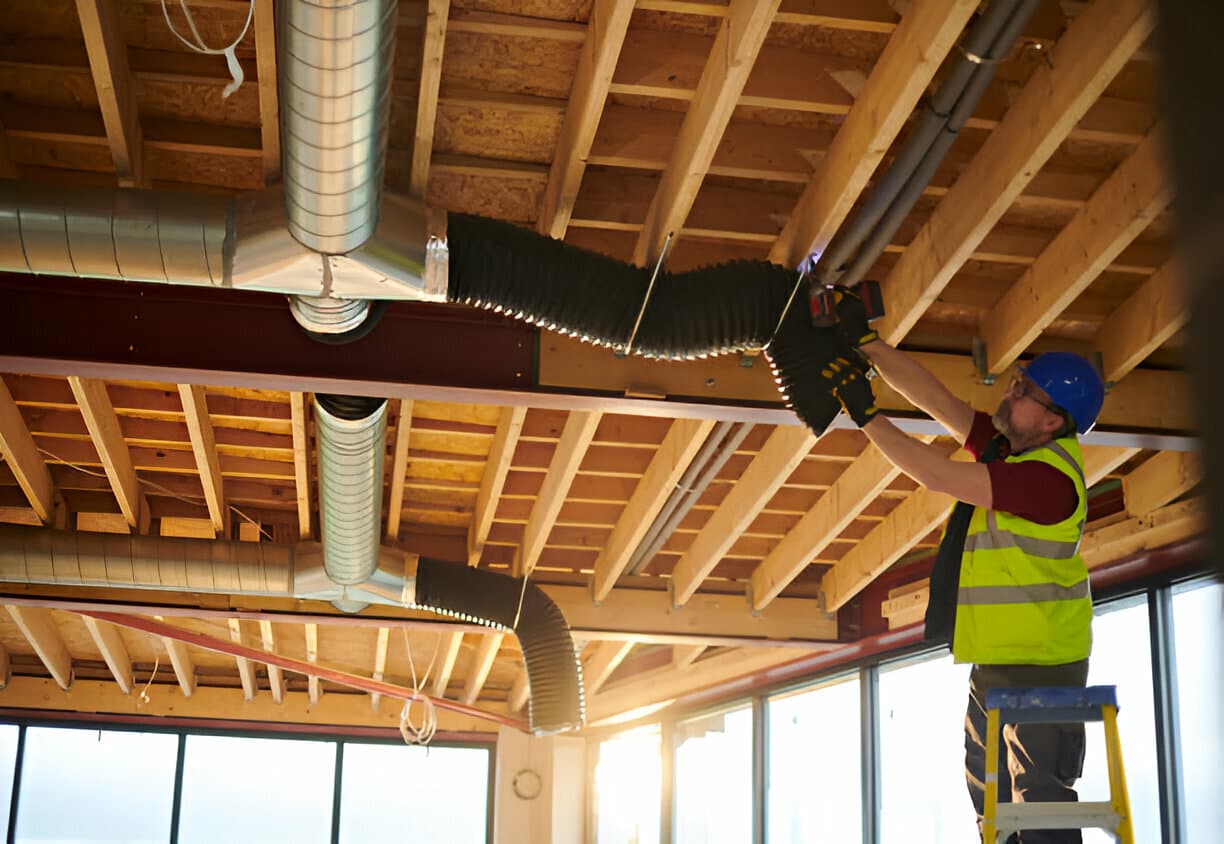
Why specialized duct design matters in Arlington, TX
Arlington’s climate produces high sensible and latent cooling loads. Attics routinely reach extreme temperatures in summer, and many local homes have long attic duct runs or undersized return paths. Poorly designed ducts in this environment mean hot supply air, uneven room temperatures, higher runtime for HVAC equipment, and humidity problems. A duct design tailored for Arlington factors in attic conditions, local building practices, and typical home layouts to reduce cooling losses and maintain comfort across every room.
Once your ductwork is properly designed, fine-tune comfort with our room temperature service in Arlington, TX — NCI-certified airflow balancing that ensures every room reaches the right temperature.
Load calculations: Manual J and Manual D basics
Accurate duct design starts with a proper load calculation. Manual J determines the heating and cooling load for your home by accounting for orientation, insulation, windows, occupancy, and local climate. Manual D uses the Manual J results to size the duct system to deliver the required airflow to each room.
- Manual J: establishes how many BTUs and CFM each space needs.
- Manual D: translates those requirements into duct sizes, trunk layout, and grille locations.
- Why both matter: oversizing equipment without correct Manual D sizing still yields poor comfort and efficiency. Professional duct design ties both calculations together to match equipment and distribution.
Duct sizing and layout planning
An effective layout minimizes frictional losses, limits long skinny runs, and balances supply and return distribution.
- Layout considerations:
- Trunk-and-branch vs. radial (boot) systems
- Location of the air handler and trunk orientation to minimize long runs through hot attics
- Return pathways and central return sizing to avoid negative pressure
- Sizing methodology:
- Use friction-rate methods and velocity limits appropriate for residential systems
- Maintain acceptable static pressure for modern equipment
- Prioritize balanced CFM to each room for consistent temperatures
Materials and sealing methods
Choice of material and sealing determines durability and leakage.
- Common materials:
- Galvanized spiral or rectangular sheet metal: durable, low leakage, preferred where space allows
- Flexible duct: useful for short runs and tight spaces but needs correct stretching, support, and insulation
- Duct board: rigid and insulating, used in some retrofit or tight-duct applications
- Sealing and insulation:
- Mastic sealant at seams and takeoffs provides long-term airtightness
- UL-approved foil HVAC tape only used as specified; cloth-backed or duct mastic is preferred for longevity
- Insulation levels chosen for attic vs. conditioned spaces to reduce conductive losses and condensation risk
Airflow balancing and reducing losses
Even with correctly sized ducts, airflow must be balanced to perform.
- Balancing strategies:
- Adjustable dampers in trunks and branch runs to fine-tune CFM
- Properly sized returns and transfer grilles to prevent short-cycling or pressure imbalances
- Room-by-room testing using flow hoods or capture hoods to validate delivered CFM
- Reducing losses:
- Minimize transitions, sharp bends, and high-velocity sections
- Seal and insulate ducts located in unconditioned attics or crawlspaces
- Improve grille and register placement to avoid dead zones and noise
Coordination with new construction and retrofit systems
Duct design differs significantly between new construction and retrofit projects.
- New construction:
- Integrate duct routing with framing and mechanical plans to keep runs short and accessible
- Plan return pathways early to avoid last-minute compromises
- Opportunity to locate air handler in conditioned space or provide a properly sealed attic enclosure
- Retrofit:
- Survey existing ducts for leakage, insulation condition, and layout limitations
- Evaluate conversion options: rework trunking, add supplemental returns, or use high-performance flexible runs where needed
- Consider combining duct upgrades with attic insulation improvements to maximize benefit
Performance and comfort benefits of proper ductwork
Well designed and installed ductwork produces measurable improvements in home comfort and HVAC performance:
- More consistent room temperatures and fewer hot or cold spots
- Improved humidity control because the system runs for appropriate cycles
- Lower runtime and lower energy use as conditioned air is delivered where needed
- Reduced system noise and fewer callbacks related to uneven performance
- Extended equipment life due to appropriate airflow and reduced short-cycling
Examples and case summaries in Arlington
- New suburban build: A new two-story Arlington home had long attic runs and undersized returns. Re-orienting the trunk runs, adding a central return, and sizing ducts per Manual D reduced attic supply losses and balanced second-floor temperatures, improving overall comfort without increasing equipment tonnage.
- Older ranch retrofit: An Arlington ranch-style home experienced noisy rooms and a high delta-T across the coil. Replacing deteriorated flex runs, sealing all seams with mastic, relocating a return grille, and performing airflow balancing produced steady airflow, lowered humidity issues, and reduced runtime.
- These example outcomes reflect common Arlington scenarios: hot attics, long runs, and the need for airtight, well-insulated ducts.
Project timeline and how pricing is determined
Typical project phases and timing:
- Initial site assessment and Manual J/M D survey: one visit, with engineering work completed within days.
- Detailed duct design and drawings: a few days to a week depending on complexity.
- Permitting (if required) and material procurement: timeline varies by jurisdiction and scope, commonly several days to a couple of weeks.
- Installation: typically completed in one to several days for common homes; larger or more complex systems take longer.
- Testing and final balancing: performed immediately after installation; verification may take a half-day to a full day.
Pricing is based on scope and complexity rather than a fixed product. Key cost drivers include:
- Home size and number of rooms to be served
- Accessibility of paths (attic height, crawlspace conditions, finished basements)
- Amount of new trunking vs. repairing existing ducts
- Need for additional returns, zoning dampers, or specialized materials
- Permitting or engineering requirements for new construction vs. retrofit
- Estimates are prepared after a site survey and load calculations so the quoted scope accurately reflects the work required.
Maintenance and long-term considerations
After a professional duct design and installation:
- Schedule periodic inspections to confirm seals and insulation remain intact
- Keep attic insulation and ventilation in good condition to reduce duct exposure to extreme temperatures
- Rebalance any time major renovations or system changes occur to preserve designed airflow
FAQs
Q: What is the difference between Manual J and Manual D?
A: Manual J calculates the heating and cooling load of the home. Manual D uses those loads to size and lay out the duct system so each room receives the required airflow.
Q: Can an old duct system be reused with a new high-efficiency AC?
A: Sometimes portions can be reused if they pass leakage and sizing checks, but often repairs, resealing, or partial rework are required to achieve performance expected from modern equipment.
Q: How does Arlington heat and humidity change design choices?
A: High attic temperatures and humid summers increase the need for sealed, insulated ducts, properly sized returns, and thoughtful routing to minimize thermal gains and avoid dampness or condensation issues.
Q: Will a new duct design lower my energy bills?
A: Properly designed ducts reduce distribution losses and improve airflow, which typically lowers runtime and energy use—but actual savings depend on existing conditions and usage patterns.
Q: How long does the duct design and installation process take?
A: From initial survey to final balancing, small to moderate projects often finish within a few days to a couple of weeks. Larger or permit-heavy projects may take longer.
Q: Do duct modifications require permits in Arlington?
A: Permit requirements vary by project scope and local code; engineering-level changes in new construction or major retrofits often trigger permitting and inspection.

Flexible Financing Options
Explore our range of flexible financing options designed to suit your needs and budget.