







Stop Swapping AC Units: The Engineering Reason We “Added a Mouth” to This Living Room
(Forney · Little Elm · North Dallas Homeowners)
Is your living room still uncomfortable after installing a brand-new air conditioner?
This is one of the most common complaints we hear from homeowners in Forney, Little Elm, and North Dallas neighborhoods—especially in single-family homes built 10–20 years ago.
You invest thousands in a high-efficiency system, but the contractor simply “swaps the box”: old unit out, new unit in.
No airflow analysis. No duct evaluation. No engineering.
At Greentech Engineering Heating & Air Conditioning, we don’t swap boxes.
We follow physics.
During a recent Daikin Fit inverter system installation, our engineering review revealed a hidden issue that explains why so many homes in Forney and Little Elm still feel uncomfortable:
The system couldn’t breathe.
Our solution wasn’t a bigger AC.
We added a mouth.
The Real Comfort Killer in Forney & Little Elm Homes: High Static Pressure
Picture this:
You’re trying to breathe through a coffee stirrer while running.
No matter how strong your lungs are, you’ll fail—not because of strength, but because of air restriction.
In HVAC engineering, this restriction is called static pressure.
Why this problem is common in Forney & Little Elm:
- Many homes were built quickly during growth booms
- Return air was value-engineered (undersized)
- Often only one central hallway return
- Large open living rooms with no return path
- Garage conversions or media rooms added later
The results homeowners experience:
- ❌ Living room always hotter than bedrooms
- ❌ Loud rushing or “wind tunnel” noise
- ❌ Higher electric bills during Texas summers
- ❌ New system that doesn’t feel any better than the old one
Why the Daikin Fit Requires Engineering—Not Guesswork
The Daikin Fit is a true inverter heat pump, not a traditional on/off AC.
It adjusts output in 1% increments, constantly communicating with your home’s heat load.
That precision is powerful—but sensitive.
Engineering reality:
- Recommended max total static pressure: ~0.5 in. w.c.
- Exceed that threshold and the system:
- Ramps up fan speed
- Gets louder
- Loses SEER efficiency
- Struggles with humidity
- Ages faster than designed
Installing a Daikin Fit without duct analysis is like installing a Tesla motor into a car with flat tires.
The system isn’t the problem.
The airflow path is.
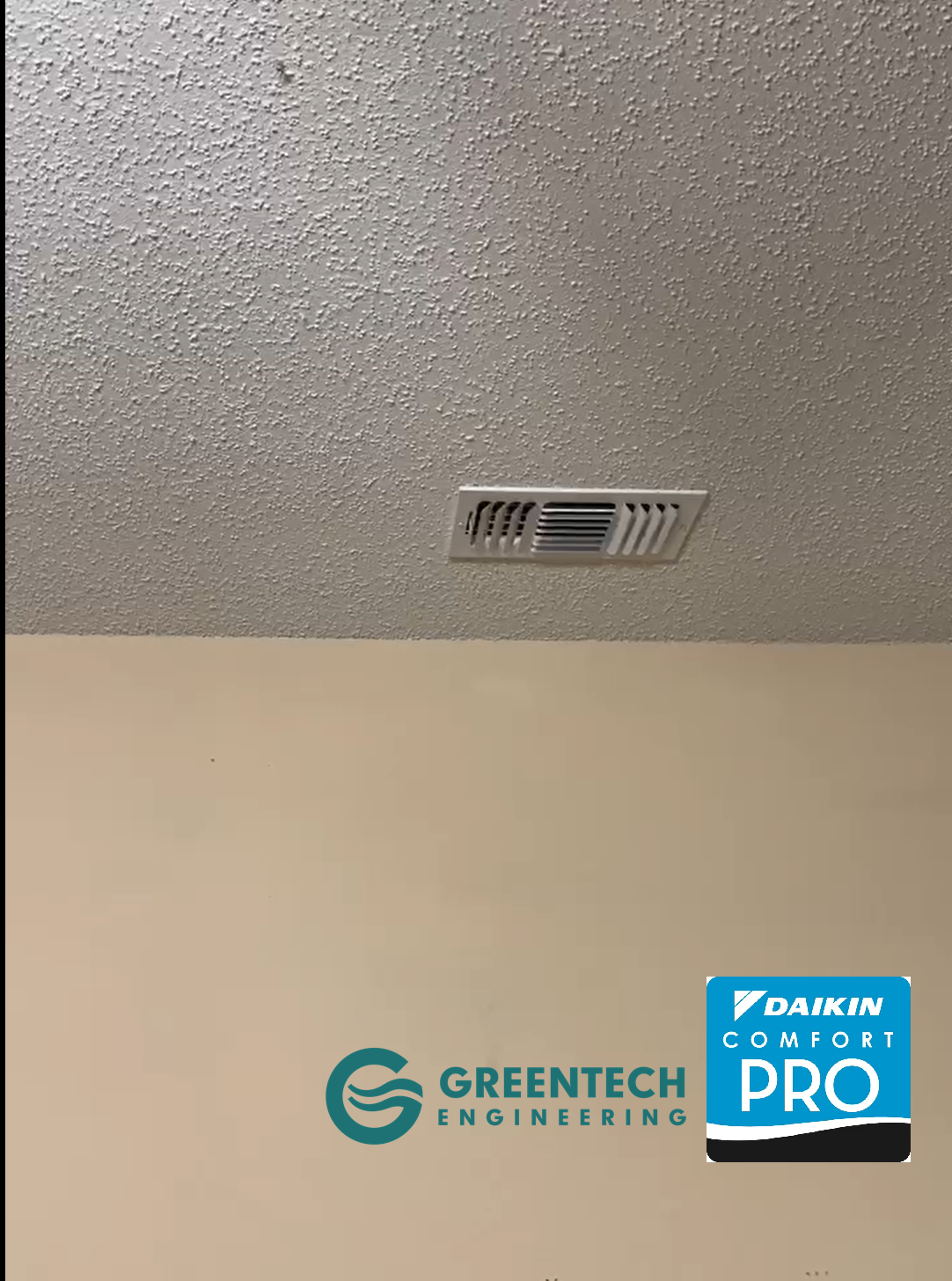
The Engineering Fix: “Adding a Mouth” (Return Air Design)
What our Manual D analysis showed
In this North Dallas–area home, the living room was a pressure trap:
- Supply air entered the space
- Heat accumulated
- No adequate return path back to the air handler
Upsizing the unit would have caused:
- Short cycling
- Higher humidity
- Worse comfort
Instead, we fixed the airflow.
What “adding a mouth” means
We installed a dedicated return air vent in the living room ceiling, allowing air to exit the space properly and return to the system.
Measurable results:
- ✔ Static pressure dropped into design range
- ✔ Blower noise reduced significantly
- ✔ Living room temperature balanced (previously ~3°F hotter)
- ✔ Improved comfort without increasing system size
This type of fix is especially effective in:
- Forney one- and two-story homes
- Little Elm homes with large open living areas
- North Dallas houses with single hallway returns
Why the Greentech Method Matters for Forney & Little Elm Homeowners
In North Texas, attic temperatures regularly exceed 140°F.
Airflow mistakes become magnified.
Many contractors still rely on:
- “500 sq ft per ton”
- “That’s how we’ve always done it”
- Equipment availability, not design
Those shortcuts cost homeowners comfort and money.
Our engineering-first process:
- Manual J Load Calculation
Room-by-room heat gain based on real data. - Manual S Equipment Matching
Equipment sized to the load—not oversized. - Manual D Duct Design
Proper return and supply airflow for quiet, efficient operation.
This is how high-efficiency systems actually perform as advertised.
Learn more about Manual J,S,D.
FAQ
Q: Why is my living room hotter than the rest of the house?
A: In many Forney and Little Elm homes, the living room lacks a return air path. Air enters but cannot escape, causing heat buildup and pressure imbalance.
Q: My AC is new—why is it so loud?
A: High static pressure. New systems move more air, but undersized returns create noise and strain.
Q: Do I need a return vent in every room?
A: Ideally yes (excluding bathrooms and kitchens). At minimum, every major room needs a pressure-relief path—return vent, jump duct, or transfer grille.
Q: Will adding a return vent really help my energy bill?
A: Yes. Lower static pressure reduces blower energy use and allows inverter systems to stay in low-power operation longer.
Q: Is the Daikin Fit worth it in Forney or Little Elm?
A: Absolutely—when installed correctly. Without duct evaluation, its efficiency and comfort advantages are compromised.
Q: How do I know if my contractor actually did Manual J?
A: Ask for the report. A real Manual J shows room-by-room calculations. If they can’t provide it, they guessed.
Q: Should I replace ducts when replacing my AC?
A: Not always. Many homes only need strategic return additions or resizing, not full duct replacement.
Bottom Line for Forney, Little Elm & North Dallas Homeowners
Comfort problems are rarely solved by bigger machines.
They are solved by better airflow design.
If your living room is still uncomfortable after an AC upgrade, the fix may not be a new system—it may be adding a mouth.
Author
Siwei (Lucas) Chen
CTO | Greentech Engineering Heating & Air Conditioning
B.S. Mechanical Engineering – Virginia Tech
ACCA Certified (Manual J, S, D)
NCI Certified – Air Balancing & Duct Optimization
10+ Years HVAC Engineering Experience in Dallas–Fort Worth
This article was written and reviewed to ensure technical accuracy, building-science alignment, and professional HVAC engineering compliance.

Flexible Financing Options
Explore our range of flexible financing options designed to suit your needs and budget.